-
Title
-
Letter to I. Singh
-
Description
-
Annex: filled out questionnaire of the Taxation Enquiry Commission
-
Date
-
1954
-
Date in document
-
yes
-
Formulas or calculations
-
no
-
Inventory number
-
NL-RtEUR_TBCOR01_021H057
-
8037
-
Storage location
-
Specifiek Magazijn
-
Filename
-
CDM8037_NL-RtEUR_TBCOR01_021H057.pdf
-
Provenance
-
Jan Tinbergen
-
Accrual Method
-
donation
-
Rights
-

-
Revised transcript
-
en
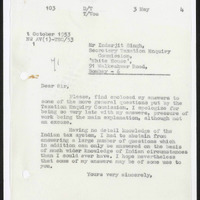
103 D/T 3 May 4
T/Vos
t October 1953
No AV(1)-TEC/53
1
Mr Indarjit Singh,
Secretary Taxation Enquiry Commission,
'White House',
91 Walkeshwar Road,
Bombay - 6
Dear Sir,
Please, find enclosed my answers to some of the more general questions put by the Taxation Enquiry Commission. I apologize for being so very late with my answers, pressure of work being the main explanation, although not an excuse.
Having no detail knowledge of the Indian tax system, I had to abstain from answering a large number of questions which in addition can only be answered on the basis of much wider knowledge of Indian circumstances than I could ever have. I hope nevertheless that some of my answers may be of some use to you.
Yours very sincerely,
(J. Tinbergen)
TAXATION ENQUIRY COMMISSION
Answers to some of the more general questions, by J. Tinbergen, the Hague, Holland.
(Numbers refer to questions)
1. Objectives (a), (b) and (c) should be adhered to; (d) is identical to (c).
2. This is such a complicated matter that it seems difficult to formulate precise criteria. By trial and error the different objectives should be promoted in such proportions that an optimum be reached, easing the experience inside and outside the country.
In most countries a number of taxes of very different character exist and the mutual proportions do not diverge too widely. Often there is about equality between revenue from direct and indirect taxes; and roughly one-half of the former is income tax, roughly one-half of the latter some general turnover tax. This might be indicative of some common experience on the optimum proportions. Income taxes in the higher brackets usually are well above 50%. The Indian tax system does not diverge, if I am well informed, too far from these criteria.
3. In a country with a low average income taxes on higher incomes will have to be high. One wonders whether incomes above R 10 000 could not be taxed higher and whether not those between R 20 000 and R 25 000 are relatively under-taxed by a few percent.
5. The smallness of the proportion of tax revenue to national income in India is primarily due to the low average income. Nevertheless it may be necessary to raise the level - given the problems of the country. Cf. answer to question 3.
6. Cf. answer to question 2.
8/9. I see no objections in principle against earmarking some taxes for certain purposes; but there are necessarily important overall expenditures which have to be financed anyhow; it would be hardly possible to link these up with specific taxes.
18. Borrowing would seem attractive for self-liquidating projects and less so for productive products that are not self-liquidating. For overall expenditures difficult to attribute to special projects borrowing would seem to be not attractive at all.
19. (a) and (b) would seem to be especially important.
20/1. The tax policy should stimulate investment by exemptions in case of investments rather than by low taxes on profits without discrimination.
23. I am afraid it would mainly promote consumption.
24. A tax on super normal increases in income might be attempted in order to raise funds for public investment.
-2-
25. The most effective tax preventing consumption from rising would be a general turnover tax.
27. Exemption for investments could be differentiated according to some classes of investments; it might for instance not be given for the construction of luxurious dwellings.
28. Some examples have been given in the preceding answers.
29. In Western Europe direct controls are considered to be not very efficient, but in war time they are nevertheless applied. Much depends on the need for private initiative, which is not so large in war, but large in the case of development in industry.
30. It does, of course. Whether it does sufficiently is a second point. I find it very difficult to judge this.
31. The only possibility seems to be to make a sharp distinction between consumption and investment (cf. above, points 20, 25, 27).
32. Not a large one. But some basic social insurances would seem to be very important.
36. Certainly.
37. Public education and propaganda, showing the importance of a high tax morale and the direct connection with the vast tasks of the Indian people. (Cf. Blue Eagle in the U.S. in the 'thirties'; Russian methods; reconstruction activity with the youth in Yugoslavia, Poland, Hungary.)
40. In times of inflation taxes should be increased and in particular taxes in income rises might be imposed. In times of depression taxes on consumption should be lowered (sales tax in particular).
41. Cf. answer on question 40. Import and export duties might be used according to the situation of the balance of payments.
42. This capacity is largely dependent on the level of the income tax; the higher this level, the higher that capacity !
43. If a large portion of expenditures is for investments they would seem to be a regulator of some importance.
44. Taxes or subsidies might certainly be useful to meet difficulties of a temporary character in special industries.
Part II. Direct Taxes
48. I am in favour of a tax on capital gains. The argument raised against it that they hinder the functioning of the capital market, although correct, does not seem to me to be very important.
55. I do not know the present regulations in India with respect to fluctuating income, but averaging them seems to be justified; as far as they are subject to crop variations, i.e. almost a random variable with, therefore, a quasi-cycle of three years, averaging over three years might be good.
61. Larger depreciation allowances on new assets (sometimes only for the first few years, and then to be compensated for by lower allowances in later years) are now being applied in several European countries, and it seems with some success.
66. Combination of income - tax and super-tax into one single scheme would seem to be a simplification. Holland always had it that way. The scheme takes the form of a table, with small increases in income, from which taxes can be read off directly. No necessity to make calculations.
As far as I understand there is a somewhat sudden jump in income tax rates at R 25 000 and I wonder whether this could not be avoided by introducing a higher rate for income between R 20 000 and R 25 000, e.g. 36% as against 26% between R 15 000 and R 20 000 and 46% (incl. surtax) between R 25 000 and R 40 000. I am afraid, however, it is very difficult for a foreigner to judge a country's tax system. I even could imagine that, given the problems of India, income taxes might be further increased, but here the above remark applies still more.
67. An exemption limit of R 4200 seems to me to be high; in Holland it is only about ƒ 2000 or R 2400.
79. In Holland there is a slight progression in the corporation tax (roughly 5% more for large corporations than for small ones).
81. Seems justified, since it is double taxation.
83. It might be unnecessary to differentiate, if special facilities are given for new investments (cf. question 61).
Part III. Commodity Taxes
110. For commodities with a luxury character or even adverse to public health, customs would seem more appropriate anyhow.
113. Export duties might be the simplest way of taxing commodities largely produced for exports if it is believed that by so doing excessive profits can be taxed without doing harm to the balance of payments.
122. I do agree.
125. Both types of transactions mentioned under (i) and (ii) are being taxed in Holland.
-
annexCount
-
1