-
Title
-
Letter to R.E.M. van den Brink
-
Date
-
1954
-
Date in document
-
yes
-
Formulas or calculations
-
no
-
Inventory number
-
NL-RtEUR_TBCOR01_021E023
-
8888
-
Storage location
-
Specifiek Magazijn
-
Filename
-
CDM8888_NL-RtEUR_TBCOR01_021E023.pdf
-
Provenance
-
Jan Tinbergen
-
Accrual Method
-
donation
-
Rights
-

-
Revised transcript
-
ne
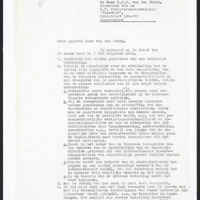
PROF. DR J. TINBERGEN DEN HAAG, 18 Juni 1954 Sijzenlaan 41
De Heer R.E.M. van den Brink, Directeur van de N.V. Uitgeversmaatschappij "Elsevier", Spuistraat 110-112 Amsterdam-C
Zeer geachte Heer van den Brink,
In antwoord op Uw brief van 16 dezer deel ik U het volgende mede.
1. Inderdaad kan worden gesproken van een volledige herziening.
2. Terwijl de conclusies over de afwikkeling van de oorlog zijn ingeperkt en ten dele weggelaten, ben ik nu meer uitvoerig ingegaan op de vraagstukken van de Europese integratie, de convertibiliteit en het vraagstuk van de onderontwikkelde landen. Enkele van de nieuwe conclusies zou ik als volgt kunnen samenvatten: als
a. Integratie wordt behandeld als een proces naar een optimale graad van centralisatie in de internationale economische politiek.
b. Bij de integratie moet niet slechts aandacht worden geschonken aan de afschaffing van invoerrechten en kwantitatieve restricties, welke men de negatieve integratie zou kunnen noemen, doch ook aan de positieve zijde, m.n. aan een gemeenschappelijke werkgelegenheidspolitiek en investeringspolitiek en aan de integratie van het bedrijfsleven door typenbeperking, marktverdeling, samenwerking e.d., terwijl aan landen die in belangrijke mate hun invoerrechten laten omlaag gaan de mogelijkheid moet worden opengelaten tot een zekere devaluatie.
c. Zowel in het kader van de Europese integratie als ten behoeve van de ontwikkeling van de onderontwikkelde gebieden zal een internationale investeringspolitiek van aanmerkelijk groter kaliber moeten worden gevoerd.
d. Voorts wordt ten behoeve van de studentenlezers ingegaan op een aantal eenvoudige schema's van de internationale handel, die een inleiding vormen tot de moderne vrij moeilijke theorie op dit gebied.
e. Op de theorie van de optimum bevolking wordt wat meer ingegaan.
3. Aan de omvang van het werk is niet veel veranderd.
4. Ik heb mijn werk aan het boek versneld toen ik hoorde dat het bij verschillende instellingen van Hoger Onderwijs als literatuur wordt gebruikt, o.a. in Rotterdam en Wageningen. Het schijnt als eerste inleiding inderdaad goed te kunnen worden gebruikt. Het is natuurlijk geen eigenlijk leerboek.
- 2 -
Voor Uw gemak heb ik sommige van de onder a t/m e vermelde uitdrukkingen in de bijlage ook in het Engels gegeven voor zover U gedacht had aan voorlichting buiten Nederland.
Met vriendelijke groeten,
Bijlage
a. Integration is presented as a process of approaching an optimum degree of centralization in international economic policy.
b. Integration is not only a question of negative measures as the elimination of tariffs and quantitative restrictions but also, and to an increasing degree, one of positive policies. For efficient integration a common employment policy and a common investment policy will be needed whereas the process of integration of production requires positive furtherance of co-operation between enterprises in order to reduce the number of types of products, to devide markets etc.
c. Both in the framework of European integration and for the development of underdeveloped countries there has to be an international investment policy on a much larger scale than was so far effectuated.
d. On behalf of the students readers a number of simple schemes of international trade is supplied which may serve as an introductory to the complicated modern theories in this field.
e. Some further attention is given to the theory of optimum population.
-
en
PROF. DR J. TINBERGEN THE HAGUE, 18 June 1954 Sijzenlaan 41
Mr. R.E.M. van den Brink, Director of the N.V. Publishing Company "Elsevier", Spuistraat 110-112 Amsterdam-C
Dear Mr. van den Brink,
In response to your letter of the 16th of this month, I inform you of the following.
1. Indeed, one can speak of a complete revision.
2. While the conclusions regarding the settlement of the war have been curtailed and partly omitted, I have now gone into more detail on the issues of European integration, convertibility, and the issue of underdeveloped countries. Some of the new conclusions I could summarize as follows:
a. Integration is treated as a process toward an optimal degree of centralization in international economic policy.
b. In integration, attention should be paid not only to the abolition of import duties and quantitative restrictions, which could be called negative integration, but also to the positive side, specifically to a common employment policy and investment policy and to the integration of business life through type restriction, market distribution, cooperation, etc., while countries that significantly lower their import duties must be left with the possibility of a certain devaluation.
c. Both within the framework of European integration and for the benefit of the development of underdeveloped areas, an international investment policy of a significantly larger caliber will have to be pursued.
d. Furthermore, for the benefit of student readers, a number of simple diagrams of international trade are discussed, which form an introduction to the modern, rather difficult theory in this field.
e. The theory of the optimum population is discussed in more detail.
3. Not much has changed regarding the size of the work.
4. I accelerated my work on the book when I heard that it is being used as literature at various institutions of Higher Education, including in Rotterdam and Wageningen. It seems it can indeed be used well as a first introduction. It is, of course, not an actual textbook.
- 2 -
For your convenience, I have also provided some of the expressions mentioned under a through e in the appendix in English, in case you had thought of providing information outside the Netherlands.
With kind regards,
Appendix
a. Integration is presented as a process of approaching an optimum degree of centralization in international economic policy.
b. Integration is not only a question of negative measures as the elimination of tariffs and quantitative restrictions but also, and to an increasing degree, one of positive policies. For efficient integration a common employment policy and a common investment policy will be needed whereas the process of integration of production requires positive furtherance of co-operation between enterprises in order to reduce the number of types of products, to devide markets etc.
c. Both in the framework of European integration and for the development of underdeveloped countries there has to be an international investment policy on a much larger scale than was so far effectuated.
d. On behalf of the students readers a number of simple schemes of international trade is supplied which may serve as an introductory to the complicated modern theories in this field.
e. Some further attention is given to the theory of optimum population.
-
annexCount
-
1