-
Title
-
Letter to H. Emanuel
-
Date
-
1953
-
Date in document
-
yes
-
Formulas or calculations
-
yes
-
Inventory number
-
NL-RtEUR_TBCOR01_019E008
-
3307
-
Storage location
-
Specifiek Magazijn
-
Filename
-
CDM3307_NL-RtEUR_TBCOR01_019E008.pdf
-
Provenance
-
Jan Tinbergen
-
Accrual Method
-
donation
-
Rights
-

-
Revised transcript
-
ne
19 Juni 1953
y/p
De Heer H. Emanuel, Cliostraat 19", Amsterdam-Z.
Zeer geachte Heer Emanuel,
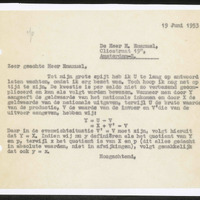
Tot mijn grote spijt heb ik U te lang op antwoord laten wachten, omdat ik erg bezet was. Toch hoop ik nog net op tijd te zijn. De kwestie is per saldo niet zo verbazend gecompliceerd en kan als volgt worden bewezen. Wanneer men door Y aangeeft de geldwaarde van het nationale inkomen en door X de geldwaarde van de nationale uitgaven, terwijl U de bruto waarde van de productie, V de waarde van de invoer en V' die van de uitvoer aangeven, hebben wij:
Y = U - V
= X + V' - V
Daar in de evenwichtssituatie V' = V moet zijn, volgt hieruit dat Y = X. Indien wij nu y definiëren als het quotient van Y en p, terwijl x het quotient is van X en p (dit alles gedacht in absolute waarden, niet in afwijkingen), volgt gemakkelijk dat ook y = x.
Hoogachtend,
-
en
June 19, 1953
y/p
Mr. H. Emanuel, Cliostraat 19", Amsterdam-Z.
Dear Mr. Emanuel,
To my great regret, I have kept you waiting too long for an answer, because I was very busy. Still, I hope to be just in time. The matter is, on balance, not so surprisingly complicated and can be proven as follows. When one indicates by Y the monetary value of the national income and by X the monetary value of the national expenditures, while U indicates the gross value of production, V the value of imports and V' that of exports, we have:
Y = U - V
= X + V' - V
Since in the equilibrium situation V' = V must be, it follows from this that Y = X. If we now define y as the quotient of Y and p, while x is the quotient of X and p (all this thought of in absolute values, not in deviations), it follows easily that also y = x.
Sincerely,