-
Title
-
Letter to Ch. Glasz
-
Description
-
With annexes: Business card and an article
-
Date
-
1953
-
Date in document
-
yes
-
Formulas or calculations
-
yes
-
Inventory number
-
NL-RtEUR_TBCOR01_018G007
-
3819
-
Storage location
-
Specifiek Magazijn
-
Filename
-
CDM3819_NL-RtEUR_TBCOR01_018G007.pdf
-
Provenance
-
Jan Tinbergen
-
Accrual Method
-
donation
-
Rights
-

-
Revised transcript
-
en
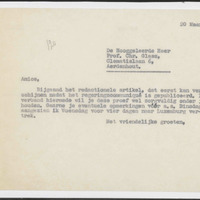
20 Maart 1953
120
De Hooggeleerde Heer Prof. Chr. Glasz, Clematislaan 6, Aerdenhout.
Amice,
Bijgaand het redactionele artikel, dat eerst kan verschijnen nadat het regeringscommuniqué is gepubliceerd. In verband hiermede wil je deze proef wel zorgvuldig onder je houden. Gaarne je eventuele opmerkingen vóór a.s. Dinsdag, aangezien ik Woensdag voor vier dagen naar Luxemburg vertrek.
Met vriendelijke groeten,
RECEIVED NOV 20 1952 M.S.A. MISSION THE HAGUE
ECA HISTORY
Tentative Outline
[unanimity] [degelijke] [land]
[Eur. initiative in reconstr]
[Samenwerking met Amer. experts]
Part I. INTRODUCTION
Chapter 1. Perspectives
Chapter 2. The Outlook in 1947
Part II. THE MAIN NARRATIVE
Chapter 3. Emergence of the Marshall Plan
Chapter 4. Action by the United States Congress
Chapter 5. Launching the European Recovery Program
Chapter 6. First Year (1948-49): Food and Tools
Chapter 7. Second Year (1949-50): Toward Economic Expansion and Unification
Chapter 8. Third Year (1950-51): Economic Progress and Military Crisis
Chapter 9. Fourth Year (1951-52): Transition to the Mutual Security Program
Chapter 10. Aid to China and Korea
Chapter 11. Programs in Southeast Asia
Part III. ENDS, MEANS, AND LESSONS GAINED
Chapter 12. Effective Administration
Chapter 13. Conception and Goals of European Recovery
Chapter 14. European Initiative
Chapter 15. Purposes and Technics of American Participation
Chapter 16. The Expansion of Production
Chapter 17. Impetus and Steps toward European Unity
Chapter 18. Economic Strength and Military Security
Chapter 19. Promoting the Advancement of Newly Developing Areas
Chapter 20. The Marshall Plan in the Contest for Minds
Chapter 21. How Great a Milestone?
HBP
28 Oct. '52
Part I. INTRODUCTION
The purpose of the introduction is (a) to put the ECA program into a setting of historic developments and trends which should whet the reader's interest and widen his perception of the scope and significance of the Marshall Plan; and (b) to cite some salient aspects of the situation in 1947 - - especially in Europe, but also in Asia - - which precipitated the thinking leading up to the ECA program.
Chapter 1. Perspectives
The Marshall Plan, in the historic setting of world crisis in the 20th Century: as a chapter in the record of U.S. aid programs - - as an answer to aggressive communism - - as a new phase of, and an instrument for, evolving U.S. foreign policy (in fostering recovery, economic expansion, integration and security in Western Europe; in promoting economic and political advancement in underdeveloped areas) - - as an influence in the development abroad of both private enterprise and governmental intervention in economic affairs - - as an episode in the longer search for durable peace, security and economic progress - - as a catalyst for expanding international cooperation - - as a factor in world politics through its contribution toward strength and unity for the free world. The development and outworkings of the Marshall Plan as providing one of the most instructive chapters in recent world history - - importance of analyzing the experience promptly in order to derive from it demonstrable lessons for the future.
Chapter 2. The Outlook in 1947
Recovery from World War II only partial - - situation at end of UNRRA program - - cold and drought in Europe in 1947 - - shortages in food and other essentials - - levels of agricultural and industrial output - - obsolescence in machinery, methods, technics - - inflationary pressures - - the dollar problem - - economic and social dislocations - - political dangers. The communist sweep in China - - actual and potential repercussions in other Far Eastern countries - - economic and political problems in these areas. Interim aid programs not sufficient in Europe or Asia - - the widening rift with Russia - - the growing peril of aggressive communism - - the need for greater unity of purpose and action.
Part II. THE MAIN NARRATIVE
The purpose of Part II is to present in compact and readable form the story of the ECA operation as it unfolded, beginning with origins preceding the enabling legislation and continuing through successive phases up to the transition to the Mutual Security Program. The narrative should indicate the main forces that shaped policy, divergencies in approach and compromises reached, the considerations underlying major decisions, the more important steps and technics adopted to carry out those decisions, and the results attained. It should also convey some distinct impressions of the shocks, emergencies and pressures that characterized day-to-day operations.
The principal account will be that of the European Recovery Program, but due attention will be given also to the development of Far Eastern programs conducted by ECA. Since basic conditions and consequent approaches to the administration of aid in Europe and Asia differed in many respects, separate treatment for Europe and the Far East is contemplated, with due recognition of interrelationships and similar elements.
Only major developments can be covered in this part of the work, which is expected to run to approximately 200 manuscript pages; the many individual country programs will not be given separate comprehensive treatment but will be drawn upon to illustrate or elucidate elements in the broad record of evolving operations.
Chapter 3. Emergence of the Marshall Plan
Evolution of the Marshall Plan concept - - the Acheson speech - - the Marshall speech - - response in the UK and Western Europe - - the Paris meeting - - reaction of Russia and Eastern Europe (pronouncements and propaganda, the ""Molotov Plan"", the Cominform, etc.) - - creation and work of the CEEC. The role of the Department of State in formulating the Marshall Plan - - work of the Budget Bureau, other agencies and special committees - - character and influence of the Harriman, Krug and Nourse committee reports - - conception of U.S. interest in Europe and Asia - - concern over what the U.S. economy could afford - - collaboration between Executive and Legislative Branches at policy and staff levels - - informing the public (governmental and private efforts, including activities of the citizens' Committee for the Marshall Plan) - - Congressional response - - public opinion reactions in the U.S. (business, labor, farm groups, the press); popular reactions in Europe.
Chapter 4. Action by the United States Congress
Department of State draft - - Herter Committee report and draft - - staff work - - intensity of interest in the Congressional committees - - pressure groups - - non-partisan approach - - contribution of individual Committee members - - the hearings - - principal witnesses - - points of view developed - - major issues considered - - alternative courses of action and decisions reached during the committee stage - - public sentiment - - psychological effect of the Communist coup in Czechoslovakia - - the great debate of 1948 - - executive-legislative coordination - - major changes wrought by Congress - - the final act (Foreign Assistance Act of 1948): objectives, main provisions, tools for the job.
Chapter 5. Launching the European Recovery Program
Legislative authorization for administration and operations - - selection and appointment of the Administrator and Special Representative in Europe - - setting up shop - - the excitement, drive, color of trying to organize a multi-billion dollar enterprise almost overnight - - formulation of objectives - - keeping the public informed - - interim administrative procedures - - establishing and staffing the ECA, including OSR and country missions - - types of personnel selected - - expediting security clearances - - nature of the agency (a ""business enterprise"", organization adapted specifically to objectives of the Marshall Plan, etc.). ECA relationship with State Department and other U.S. agencies, in Washington and overseas - - relations with Congress - - the ""Watchdog Committee"" - - advisory boards. Negotiations in Europe - - establishment, functions and preliminary work of the OEEC - - collaboration between European and U.S. technicians - - preparations made by participating countries for the receipt of aid - - negotiating the bilateral agreements. Determining the basis for country allotments - - initial procurement policies and procedures - - the first emergency programs - - psychological effects.
Chapter 6. First Year (1948-49): Food and Tools
Organization ""airborne"" by the first of August. The immediate and urgent task: food and tools to Europe - - the dollar problem - - first shipments - - the emergency operation - - its effects. The ""country studies"" - - methods of reducing the dollar deficit - - balance-of-payments and internal-accounts approach to aid-requirements analysis - - cooperation between European and U.S. economic technicians - - the changing meaning of recovery - - recovery goals - - the ""multiplier"" concept - - commodity and capital goods shipments during the year. Financial operations - - protecting the U.S. domestic economy. Aid to European agriculture - - industrial projects - - beginning of technical assistance - - investment - - use of counterpart funds - - strategic materials program - - rise in production, productivity and employment - - monetary and financial stabilization - - stimulation of trade - - American aid and intra-European payments; external payments. Work of OEEC - - European cooperation. Relations with the Soviet bloc. Keeping the public posted - - contacts with Congress - - preparing the 1950-51 program - - evolution in programming procedures.
Chapter 7. Second Year (1949-50): Toward Economic Expansion and Unification
Continuing advances in industrial and agricultural production - - in employment, foreign trade and financial stability - - promotion of dollar exports - - no genuine recovery without economic expansion - - investment patterns - - planning for accelerated development in the dependent overseas territories - - encouragement to private enterprise - - investment guaranties. Increasing attention to question of economic integration in Europe - - Congressional interest - - significance and activities of OEEC - - efforts toward liberalization of intra-European trade - - intra-European payments plan - - European Payments Union - - Schuman Plan proposed (May 9, 1950) - - Mutual Defense Assistance Program.
Chapter 8. Third Year (1950-51): Economic Progress and Military Crisis
The invasion of South Korea - - U.S. and U.N. reaction - - impetus to rearmament - - economic aid linked to defense of the free world - - expansion in strategic materials production and procurement - - aid to Yugoslavia and loans to Spain. Delayed impact of rearmament programs - - recovery momentum in production and trade - - agricultural and industrial projects - - productivity and technical assistance - - prices and financial stability. Necessity for expanding Europe's economic base - - accelerating development in the overseas territories. Further gradual steps toward European economic unification through trade liberalization, EPU, NATO, signing of the Schuman Plan treaty (April 18, 1951).
Chapter 9. Fourth Year (1951-52): Transition to Mutual Security Program
Preliminary thinking on new orientation necessitated by defense requirements - - recommendations and influence of the Gray and Rockefeller reports - - other studies and recommendations - - effects of rearmament upon European economic recovery and dollar-dependence not fully apparent in spring of 1951 - - the President's budget message - - the temper of Congress - - the Mutual Security Act - - greatly increased emphasis on defense - - economic aid as ""defense support"" - - the 1951-52 program - - expansion of military aid - - establishment of the Mutual Security Agency - - survival of Point Four. Further steps toward coordination in Europe, especially in the area of common defense - - NATO and planning for the European Defense Community - - diminishing role of the OEEC - - the task and method of allocating resources and manpower to defense - - work of the TCC and the ""three wise men"" - - results - - economic impact of defense programs - - gains and losses - - wind-up of the European Recovery Program and ECA - - transition to Mutual Security.
Chapter 10. Aid to China and Korea
Basic poverty and retarded economic-political-social development in Asia - - the legacy of colonialism - - upsurging of revolutionary thought and movements - - the rise of nationalism. Impact of World War II in China - - UNRRA and interim aid programs - - direction and tactics of the communist movement - - ""capture"" of the Chinese revolution by international communism. Congressional hearings on China - - passage of the China Aid Act as part of the Foreign Assistance Act of 1948 - - outlines of the program - - the China Mission - - emergency food deliveries and rationing - - industrial projects - - the Joint Commission for Rural Reconstruction - - agricultural production and land reform programs - - continuing Communist gains in, and eventual control of, the China mainland - - retreat to Formosa. Previous Chinese record in Formosa - - immigration from the main land, political and social unrest, inflation - - commodity, industrial, agricultural and land reform programs - - impact of these programs - - steps toward fiscal reform - - gradual stabilization - - military aid and its economic implications - - situation at end of the ECA period.
Inception and objectives of the ECA Korea program - - take-over from the U.S. military - - launching of the relief and reconstruction operation - - relations with North Korea - - the aim of viability - - translation of this aim into a workable program - - concentration on emergency commodity imports, fertilizer and power production, land reform - - progress before the invasion of South Korea - - effects of the invasion - - reversion of responsibilities to military authorities - - creation of UNKRA.
Chapter 11. Programs in Southeast Asia
Increased threat of communist expansion in southeast Asia - - insecurity of inexperienced new governments faced with intractable economic, political and social problems - - their need for winning confidence and support of their peoples - - local inertias and lack of organizational experience - - hatred of ""colonialism"" and sensitiveness to ""intervention"". Dual paradox in aiding partially reactionary regimes as means toward safeguarding their independence from communist domination, while attempting to overcome with liberal, constructive measures resentments carried over from past colonialism. ECA consultations with State Department and role in policy formation - - the Griffin survey mission - - negotiation of aid agreements. Establishment of the Special Economic and Technical (STEM) Missions - - first emergency programs - - initial reactions of recipient governments - - communist propaganda - - emergence of agricultural, health and training programs - - applications of the Point Four concept - - obstacles and difficulties encountered - - gradual rise in confidence as programs gain ground. Developing rationale of aid based on political and economic objectives - - effort to strengthen progressive elements - - working from within, i.e., trying to see problems from the viewpoint of the people of the area - - developments in technical assistance - - health programs - - aids for increasing production - - illustrations of joint planning - - encouragement of agrarian, financial and political reforms - - methods devised for assisting in the modernizing of governmental and business institutions. Effect of transition to greater emphasis upon security objectives. Assessment of net gains and setbacks at end of the ECA program. Continuing perils in this region.
Part III. ENDS, MEANS, AND LESSONS GAINED
The aim of this third and final part of the work is to bring together, in a series of condensed chapters, a ""distillation"" of the thinking of persons who have participated in or observed closely, the recovery program, and who have reflected deeply on the meaning of the Marshall Plan in the present period of world history. An adequate evaluation of this vast enterprise requires not only an analysis of the way in which specific goals were pursued and the measurable results attained, but also an effort to discern what light was thrown by the ECA experience on some of the more deepseated and pressing problems of the day. The purpose of this part of the volume will not be to repeat what has been said in previous sections, nor to present a series of independent essays on the questions treated. It will be, rather, to derive from analysis of the ECA experience some of the insights and lessons which may be of greatest continuing pertinence and value.
As presently contemplated, then, Part III will contain a critical study and evaluation of the major objectives of the Marshall Plan, the means employed for their realization, and the lessons gained in the course of actual operations. Beginning with a consideration of factors in the swift development of an organization designed to conduct competently and with dispatch the vast and enormously complex aid program, the analysis will move on to a more fundamental review and critique of the conception and goals of European recovery.
Since the initial basic idea upon which the Plan was based was that of a cooperative European effort buttressed by American aid, attention will be directed next to the nature and extent of European initiative, the precedent which this established and the groundwork which it laid for effective cooperation. This will be followed by a study of the purposes and technics of American participation - - through the provision of aid on a massive scale and through active cooperation and participation in the development of programs and of policies needed to make the aid effective. Consideration will then be given to the means whereby some of the more spectacular results of the European Recovery Program were achieved - - in the field of production - - and to the obstacles which prevented an even more impressive rise in industrial and agricultural output.
The next theme will be that of economic unification in Europe - - the evolution and merits of the concept itself as seen during the ECA period and the significance of the specific efforts exerted in behalf of this basic long-range objective. After this will come an analysis of the effects of the rearmament program upon ERP, and the adequacy of the reorientation that developed toward the dual objective of economic strength and military security. The ensuing chapter will be devoted to a critical review of the aims and technics employed by ECA in promoting the advancement of underdeveloped - - or newly developing - - areas, in southern Europe, the dependent overseas territories, and especially the Far East. This will lead into a consideration of the role and significance of the Marshall Plan in relation to the crucial contest between East and West for psychological and political advantage among the people of Western Europe and in vast areas economically less advanced.
Finally, an effort will be made to view the Marshall Plan in terms of its overall results, seen in relation to initial goals and terms of reference; and then to present in sharp focus some of the problems that remained unsolved when the program came to an end.
Before this study has reached a more advanced stage, and particularly before there has been opportunity for extensive consultations here and abroad with persons who have in the best position to appraise soberly the the wider import of the Marshall Plan, it would be premature to try to set forth in any final fashion the approach to be taken in this part of the work, or to state what might appear to be some of the more meaningful insights and lessons gained from this new venture in American foreign relations. A more detailed program for this portion of the work will be developed in January. Some of the topics and question on which we shall in the interim seek thoughtful observations and opinions within the participating countries are listed below under tentative chapter headings.
Chapter 12. Effective Administration
Central aims in the planning of ECA as an agency - - chief factors instrumental in rapid organization - - recruiting methods - - criteria in selecting key personnel, in choosing professional staff - - advance from informal ""chaos"" to orderly administration - - distinctive features in the theory and form of organization adopted (e.g. centralized role of programming) - - new departures, for a government agency, in habits and technics of management - - relations with other agencies, in Washington and abroad - - relations with participating governments.
Practical advantages and disadvantages of ECA's separate-agency status - - in adapting its organization and operating procedures to the pursuit of specific new objectives - - in policy formulation - - in the conduct of relations with the OEEC and other international organs - - in country relationships and programming - - in dealing with special problems as they arose. Illustrations of intra-governmental issues and how they were resolved - Washington and abroad. Division of responsibilities between ECA/Washington and the European regional office (OSR) - - relative emphasis in orientation of these offices toward Congress and toward European governments - - specific issues and their resolution - - which matters were best dealt with by ECA/W? which by OSR? Organizational pattern, functions and supervision of the country missions - - noteworthy problems in mission administration and how they were resolved.
Problems faced in the organization of CEEC, OEEC, EPU - - British participation - - innovations introduced - - administrative strengths and weaknesses of these coordinating agencies. Variations in the methods whereby participating governments handled their relations with ECA - - and in which they administered the aid received; among the procedures and practices adopted, which were the more effective?
Chapter 13. Conception and Goals of European Recovery
Focusing of attention, in early planning, on study of Europe's economic problems and what would be necessary in order to cope with them - - contrast with earlier approaches, e.g. by UNRRA - - debate over relative importance of currency convertibility, non-discriminatory trade, production, employment, and effort to overcome balance-of-payments deficits - - consideration of related social and political objectives - - emergence of new emphases in U.S. and European thinking and planning. Europe viewed not only as a grouping of individual economies, but also as a whole - - both short- and long-range problems envisaged - - planning aided by Congressional approval in principle of a four-year program.
Major emphasis as actual programming began, upon attainment of short-run objectives in individual countries - - many reasons for this (Popular conception of ""recovery"", desire to achieve positive results promptly, etc.) - - early operations characterized by predominant aim of achieving massive increases in production - - and related aims of increased trade and fiscal stability - - GNP studies and ""recovery guides"" - - balance of payments analysis and viability goal - - reducing the dollar gap - - ""spectrum"" of countries ranging from those having primarily an exchange problem (e.g. Belgium) to those having a serious lack in net resources (e.g. Greece) - - studies of national internal accounts - - subsequent influence upon economic policies - - concept of increasing viability and diminishing aid - - impressive gains in many countries, especially in production.
Major obstacles in translating production and trade increases into attainment of broader Marshall Plan objectives increasingly apparent as program developed - - individual economies with resources and markets too small for the mass production and mass markets needed for Europe to compete successfully in the modern world - - problems greatly accentuated by trade and exchange barriers (including the protective measures adopted by planned economies). Increasing recognition of urgent need for European economic unification - - translation from general conception into specific processes and institutions - - the start made toward European unity. (Detailed analysis of the impetus and steps toward unification to appear in Chapter 17.)
Problems encountered as program developed also brought into clearer focus other important obstacles to the emergence of an economically free, strong and secure Europe. Among these problems, with wide variations from country to country, were those of: internal distribution - - it being found that the benefits of increased production did not necessarily or automatically ""trickle down"" to all economic groups - - inept industrial management - - low labor productivity - - weak labor unions in some areas and, in others, unions with a primarily political orientation - - agrarian inequities, especially as regards land tenure - - inequitable tax structures or weak enforcement of tax laws - - low or unproductive public and private investment - - inadequate development of natural resources - - lag in reassessment of colonial economic policies. Relevant problems in U.S. policy - - e.g. European dollar earning impeded by necessity of hurdling U.S. tariff barriers.
ECA experience in relation to these problems: to what extent were they recognized? - - how were they analyzed? - - what steps, if any, were taken to deal with them? - - what was learned in the process? In summary, what evolution took place in the conception and goals of European recovery - as reflected in actual programming? or in the thinking of the most qualified participants and observers?
Impact of Korea and the resultant defense programs - - budgetary effects accentuated by soaring military costs and disproportionate rise in prices of raw materials - - diversion of attention and energies in Congress, in the Executive Branch - - effect of reorientation upon economic programming and planning - - partial submersion of many longer-range objectives.
Tentative conclusions: initial conception of European Recovery Program sound - - progress outstanding in relation to shorter-range goals - - but European problems too deep-seated to be resolved by these measures alone - - broader and more fundamental measures required - - continuing progress toward unification imperative but itself no panacea - - insights gained into character of further measures needed for the building of a strong and healthy European economy, genuinely free from dependence upon extraordinary external assistance - - pursuit of these longer-range objectives, despite added burdens of defense, essential to the economic health and security of the free world.
Chapter 14. European Initiative
Difficulty of understanding adequately problems faced by the Europeans - - dead weight of past wars and rivalries - - current external and internal dissensions and fears - - trade and other barriers - - a house divided - - the communist danger - - the American offer of aid made contingent upon European initiative - - conception of external aid as essential, but basic remedy only from within - - would Europe act? - - initiative shown in response to the Marshall speech, establishment of CEEC, cooperative programming of European efforts to be undertaken and analysis of U.S. assistance needed - - initiative in development of OEEC, EPU. The Schuman Plan - developed entirely on European initiative. Role of European governments in development of NATO.
Country aid programs also dependent upon foundations of self-help and cooperation. Illustrations, in individual countries, of initiative shown in tackling both short- and long-range goals - through planning and adoption of specific programs, and through changes in governmental policies. Illustrations should throw light on types of internal and external difficulties encountered, and how they were met.
Aim of this chapter: to bring out as clearly as possible the basic and crucial expansion of European initiative, indicating the character and dimensions of the efforts actually put forward by the Europeans as a background essential to an intelligent understanding of American aid and participation.
Chapter 15. Purposes and Technics of American Participation
Place of the Marshall Plan in U.S. post-war foreign relations - - reflecting, in economic sphere, trend from isolationism toward greater acceptance of responsibilities of free world leadership - - some notable innovations in declared foreign policy objectives - - but with essential continuity in underlying purposes - - stimulus toward, and support for, ERP seen as resultants of the whole complex of prevailing influences affecting and determining U.S. policies during this period - - importance of these influences being recognized - - misleading effects of capsule phrases. Basic trend during these years (without implying over-easy assumptions as to its permanence, or minimizing cross-currents) seen as being toward a widening conception of interdependence between U.S. national interest and the economic-political health and security of the rest of the free world, with emphasis on Western Europe - - the Marshall Plan, with strong bi-partisan support, as an outstanding embodiment of this trend.
Central aim of U.S. Government, in supporting ERP: to serve the interest of the U.S., in this larger sense, by strengthening the economies and the democratic political fabric of free Europe - - gravity of European situation which precipitated ERP - - internal efforts significant but not adequate - - need for massive external aid - - but problems too deep to be solved by dollars and goods alone (see Chapter 13) - - scope and significance of U.S. interests involved. Central and collateral purposes as seen by ERP planners, as stated in U.S. authorizing legislation, and as reflected in bilateral agreements, were broad - - these ends included (in language of Congress) ""a plan of European recovery,"" ""a strong production effort,"" ""progressive elimination of trade barriers,"" ""economic unification,"" ""mutual security,"" ""the freedom of Europe,"" - all to be supported with aid while safeguarding the ""economic stability of the United States."" Hope for major results in Europe, and freedom from extraordinary external assistance, within four years.
Contriving of means for forwarding these objectives led to the setting up of intermediate goals, policies and institutions - - more disagreement over subsidiary goals and methods than over primary objectives - - illustrations. Importance of policy determinations by ECA and Executive Branch within the framework of Congressional authorizations - - participation of working staffs in policy formation - - role of OSR and missions. Dependence upon mutual consent between U.S. and participating countries. Successes and failures in interpreting U.S. aims and policies at home and abroad.
The great innovation of the Marshall Plan and resultant programs, not so much in the ends pursued as in the means adopted - - i.e., the conscious use of foreign aid and accompanying negotiations, to an extent never before envisaged in peacetime, as a primary instrument of U.S. foreign policy in seeking to attain specific constructive goals. This foreign-aid instrument actually a whole ""kit of tools"" which made possible the transformation of policy objectives into cooperative working programs - - and the tackling of basic problems in practical ways without waiting for critical exigencies to arise. What were the methods or technics thus introduced into the conduct of U.S. foreign economic policy, and how were they employed?
a) Invitation to participating countries, individually and collectively, to state what they proposed to do in order to regain economic stability and strength, and to assess the character and extent of external aid required to enable them to attain these objectives - - work of the CEEC and OEEC - - individual country submissions.
b) Effort to understand the economic situation within each recipient country - - the ""country studies"" of 1948-49, analyzing: war impact; extent of reconstruction; resources and their use (production, productive efficiency, consumption, investment, exports); financial situation and policy; balance of payments; recovery needs and programs (in agriculture, industry, transport, communications, raw materials development); internal and external financing required; political and social factors - - more refined analyses as programs advanced.
c) Consultation and negotiatio
-
annexCount
-
2