-
Title
-
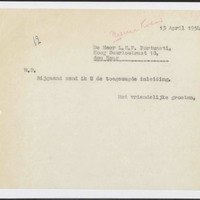
Letter to L.H. Fortunati
-
Description
-
Annex: manuscript of an introduction titled 'Economische bijdragen tot het doen afnemen van de internationale spanningen'. Tag on letter: 'Nieuwe Koers'.
-
Recipient
-
Fortunati, L.H.
-
Date
-
1954
-
Date in document
-
yes
-
Formulas or calculations
-
no
-
Inventory number
-
NL-RtEUR_TBCOR01_021N006
-
6571
-
Storage location
-
Specifiek Magazijn
-
Filename
-
CDM6571_NL-RtEUR_TBCOR01_021N006.pdf
-
Provenance
-
Jan Tinbergen
-
Accrual Method
-
donation
-
Rights
-

-
Revised transcript
-
ne
13 April 1954
De Heer L.H.F. Fortunati,
Hoog Buurlostraat 18,
den Haag
W.P.
Bijgaand zend ik U de toegezegde inleiding.
Met vriendelijke groeten,
Economische bijdragen tot het doen afnemen van de internationale spanningen
Men zou kunnen zeggen, dat de spanningen, die thans de wereld beheersen, voor een deel hun oorsprong hebben gevonden in het economische. Als men de spanningen tussen de communisten en de niet-communisten namelijk als de belangrijkste beschouwt, dan vinden deze hun oorsprong in belangentegenstellingen tussen arbeiders en niet-arbeiders, zoals die gezien werden in de tijd van Marx. Een bijzondere vorm hebben zij intussen mede gekregen door vermenging met allerlei andere elementen, in de eerste plaats ideologische. De communisten hebben een leer van absolute onverdraagzaamheid ontwikkeld, sterk verwant met de absolute onverdraagzaamheid van de nationaal-socialisten; de politieke spanningen worden medebepaald door nationale belangen van Rusland en Amerika, en tenslotte door de belangen van de onderontwikkelde gebieden, die door de Russen sterker naar voren gebracht worden door de propaganda die zij in deze gebieden voeren.
Als de pessimistische veronderstelling, dat de communisten een volkomen onverdraagzaamheid zullen blijven vertonen, juist is, is het de vraag of er veel gedaan kan worden tot vermindering van de spanningen, behalve het aanvaarden van de communistische zienswijze. In de mate waarin deze mogelijkheid zich voordoet, is er geen andere uitweg dan ieder op zijn stuk blijven staan zolang men van zijn goed recht overtuigd is. Wij mogen daarnaast altijd nog met de mogelijkheid rekenen, dat het anders zou blijken te zijn en dan zouden oplossingen wellicht in deze richting kunnen worden gevonden, dat een langzamerhand objectievere discussie mogelijk zou worden, over welke sociale en economische politiek de beste is, waarbij elementen zowel van de communistische als van de niet-communistische maatschappij-inrichting overgenomen zouden moeten worden. De eerste zou zijn totalitaire eisen moeten laten vallen, terwijl de laatste bereid zou moeten zijn tot een aantal verdere hervormingen op het gebied van de eigendom of de organisatie van de maatschappij.
Wat kan men in de Westelijke wereld doen om het maximum aan goede wil te tonen? Ten eerste, een open oog hebben voor de verdere hervorming van de maatschappij dezer landen in de richting van toenemende medezeggenschap, gelijke kansen voor iedereen (onderwijs, erfrecht), egalisering van de inkomens waar dat kan zonder de efficiency aan te tasten. Ten tweede, door met name aan de ontwikkeling van de onderontwikkelde gebieden meer beschikbaar te stellen dan op het ogenblik het geval is. De moeilijkheid van het vraagstuk is niet alleen, dat er grotere en veel grotere kapitaalbedragen nodig zijn dan
-2-
tot nu toe beschikbaar zijn gesteld, maar ook dat het vraagstuk geen uitzicht biedt op een redelijke oplossing, indien men ook niet bereid is het bevolkingsvraagstuk te stellen en aan te vatten. Ten derde, door te blijven trachten een gedachtenwisseling met de communisten te voeren over wat er ter verbetering van de sociale structuur mogelijk is, zonder inmiddels totalitaire politieke vormen te aanvaarden. Een vergelijking zou nuttig kunnen zijn tussen wat in de Westelijke landen en datgene wat in de Oostelijke landen is gedaan om de sociale ongelijkheid te verminderen. Deze vergelijking valt zeker niet altijd ten nadele van het Westen uit, al is het waar dat in de Oostelijke landen de eigendomsverhoudingen op meer radicale wijze zijn gewijzigd. Evenzeer staat voor het Westen vast, dat het belastingstelsel veel progressiever is en er zijn andere punten, waarop de vergelijking ten voordele van het Westen zou kunnen uitvallen. Een meer objectieve discussie kan altijd bijdragen tot beter onderling begrip, tenzij een van beide partijen dat begrip bepaald niet wenst.
J. Tinbergen
-
en
April 13, 1954
Mr. L.H.F. Fortunati,
Hoog Buurlostraat 18,
The Hague
W.P.
Enclosed I send you the promised introduction.
With kind regards,
Economic contributions to reducing international tensions
One could say that the tensions that currently dominate the world have partly found their origin in the economic sphere. If one considers the tensions between the communists and the non-communists as the most important, then these find their origin in conflicts of interest between workers and non-workers, as they were seen in the time of Marx. In the meantime, they have also taken on a special form through mixing with all kinds of other elements, primarily ideological ones. The communists have developed a doctrine of absolute intolerance, closely related to the absolute intolerance of the national socialists; political tensions are co-determined by the national interests of Russia and America, and finally by the interests of the underdeveloped areas, which are brought forward more strongly by the Russians through the propaganda they conduct in these areas.
If the pessimistic assumption that the communists will continue to show complete intolerance is correct, it is questionable whether much can be done to reduce the tensions, other than accepting the communist viewpoint. To the extent that this possibility arises, there is no other way out than for everyone to stand their ground as long as they are convinced of their rightness. We may also always count on the possibility that it might turn out differently, and then solutions could perhaps be found in this direction, that a gradually more objective discussion would become possible about which social and economic policy is best, whereby elements of both the communist and the non-communist social organization would have to be adopted. The former would have to drop its totalitarian demands, while the latter would have to be prepared for a number of further reforms in the field of ownership or the organization of society.
What can be done in the Western world to show the maximum of goodwill? Firstly, to have an open eye for the further reform of the society of these countries in the direction of increasing participation, equal opportunities for everyone (education, inheritance law), equalization of incomes where possible without affecting efficiency. Secondly, by making more available for the development of underdeveloped areas in particular than is currently the case. The difficulty of the problem is not only that larger and much larger amounts of capital are needed than
-2-
have been made available so far, but also that the problem offers no prospect of a reasonable solution if one is not also prepared to pose and tackle the population problem. Thirdly, by continuing to try to conduct an exchange of ideas with the communists about what is possible to improve the social structure, without in the meantime accepting totalitarian political forms. A comparison could be useful between what has been done in the Western countries and what has been done in the Eastern countries to reduce social inequality. This comparison certainly does not always turn out to the disadvantage of the West, although it is true that in the Eastern countries ownership relations have been changed in a more radical way. It is equally certain for the West that the tax system is much more progressive and there are other points on which the comparison could turn out in favor of the West. A more objective discussion can always contribute to better mutual understanding, unless one of the two parties definitely does not want that understanding.
J. Tinbergen
-
annexCount
-
1