-
Title
-
Letter to C.F. Roos
-
Description
-
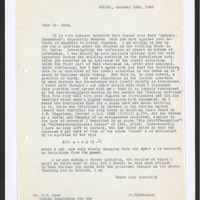
Transcript of a letter from Tinbergen to dr. C.F. Roos.
-
Date
-
1936
-
Date in document
-
yes
-
Formulas or calculations
-
yes
-
Inventory number
-
NL-RtEUR_TBCOR01_008R009
-
1154
-
Storage location
-
Specifiek Magazijn
-
Filename
-
CDM1154_NL-RtEUR_TBCOR01_008R009.pdf
-
Provenance
-
Jan Tinbergen
-
Accrual Method
-
donation
-
Rights
-

-
Revised transcript
-
en
10B/12809/12653
GENEVA, October 13th, 1936
Dear Dr. Roos,
It is with extreme interest that I read your book "Dynamic Economics"; especially because here you have applied your methods of analysis to actual figures. I am writing to you to ask you a question about the chapter on the building trade in St. Louis. Investigating the influence of credit on volume of investment, I was struck by your analysis stating that the most important factor for building activity is the foreclosure rate, which you consider as an indicator of the credit situation. I think the first part of this statement is, after your analysis, quite convincing, but I don't agree with you that the foreclosure rate is an indicator of the credit situation in the sense as is meant in business cycle theory. Now this is, to some extent, a question of words. Of more importance is the further question by what factors the foreclosure rate itself chiefly is determined. I would have thought - and other people with whom I discussed this question have agreed with me - that it is largely determined by the demand-supply-situation in the market for "housing services". This fits very well with your figures on foreclosures per 100.000 families which show a higher correlation with vacancies. So I reach the conclusion that for a large part new house building in St. Louis was determined by factors in the housing market itself that therefore the long waves in building (also found by J.H. Riggelman, Journal A.S.A. 1933 (XXVIII) p.174, for the States as a whole) are largely of an endogenous character, similar to the type of movement I described in my paper "Ein Schiffbauzyklus" in "Weltwirtschaftliches Archiv" of 1931, p.152. Unfortunately I have no copy left to include, but the chief point is that the increase x? per unit of time of the house "stock" x is determined by an equation of the type
x?(t) = - a x (t - ?)
where a and ? are only slowly changing data and where x is measured as deviations from its trend.
I am now making a closer analysis, the results of which I shall no doubt send to you; but I should be very much obliged to know whether you agree with the principal thought in the above. Thanking you in advance, I am
Yours very sincerely
(J. Tinbergen)
Dr. C.F. Roos
Cowles Commission for the Advancement of Science
Mining Exchange Building
COLORADO SPRINGS. (Colo)
U.S.A.