-
Title
-
Letter to L.J. Zimmerman
-
Description
-
Annex: manuscript of a summary of a book review.
-
Date
-
1950
-
Date in document
-
yes
-
Formulas or calculations
-
no
-
Inventory number
-
NL-RtEUR_TBCOR01_014W035
-
2306
-
Storage location
-
Specifiek Magazijn
-
Filename
-
CDM2306_NL-RtEUR_TBCOR01_014W035.pdf
-
Provenance
-
Jan Tinbergen
-
Accrual Method
-
donation
-
Rights
-

-
Revised transcript
-
ne
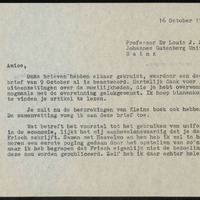
16 October 1950
Professor Dr Louis J. Zimmerman, Johannes Gutenberg Universität, Mainz
Amice,
Onze brieven hebben elkaar gekruist, waardoor een deel van je brief van 9 October al is beantwoord. Hartelijk dank voor je nadere uiteenzettingen over de moeilijkheden, die je hebt overwonnen en nogmaals met de overwinning gelukgewenst. Ik hoop binnenkort de tijd te vinden je artikel te lezen.
Je zult nu de besprekingen van Kleins boek ook hebben gekregen. De samenvatting voeg ik aan deze brief toe.
Wat betreft het voorstel tot het gebruiken van uniforme symbolen in de economie, lijkt het mij aanbevelenswaardig dat je daarover aan Frisch schrijft. Samen met Haavelmo en hem heb ik wel in het uniformeren een eerste poging gedaan door het opstellen van zo'n lijst, maar ik heb begrepen dat Frisch eigenlijk niet de bedoeling had dat deze zou worden gepubliceerd. Zelf heb ik daar echter helemaal geen bezwaar tegen.
Met hartelijke groeten,
SAMENVATTING. Dr Klein heeft drie verschillende modellen van het conjunctuurmechanisme in de Verenigde Staten 1921-1941 uitgewerkt. Het eerste bestond uit zes vergelijkingen, het tweede uit drie en het derde uit zestien. Bij het eerste model gebruikt hij drie verschillende methoden van statistische verificatie. Bij het derde model twee. Tengevolge van de goede overeenstemming tussen waargenomen en berekende reeksen lopen de verschillen in de coëfficiënten, die hij vindt, slechts weinig uiteen. Belangwekkend is, dat de "Propension marginale aux dépenses" voor niet-arbeiders zeer dicht bij 1 blijkt te liggen. Dr Klein neemt aan, dat de investeringen niet alleen afhangen van de winsten, doch ook van het aanwezige kapitaal. Dit laatste feit blijkt er toe te leiden, dat de waarde voor de "multiplication keynésienne" veel geringer wordt dan bij andere modellen; voor een zo groot land als de Verenigde Staten wel ongeveer 2. Dr Klein vindt verder dat de invloed van de liquide reserves op de "production à la consommation" verwaarloosbaar is.
Zijn derde model is theoretisch beter gefundeerd, doch in sommige opzichten minder uitgewerkt dan het model indertijd door de Volkenbond gepubliceerd. Het is opvallend, dat nergens een invloed van de "new Deal" politiek wordt gesignaleerd.
Het boek is in een zeer geserreerde stijl gehouden, waardoor het niet eenvoudig leest, doch het houdt een zeer grote hoeveelheid interessante resultaten in.
J. Tinbergen
-
en
16 October 1950
Professor Dr Louis J. Zimmerman, Johannes Gutenberg University, Mainz
Amice,
Our letters have crossed, which means that part of your letter of October 9 has already been answered. Thank you very much for your further explanations regarding the difficulties you have overcome, and congratulations once again on the victory. I hope to find the time to read your article soon.
You will now also have received the reviews of Klein's book. I am attaching the summary to this letter.
Regarding the proposal to use uniform symbols in economics, it seems advisable to me that you write to Frisch about it. Together with Haavelmo and him, I did make a first attempt at standardization by drawing up such a list, but I understood that Frisch actually did not intend for it to be published. Personally, however, I have no objection to it at all.
With kind regards,
SUMMARY. Dr. Klein has developed three different models of the business cycle mechanism in the United States 1921-1941. The first consisted of six equations, the second of three, and the third of sixteen. In the first model, he uses three different methods of statistical verification. In the third model, two. Due to the good agreement between observed and calculated series, the differences in the coefficients he finds vary only slightly. It is interesting to note that the "Propension marginale aux dépenses" for non-workers appears to be very close to 1. Dr. Klein assumes that investments depend not only on profits but also on the available capital. This latter fact appears to lead to the value for the "multiplication keynésienne" being much lower than in other models; for a country as large as the United States, about 2. Dr. Klein further finds that the influence of liquid reserves on "production à la consommation" is negligible.
His third model is theoretically better founded, but in some respects less developed than the model published by the League of Nations at the time. It is striking that nowhere is an influence of the "New Deal" policy noted.
The book is written in a very concise style, which makes it not easy to read, but it contains a very large amount of interesting results.
J. Tinbergen
-
annexCount
-
1