-
Title
-
Letter to W.J. Baumol
-
Description
-
With annex: Leaflet about 'Economic Dynamics, an introduction' by William J. Baumol.
-
Date
-
1951
-
Date in document
-
yes
-
Formulas or calculations
-
no
-
Inventory number
-
NL-RtEUR_TBCOR01_016B010
-
1805
-
Storage location
-
Specifiek Magazijn
-
Filename
-
CDM1805_NL-RtEUR_TBCOR01_016B010.pdf
-
Provenance
-
Jan Tinbergen
-
Accrual Method
-
donation
-
Rights
-

-
Revised transcript
-
en
198
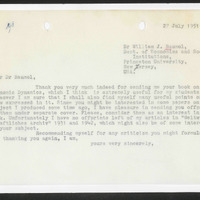
27 July 1951
Dr William J. Baumol,
Dept. of Economics and Social Institutions,
Princeton University,
New Jersey,
USA.
Dear Dr Baumol,
Thank you very much indeed for sending me your book on Economic Dynamics, which I think is extremely useful for my students. Moreover I am sure that I shall also find myself many useful points of view expressed in it. Since you might be interested in some papers on the subject I produced some time ago, I have pleasure in sending you offprints of them under separate cover. Please, consider them as an interest in your work. Unfortunately I have no offprints left of my articles in "Weltwirtschaftliches Archiv" 1931 and 1942, which might also be of some interest to your subject.
Recommending myself for any criticism you might formulate and thanking you again, I am,
yours very sincerely,
ECONOMIC DYNAMICS:
an introduction
by William J. Baumol
with a chapter by Dr. Ralph Turvey
• a survey of analyses of economic processes involving time
• an introduction to the mathematical techniques employed
• a summary of important recent theoretical developments
William J. Baumol is Assistant Professor, Dept. of Economics and Social Institutions, Princeton University. He received his Ph.D. from the London School of Economics, where he was Assistant Lecturer. He has served as an economist with the Dept. of Agriculture.
New and important to teachers and students because it is—
• The only elementary exposition, complete with problems and answers, of the basic mathematical techniques of dynamic economic analysis.
• A completely self-contained treatment which can be studied by anyone at all acquainted with the techniques of economic analysis even though he has not previously worked with dynamics.
• The only text which explains recent and continuing developments in economic theory which are receiving the utmost attention in the profession but which are for the most part exceedingly difficult in the original.
• A useful reference for professional economists, especially those who are interested in but do not specialize in the branch dealt with.
• The only summary available in English of valuable recent Scandinavian developments—among the most important non-English language contributions of our time.
For advanced economics courses, the first comprehensive study of economic dynamics
The first textbook treatment of a greater part of this subject, this new book explains the methods and principal contributions in the analysis of the development of economic phenomena with the passage of time. At the same time it makes available to the general student some [of] the [most] important recent developments in economic theory and provides him with mathematica[l] technique[s] which he may later use to embark on his own research. It points out the importance of dynamic theory in the study of all economic theory, reminding its readers that static problems cannot be discussed without reference, however implicit and rudimentary, to dynamical considerations.
Divided into three parts, the book begins with a section entitled "Magnificent Dynamics" and characterized methodologically by the use of sweeping generalizations as to technology and the psychology of the community. The subject matter is the development of economics as a whole over long periods of time or the evolution of capitalism. Included are [the] works [of] Ricardo, Marx, Schumpeter, [and] Harrod.
"Statics Involving Time," the second part of the text deals with influence of the recognition of the existence of change by members of the community on the economic situation at a particular moment. Methodology used is essentially that of static analysis. Much of the work of Hicks, Lange, and Samuelson is included.
"Process Analysis," the third section, deals primarily with the analysis of day to day developments in the economy and its parts. In addition to discussion of the contributions of Samuelson, the Swedes, Metzler, Domar, etc., this includes the only available self-contained introduction to the mathematical techniques of dynamic analysis so completely and comprehensively explained as to require no more than an elementary high school algebra background. The use of difference and differential equations, which is rapidly becoming one of the most important tools of the economic theorist, is given here an elementary exposition.
An important chapter, written by Dr. Ralph Turvey of the London School of Economics, is also here, describing developments in Scandinavia from where some of the most important non-English language contributions to the subject have originated. This is the only such summary available in English.
ECONOMIC DYNAMICS
BAUMOL: Economic Dynamics
Preface
1. Introductory
Part I THE MAGNIFICENT DYNAMICS
2. The Classical Dynamics
3. The Dynamics of Marx and Schumpeter
4. Mr. Harrod's Model
Part II STATICS INVOLVING TIME
5. The Equilibrium of the Firm
Appendix: Uncertainty and the Equilibrium of the Firm
6. Price Flexibility and the Equilibrium of the Economy
7. Dynamics, Comparative Statics and the Stability of Static Equilibrium
Part III PROCESS ANALYSIS
8. Period Analysis
Appendix: A Note on Functionals
9. Some Simple Dynamic Models and the Technique of Their Construction
10. Some Simple Dynamic Models (Continued)
11. Some Simple Dynamic Models (Concluded)
Appendix: Examples of the Solution of Higher Order Systems
12. Simple Differential Equation Systems
A Short Reading List
Answers to the Problems
Index
Coming in June, c. 254, probably $5.00
THE MACMILLAN COMPANY, 60 Fifth Ave., New York 11
D-1933-Printed in U.S.A.-L-5-51
-
annexCount
-
1