-
Title
-
Letter to J. Goudriaan
-
Date
-
1952
-
Date in document
-
yes
-
Formulas or calculations
-
no
-
Inventory number
-
NL-RtEUR_TBCOR01_017G008
-
4872
-
Storage location
-
Specifiek Magazijn
-
Filename
-
CDM4872_NL-RtEUR_TBCOR01_017G008.pdf
-
Provenance
-
Jan Tinbergen
-
Accrual Method
-
donation
-
Rights
-

-
Revised transcript
-
ne
PROF. DR J. TINBERGEN
DEN HAAG, 31 Juli 1952
Sijzenlaan 41
410
De Hooggeleerde Heer Prof. Dr Ir
J. Goudriaan,
Hotel Irene,
Pretoria
Waarde Goudriaan,
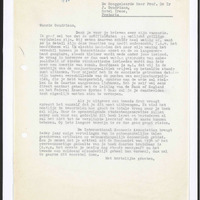
Dank je voor je brieven over mijn recensie. Ik geef wel toe dat de coëfficiënten [ij] wellicht grillige variabelen zijn. Wij weten daarvan echter heel weinig af, want zo in detail zijn deze reacties nog nooit onderzocht. T.a.v. het hoofdthema wil ik slechts herhalen dat naar mijn mening het verschil tussen je theoretische opzet en de nu langzamerhand gangbare, steeds kleiner wordt mede onder jouw invloed. De vraag in hoeverre er dan moet worden gesproken van onbepaaldheid of sterke stochastische invloeden wordt dan iets meer een kwestie van smaak. Hoofdzaak is m.i. dat wij in de praktijk van de conjunctuurpolitiek vrijwel op hetzelfde standpunt uitkomen. Voor mijzelf heb ik de conclusie getrokken dat [ik in] mijn bureau verschillende van de punten van conjunctuurpolitiek, die je hebt voorgesteld, opnieuw aan de orde zal stellen in de daartoe aangewezen lichamen. Heb je zelf wel eens direct contact gehad met de leiding van de Bank of England en het Federal Reserve System? Daar zul je je denkbeelden toch eigenlijk moeten zien te verkopen.
Als je uitgever een tweede druk vraagt spreekt het vanzelf dat je dit moet uitbrengen. Ik vind het moeilijk te beoordelen hoe groot de totale vraag naar je boek zal zijn. Maar de opeenvolgende studentengeneraties zullen zeker ook voor een gedeelte dit boek lezen en bestuderen al zal het niet tot de verplichte leerstof van de massa kunnen behoren. Op iets langere termijn is er dus geen groot risico.
De International Economic Association brengt ieder jaar enige vertalingen van in ontoegankelijke talen geschreven artikelen op wetenschappelijk economisch gebied. Zou je menen dat je artikel uit de Economist van 1934 of het overeenkomstige gedeelte van je boek daartoe bruikbaar is (d.w.z. het eerste je mening nog steeds weergeeft en het tweede een voldoend afzonderlijk geheel kan vormen), dan zal ik gaarne dit voorstel doen.
Met hartelijke groeten,
-
en
PROF. DR J. TINBERGEN
THE HAGUE, July 31, 1952
Sijzenlaan 41
410
The Highly Learned Gentleman Prof. Dr. Ir.
J. Goudriaan,
Hotel Irene,
Pretoria
Dear Goudriaan,
Thank you for your letters about my review. I do admit that the coefficients [ij] are perhaps erratic variables. We know very little about them, however, because these reactions have never been investigated in such detail. Regarding the main theme, I only want to repeat that in my opinion the difference between your theoretical setup and the one that is now gradually becoming common is becoming smaller and smaller, partly under your influence. The question of to what extent one should then speak of indeterminacy or strong stochastic influences then becomes somewhat more a matter of taste. The main point is, in my opinion, that in the practice of business cycle policy we arrive at almost the same point of view. For myself, I have drawn the conclusion that [I in] my office will again raise several of the points of business cycle policy that you have proposed in the appropriate bodies. Have you ever had direct contact yourself with the management of the Bank of England and the Federal Reserve System? That is where you should actually try to sell your ideas.
If your publisher asks for a second edition, it goes without saying that you should release it. I find it difficult to judge how large the total demand for your book will be. But successive generations of students will certainly read and study this book at least in part, even if it cannot belong to the compulsory curriculum of the masses. In the somewhat longer term, there is therefore no great risk.
The International Economic Association publishes several translations every year of articles written in inaccessible languages in the scientific economic field. Would you think that your article from the Economist of 1934 or the corresponding part of your book is suitable for this (i.e., the first still reflects your opinion and the second can form a sufficiently separate whole), then I would be happy to make this proposal.
With kind regards,