Letter to R.W. Goldsmith
- Title
- Letter to R.W. Goldsmith
- Recipient
- Goldsmith, R.W.
- Language
- English
- City
- Washington, D.C.
- Date
- 1953
- Date in document
- yes
- Formulas or calculations
- no
- Inventory number
- NL-RtEUR_TBCOR01_018G011
- 4594
- Storage location
- Specifiek Magazijn
- Filename
- CDM4594_NL-RtEUR_TBCOR01_018G011.pdf
- Provenance
- Jan Tinbergen
- Accrual Method
- donation
- Rights
-

- Revised transcript
-
en
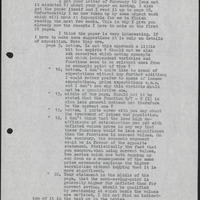
PROF. DR J. TINBERGEN THE HAGUE, 20 March 1953
Raamweg 18 (office address)
Mr Raymond W. Goldsmith, 1129 Vermont Avenue N.W. Washington 5 D.C.
Dear Mr Goldsmith,
I got your letter of February 10 (was not it misdated ?) about your paper on saving. I also got the paper itself and I read it up to page 28. Unfortunately I am now taken up by some urgent work which will make it impossible for me to finish reading the next few weeks. This is why I give you already now the remarks I have to make on the first 28 pages.
I think the paper is very interesting. If I have to make some suggestions it is only on details of exposition. Here they are.
page 5, bottom. Is not this approach a little bit too empiric ? Should not we also ask ourselves which saving concepts and which independent variables and functions seem to be relevant ones from an economic point of view ?
" 10, bottom. I don't quite like to speak of expectations without any further addition; I would rather prefer to speak of income expectations, price expectations a. s. o. and I don't see why this variable should not be a quantitative one.
" 15, middle of the page. Should not it be stated that the function S/Y = f (X) is also less general and need not therefore be the correct one ?
" 15, bottom. I quite agree with you say about the treatment of prices and population.
" 18. I don't think that the less high coefficients of determination you get with deflated values prove in any way that these functions would be less significant than the functions in current values. On the contrary, the economic argument would be in favour of the opposite statement. Statistically the fact that you compare, when using current values, two series which are both dancing up and down as a consequence of the same price movements explains the higher correlation without implying that it is more significant.
" 22. Your statement in the middle of the page, that the zero-saving-point is generally higher for deflated than for current saving, should be qualified by mentioning at which basis the values are deflated. I did not find an indication of it in the text or in the tables.
As a last general remark, may I suggest that more historical graphs are added ?
With best personal regards,
yours very sincerely,
- Item sets
- Tinbergen Letters Sent