-
Title
-
Letter to de Bruin
-
Recipient
-
Bruin
-
Date
-
1951
-
Date in document
-
yes
-
Formulas or calculations
-
no
-
Inventory number
-
NL-RtEUR_TBCOR01_016B030
-
1699
-
Storage location
-
Specifiek Magazijn
-
Filename
-
CDM1699_NL-RtEUR_TBCOR01_016B030.pdf
-
Provenance
-
Jan Tinbergen
-
Accrual Method
-
donation
-
Rights
-

-
Revised transcript
-
ne
Overdruk uit De Linie van 18 Mei 1951
„Economische toekomst van het Westen"
besproken door Dr P. de Bruin S.J.
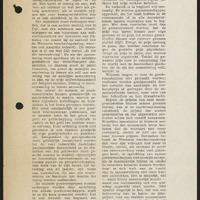
De Korea-gebeurtenissen hebben voor de stellingen van Dr Ir M. Dijt in zijn boek over de economische toekomst van het Westen 1) een eclatante proef op de som gegeven. De stabiliteit der grondstoffenprijzen is van overwegend belang voor de welvaart. Alle schokken in de economische welvaart komen van onmatige prijsdalingen of prijsstijgingen van basisgrondstoffen of lopen er op uit. Het komt er weinig op aan, wat men als oorzaak en wat men als gevolg beschouwt; als er stabiele prijzen zijn voor basisgrondstoffen dan is er ook stabiliteit in de welvaart.
Die stabiliteit moet verkregen worden, dat is een andere stelling van Ir Dijt, met een minimum aan staatsingrijpen en een maximum aan zelfwerkzaamheid der bewoners van Panunia (zo noemt hij de eenheid van de Westerse beschavingskring, waartoe ook Amerika behoort). De economie is er om wat Dijt noemt „de zin der samenleving". De zin der samenleving moet spontaan uit de zedelijke gezindheid der wereldburgers ontspruiten en daarom moet de juiste economie, om zowel de zedelijke samenleving te dienen als zelf ook een uiting van de zedelijke samenleving te zijn, op de vrije zelfwerkzaamheid der burgers steunen. Dwang is mensonwaardig en maakt armoedig.
Om echter de mensen de goede economische keuzen gemakkelijk en aantrekkelijk te maken, moeten zekere algemene instellingen en technieken in het leven geroepen worden. Het eerst noodzakelijk is een geordend internationaal geldwezen, dat de mensen belet in het groot van geld en geldschepping misbruik te maken en het geld een stabiele waarde verleent. Deze ordening wordt niet gevonden in een stabiele goudprijs bij vrije goudproductie en goudhandel. Integendeel de goudproductie moet geleidelijk verminderd worden tot de voor industriële doeleinden noodzakelijke hoeveelheid en de stabiliteit van het geldwezen moet gezocht worden in stabiele cijferprijzen en doelmatige internationale en nationale papier- en girogeldschepping. Het boek van Ir Dijt bevat, ter bereiking van dit laatste, een reeks van voorstellen, die aan alle economisten en bankiers ten zeerste ter lezing worden aanbevolen.
De stabiele goederenprijzen moeten verkregen worden door oprichting van enkele goederenschappen, zoals ze in dit boek genoemd worden. Dat is een kwestie van beginsel, een kwestie van keuze en een kwestie van techniek. Het beginsel is reeds door vele geleerden en politici aanvaard. Het ligt ten grondslag aan de grondstoffenvaluta van Goudriaan, aan de grondstoffenpolitiek van Byrd en anderen, aan het plan Schuman en het plan-Stikker. Over de keuze en de techniek echter bevat het boek van Dijt zeer originele voorstellen. De keuze moet beperkt blijven tot de leidende basisgrondstoffen: tarwe, suiker, katoen, koffie en rubber. Of hij hiermee ineens precies het juiste getroffen heeft, doet weinig ter zake. Als men eenmaal met het valoriseren van de basisgrondstoffen begint, dan zal vanzelf wel blijken of er nog enkele aan toegevoegd moeten worden en of misschien een enkel ervan overbodig wordt. De hoofdzaak ligt in de techniek.
De techniek moet zodanig zijn, dat ze samengaat met vrije voortbrenging en vrije handel in de samenwerkende landen. Zij moet vanzelf leiden tot de opheffing van de invoerrechten, uitvoerpremies, invoerverboden en contingenteringen, die thans het vrije verkeer beletten.
De techniek is in beginsel vrij eenvoudig. Er worden goederenschappen opgericht, die tot taak hebben in de voornaamste of in alle samenwerkende landen voorraden aan te leggen. Met deze voorraden moet dan zo gemanipuleerd worden, dat de prijs van tarwe binnen zeer enge grenzen en de prijs der andere grondstoffen binnen wat ruimere grenzen stabiel blijft. Dreigt de prijs omhoog te gaan, dan worden voorraden tegen de gestelde prijs afgestoten; dreigt de prijs te dalen, dan worden voorraden opgekocht. Totdat de gewenste prijs voor de voorziening van de markt met de hoeveelheid goederen, die de zin der samenleving redt, bereikt is.
Winsten mogen er door de goederenschappen niet gemaakt worden; verliezen worden goedgemaakt door het verschil van aankoops- en verkoopsprijs of gedragen door de samenwerkende landen, naar rato van hun behoeften en hun draagkracht.
Blijven de prijzen van deze basisgrondstoffen binnen zekere grenzen stabiel, dan is de marktvoorziening verzekerd, de prijzen der andere grondstoffen en der afgewerkte producten zullen zich vanzelf aanpassen. Mogelijke speculaties in kleinere sectoren van het economisch leven hinderen dan de welvaart niet meer overmatig, omdat ze niet om zich heen kunnen grijpen. Bovendien behoeft de Westerse beschavingskring dan voor zijn welvaart niet meer te vrezen, omdat, als eenmaal de geest van samenwerking vaste voet gekregen heeft, de oprichting van andere goederenschappen niet moeilijk zal zijn, als ze noodzakelijk blijken en omdat de outsiders beheerst kunnen worden, daar ze zich toch aan de macht van de samenwerkers niet meer kunnen onttrekken. Het is mogelijk, dat — zoals Korea aannemelijk maakt — naast een katoenschap ook een wolschap opgericht moet worden. Niet minder mogelijk is het, dat ook een beheersing van de kolen- en ijzerprijzen voor een stabiele economische orde gevorderd wordt. De techniek der kolen- en ijzerprijzenbeheersing zal een andere moeten zijn dan die der goederenschappen van Ir Dijt. Het vormen van buffervoorraden is voor kolen, ijzer en staal ondoenlijk. Daartoe zal een project moeten dienen in de zin van het Schuman-plan.
Onze politici, hogere ambtenaren, onderhandelaars over handelsverdragen, economisten en economieleiders behoren dit werk met zorg te bestuderen en hun handelingen erdoor te laten inspireren.
1) Dr. M. D. Dijt, „De Economische Toekomst van het Westen". — Uitgave: Stichting „Westergeest", Haarlem, 1951, 642 blz.
24 Juli 1951
De Heer T. de Bruin, Kerkstraat 3b, Alphen a/d Rijn.
Zeer geachte Heer de Bruin,
In antwoord op Uw brief van 20 Juni en de daarbij gevoegde nieuwe uitgave over "Auto-Balans-Economie" meld ik U het volgende.
Ongetwijfeld is deze uitgave veel begrijpelijker. Voor zover zij een pleidooi voor prijsstabilisatie inhoudt ben ik het daarmede goeddeels eens. Ook ben ik het eens met de visie dat die in het bijzonder door een juiste aanpassing van de geldhoeveelheid moet worden nagestreefd. Doch het zal U niet verbazen wanneer ik daaraan toevoeg dat de complicaties, die in de werkelijkheid optreden, nu juist altijd de zaak zo moeilijk maken. Dat U deze complicaties niet alle behandelt in Uw geschriften kan niemand U kwalijk nemen. Geen mens is daartoe in staat; integendeel, deze complicaties zijn van zovele verschillende soorten en zo omvangrijk, dat een deel ervan slechts in de omvangrijke economische litteratuur kan worden behandeld, terwijl een ander deel slechts wordt behandeld in staatsstukken al naar mate zij zich voordoen. Zo zult U bijv. in de zg. werkgelegenheidsnota van de Regering en het daarop verschenen voorlopig verslag van de Tweede Kamer een aantal dezer vraagstukken behandeld zien. Men kan dus, geloof ik, niet anders verlangen dan dat door de diverse regeringen getracht wordt naar de beginselen te handelen, die in Uw geschrift worden gepropageerd, maar wij moeten tegelijkertijd zien dat niet altijd de uitvoering dezer beginselen eenvoudig is en zelfs niet altijd mogelijk is. En dan komt men precies op de discussie van concrete gevallen en van details, die in de economische litteratuur aan de gang is. Ik geloof dus dat U Uw eisen te hoog stelt wanneer U meent dat plotseling Uw geschrift als het ware een omwenteling in de gedachten zou brengen. Het zal, evenals zovele andere nuttige geschriften, geleidelijk aan kunnen bijdragen tot het rijp maken van de publieke opinie voor stabilisatie van het economisch leven. Dit laatste zal moeten zijn aanpassen aan de vele practische en toevallige omstandigheden die zich op de weg van een enkel land voordoen.
Hoogachtend,
-
en
Reprint from De Linie of May 18, 1951
"Economic Future of the West"
discussed by Dr. P. de Bruin S.J.
The Korea events have provided a striking proof for the propositions of Dr. Ir. M. Dijt in his book on the economic future of the West 1). The stability of raw material prices is of predominant importance for prosperity. All shocks in economic prosperity come from excessive price falls or price increases of basic raw materials or lead to them. It matters little what one considers as cause and what one considers as consequence; if there are stable prices for basic raw materials, then there is also stability in prosperity.
That stability must be obtained, which is another proposition of Ir. Dijt, with a minimum of state intervention and a maximum of self-activity of the inhabitants of Panunia (as he calls the unity of the Western civilization circle, to which America also belongs). The economy exists for what Dijt calls "the meaning of society". The meaning of society must spring spontaneously from the moral disposition of the world citizens and therefore the correct economy, in order to serve both the moral society and to be an expression of the moral society itself, must rely on the free self-activity of the citizens. Compulsion is unworthy of humans and makes them poor.
However, to make good economic choices easy and attractive for people, certain general institutions and techniques must be brought into existence. The first necessity is an ordered international monetary system that prevents people from abusing money and money creation on a large scale and gives money a stable value. This order is not found in a stable gold price with free gold production and gold trade. On the contrary, gold production must be gradually reduced to the amount necessary for industrial purposes, and the stability of the monetary system must be sought in stable numerical prices and effective international and national paper and giro money creation. Ir. Dijt's book contains, to achieve the latter, a series of proposals that are highly recommended for reading to all economists and bankers.
Stable commodity prices must be obtained through the establishment of several commodity boards, as they are called in this book. This is a matter of principle, a matter of choice, and a matter of technique. The principle has already been accepted by many scholars and politicians. It underlies Goudriaan's raw material currency, the raw material policy of Byrd and others, the Schuman plan, and the Stikker plan. Regarding the choice and the technique, however, Dijt's book contains very original proposals. The choice must be limited to the leading basic raw materials: wheat, sugar, cotton, coffee, and rubber. Whether he has hit exactly the right ones with this is of little consequence. Once one starts with the valorization of basic raw materials, it will naturally become clear whether a few more need to be added and whether perhaps one of them becomes redundant. The main point lies in the technique.
The technique must be such that it goes hand in hand with free production and free trade in the cooperating countries. It must naturally lead to the abolition of import duties, export premiums, import bans, and quotas, which currently prevent free movement.
The technique is in principle quite simple. Commodity boards are established, whose task is to build up stocks in the main or in all cooperating countries. These stocks must then be manipulated in such a way that the price of wheat remains stable within very narrow limits and the price of other raw materials within somewhat wider limits. If the price threatens to rise, stocks are sold off at the set price; if the price threatens to fall, stocks are bought up. Until the desired price for supplying the market with the quantity of goods that saves the meaning of society is reached.
Profits must not be made by the commodity boards; losses are made up by the difference between purchase and selling price or borne by the cooperating countries, in proportion to their needs and their capacity.
If the prices of these basic raw materials remain stable within certain limits, then the market supply is assured, and the prices of other raw materials and finished products will adjust themselves. Possible speculations in smaller sectors of economic life will then no longer hinder prosperity excessively, because they cannot spread. Moreover, the Western civilization circle then no longer needs to fear for its prosperity because, once the spirit of cooperation has gained a firm foothold, the establishment of other commodity boards will not be difficult if they prove necessary, and because outsiders can be controlled since they can no longer escape the power of the cooperators. It is possible that — as Korea makes plausible — a wool board must be established alongside a cotton board. It is no less possible that control of coal and iron prices for a stable economic order is required. The technique of coal and iron price control will have to be different from that of Ir. Dijt's commodity boards. Forming buffer stocks is unfeasible for coal, iron, and steel. For that, a project in the sense of the Schuman plan will have to serve.
Our politicians, senior officials, negotiators of trade treaties, economists, and economic leaders should study this work with care and let their actions be inspired by it.
1) Dr. M. D. Dijt, "The Economic Future of the West". — Publication: Stichting "Westergeest", Haarlem, 1951, 642 pp.
July 24, 1951
Mr. T. de Bruin, Kerkstraat 3b, Alphen a/d Rijn.
Dear Mr. de Bruin,
In response to your letter of June 20 and the accompanying new publication on "Auto-Balance Economy," I inform you of the following.
Undoubtedly, this publication is much more understandable. Insofar as it contains a plea for price stabilization, I largely agree with it. I also agree with the vision that this should be pursued in particular through a correct adjustment of the money supply. However, it will not surprise you when I add that the complications that occur in reality are precisely what always make the matter so difficult. No one can blame you for not dealing with all these complications in your writings. No human being is capable of that; on the contrary, these complications are of so many different kinds and so extensive that some of them can only be treated in the extensive economic literature, while another part is only treated in state documents as they arise. For example, you will see a number of these issues addressed in the so-called employment note of the Government and the subsequent preliminary report of the House of Representatives. One cannot, I believe, expect anything else than that the various governments try to act according to the principles propagated in your writing, but we must at the same time see that the implementation of these principles is not always simple and even not always possible. And then one arrives precisely at the discussion of concrete cases and details that is ongoing in the economic literature. I believe, therefore, that you set your demands too high when you think that suddenly your writing would, as it were, bring about a revolution in thoughts. Like so many other useful writings, it will gradually be able to contribute to ripening public opinion for the stabilization of economic life. The latter will have to be an adaptation to the many practical and accidental circumstances that occur on the path of a single country.
Sincerely,
-
annexCount
-
1