-
Title
-
Letter to R.J. Swanenburg de Veye
-
Description
-
Annex: manuscript of the contribution of Tinbergen to Studium Generale 1955-56.
-
Recipient
-
Swanenburg de Veye, R.J.
-
Date
-
1955
-
Date in document
-
yes
-
Formulas or calculations
-
no
-
Inventory number
-
NL-RtEUR_TBCOR01_023D002
-
6546
-
Storage location
-
Specifiek Magazijn
-
Filename
-
CDM6546_NL-RtEUR_TBCOR01_023D002.pdf
-
Provenance
-
Jan Tinbergen
-
Accrual Method
-
donation
-
Rights
-

-
Revised transcript
-
ne
Ves
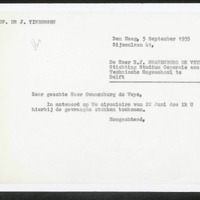
PROF. DR J. TINBERGEN
Den Haag, 5 September 1955
Sijzenlaan 41,
De Heer R.J. SWANENBURG DE VEYE, Stichting Studium Generale aan de Technische Hogeschool te Delft
Zeer geachte Heer Swanenburg de Veye,
In antwoord op Uw circulaire van 22 Juni doe ik U hierbij de gevraagde stukken toekomen.
Hoogachtend,
Economie: conjunctuurverschijnselen
De docent studeerde natuurkunde aan de Rijksuniversiteit te Leiden, waar hij in 1929 promoveerde. Hij wendde zich nadien echter tot de statistiek en de wiskundige economie en was aanvankelijk verbonden aan het Centraal Bureau voor de Statistiek, waar hij belast was met het conjunctuuronderzoek. Van 1936-1938 verrichtte hij soortgelijk onderzoek voor het Secretariaat van de Volkenbond. Van 1945-1955 was hij directeur van het Centraal Planbureau en als lid van de Sociaal-Economische Raad werkte hij mede aan een aantal adviezen van deze Raad. Van zijn hand verschenen diverse publicaties op het gebied van het conjunctuuronderzoek en de economische politiek. Sedert 1933 doceert hij aan de Nederlandsche Economische Hoogeschool te Rotterdam.
De voordrachten zullen allereerst een korte beschrijving van de conjunctuurverschijnselen beogen. De schommelingen in de economische toestand die met deze naam worden aangeduid zijn internationaal min of meer gelijkgericht en bestaan sedert ca 1800. Zij zijn vrij regelmatig en vertonen zich vooral in de investeringsbedrijvigheid en de grondstoffenprijzen. Berucht is de grote depressie van de dertiger jaren van de 20e eeuw, die een diepgaande sociale en politieke invloed heeft gehad.
Vervolgens zullen enkele aspecten van de verklaring van deze verschijnselen worden besproken. Daarbij dient in aanmerking te worden genomen dat van een algemeen aanvaarde, algemeen geldige verklaring niet kan worden gesproken, in verband met de beperkte omvang en waarde der statistische gegevens en in verband met de wisselende omstandigheden waaronder het economische leven zich ontwikkelt. Er is voorts aanleiding om onderscheid te maken tussen datgene wat relevant is voor een verklaring en datgene wat voor een beïnvloeding der bewegingen van belang is.
Het laatste deel der beschouwingen zal op de vraag van deze beïnvloeding, d.w.z. de conjunctuurpolitiek, ingaan.
-
en
Ves
PROF. DR J. TINBERGEN
The Hague, 5 September 1955
Sijzenlaan 41,
Mr. R.J. SWANENBURG DE VEYE, Studium Generale Foundation at the Technical University of Delft
Dear Mr. Swanenburg de Veye,
In response to your circular of June 22, I hereby send you the requested documents.
Sincerely,
Economics: business cycle phenomena
The lecturer studied physics at the State University of Leiden, where he obtained his doctorate in 1929. He subsequently turned to statistics and mathematical economics and was initially associated with the Central Bureau of Statistics, where he was in charge of business cycle research. From 1936-1938 he performed similar research for the Secretariat of the League of Nations. From 1945-1955 he was director of the Central Planning Bureau and as a member of the Social and Economic Council he contributed to a number of recommendations of this Council. Various publications by him appeared in the field of business cycle research and economic policy. Since 1933 he has been teaching at the Netherlands School of Economics in Rotterdam.
The lectures will first of all aim for a short description of business cycle phenomena. The fluctuations in the economic situation indicated by this name are internationally more or less aligned and have existed since approximately 1800. They are fairly regular and manifest themselves especially in investment activity and raw material prices. Notorious is the great depression of the thirties of the 20th century, which had a profound social and political influence.
Subsequently, some aspects of the explanation of these phenomena will be discussed. In this regard, it should be taken into account that one cannot speak of a generally accepted, generally valid explanation, in connection with the limited scope and value of the statistical data and in connection with the changing circumstances under which economic life develops. There is furthermore reason to distinguish between what is relevant for an explanation and what is important for influencing the movements.
The last part of the considerations will address the question of this influencing, i.e., business cycle policy.
-
annexCount
-
1