-
Title
-
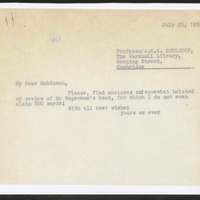
Letter to E.A.G. Robinson
-
Description
-
Annexes: letter from Robinson to Tinbergen; manuscript of a book review of 'Narrenspiegel der Statistik- Die Umrisse eines statistischen Weltbilders' by Ernst Wagemann.
-
Date
-
1952
-
Date in document
-
yes
-
Formulas or calculations
-
no
-
Inventory number
-
NL-RtEUR_TBCOR01_017R011
-
4321
-
Storage location
-
Specifiek Magazijn
-
Filename
-
CDM4321_NL-RtEUR_TBCOR01_017R011.pdf
-
Provenance
-
Jan Tinbergen
-
Accrual Method
-
donation
-
Rights
-

-
Revised transcript
-
en
July 28, 1952
401
Professor A.E.G. ROBINSON, The Marshall Library, Downing Street, Cambridge
My dear Robinson,
Please, find enclosed and somewhat belated my review of Dr Wagemann's book, for which I do not even claim 800 words!
With all best wishes
yours as ever
From E. A. G. ROBINSON THE MARSHALL LIBRARY DOWNING STREET CAMBRIDGE
THE ROYAL ECONOMIC SOCIETY THE ECONOMIC JOURNAL
R. F. HARROD } Joint Editors E. A. G. ROBINSON }
26. 2. 1951.
Dear Professor Tinbergen,
I am sending you herewith the review copy of the following book, which you have kindly promised to review for the Economic Journal.
The review will probably be required for the September issue of the Journal. I should be very grateful if I might receive your manuscript by 1st June.
[gaarne lenen! nieuwste druk (ca 1950)]
Owing to the great pressure on the space of the Journal it is necessary to restrict somewhat the length of reviews. I should be glad therefore if you could limit yourself to about 800-1000 words.
Yours sincerely, [E. A. G. Robinson]
"Narrenspiegel Der Statistik - Die Umrisse eines statistischen Weltbildes" by ERNST WAGEMANN.
ERNST WAGEMANN, Narrenspiegel der Statistik. Die Umrisse eines statistischen Weltbildes. 3rd revised edition, A. Francke, A.G. Verlag, Berne, 1950; Pp 253, 35 diagr.
Professor Wagemann undertook to write this book in order to restrict the influence of the well-known dictum that statistics represents the worse type of lies. He wanted to show that there is a rigorous system of statistical sins and hence a possibility to avoid them. He succeeded in supplying us with an amusing collection of errors taken from all classes of subjects where statistical methods have been used, though primarily from the economic field. He placed them in the framework of a systematic treatment, of which alternatively solemn scientific expressions and interesting and well-chosen every-day observations form the composing elements. The author did not want to include in his treatment the realm of mathematical statistics; it is qualitative rather than quantitative philosophy which he offers, even if the subject is figures.
Reminding the reader of the census effectuated by King David, which was considered a heavy sin, the author suggests that much of the aversion, even today, of statistics may be explained by the original uses made of them: military and fiscal. Mankind had to go a long way before she mastered the realm of figures, he adds. This is illustrated with the way in which certain primitive peoples formed their counting techniques. In his systematic treatment, professor Wagemann makes a sharp distinction between "the mathematical and the empirical figure, corresponding, respectively, with a promise of truth and one of probability only". His book is subdivided in three main chapters, about (i) the art and the difficulty of counting, (ii) ways and deadlocks of statistical comparison, and (iii) methods and errors in estimation. In a final chapter he develops a "statistical view of the world".
In his first chapter he deals, among many other topics, with the difficulties of a correct definition and delimitation of statistical populations and of the shifts in concepts that may slip in during the analysis; with the techniques of summation and averaging and with the computation of dispersions.
In the second chapter, it is statistical comparison that is discussed, with its technical expressions: statistical series, index numbers and correlation coefficients. It is primarily here that he offers a systematic survey of possible errors (p. 108) with a large number of examples. The well-known difficulties of unweighted index-numbers that may show a rise both forward and backward are discussed extensively, as well as, e.g., the possibility that the two subgroups of a statistical population may both show a rising mean with the general average falling, etc.
- 2 -
In the third chapter Dr Wagemann offers a system of estimation methods, in the following way:
Estimation of a total from a partial population: "representation"
" " a partial from a total " : "inclusion"
" from one or more populations of the same type as the population to be estimated : "generalisation"
" from a population of a different type : "substitution",
where the latter two are subdivided in further methods of estimation. He rightly emphasises the growing importance of estimates in the practice of statistical applications and contributes much to their understanding. Of each of the types of estimation he distinguishes a correct and an erroneous application, taken from such different angles as marriages of German colonists, submarines, public-opinion samples, Germany's capacity to pay, consumption of fats and alcoholic beverages, demographic forecasts, etc.
The book is an elementary one, written for the persuasion of critics of statistical methods as well as for the training of statisticians. It derives its value before all from the very rich experience of its author, from his vivid style and his refreshing view on many aspects of human life.
J. Tinbergen.
-
annexCount
-
2