-
Title
-
Letter to J.J. Polak
-
Date
-
1954
-
Date in document
-
yes
-
Formulas or calculations
-
no
-
Inventory number
-
NL-RtEUR_TBCOR01_022P040
-
7932
-
Storage location
-
Specifiek Magazijn
-
Filename
-
CDM7932_NL-RtEUR_TBCOR01_022P040.pdf
-
Provenance
-
Jan Tinbergen
-
Accrual Method
-
donation
-
Rights
-

-
Revised transcript
-
ne
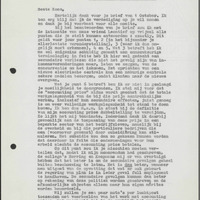
J. TINBERGEN Den Haag, 5 October 1954
Raamweg 18
De Heer Dr J.J. Polak,
International Monetary Fund,
1818 H. Street N.W.,
Washington D.C.
Beste Koos,
Hartelijk dank voor je brief van 1 October. Ik ben erg blij dat je de verdediging op je wil nemen en dank je bij voorbaat voor alle moeite.
Bij het beantwoorden van je brief zou ik met de intonatie van onze vriend Leontief op vrijwel alle punten die je stelt kunnen antwoorden : exactly. Dit geldt voor jouw punten 1, 2 (in het bijzonder je allerlaatste veronderstelling), 3 (waar ik dus ongelijk moet erkennen), 4 en 5. Wat 3 betreft heb ik me wel enigszins schuldig gemaakt aan onnauwkeurige terminologie; in feite heb ik hier wel gedacht aan secundaire verliezen die niet het gevolg zijn van inkomensveranderingen maar, laten we zeggen, van de concurrentie om het inkomen. Het oprichten van een nieuwe electrische centrale kan een naburige centrale zekere nadelen bezorgen, omdat klanten naar de nieuwe overgaan.
Wat je punt 6 betreft ben ik er niet in geslaagd je moeilijkheid te doorgronden. Ik stel mij voor dat de "accounting price" aldus wordt geschat dat de totale werkgelegenheid van de bij die prijs aantrekkelijke werken, inclusief hun secundaire effecten, juist genoeg is om weer volledige werkgelegenheid tot stand te doen komen. Ik ben dus m.a.w. in staat bij de definitie van mijn accounting price dubbeltelling te vermijden. Zo lijkt het mij tenminste. Inderdaad denk ik daarbij gewoonlijk aan de toepassing van deze prijs in een beperkte sector van het bedrijfsleven, namelijk bij de overheid en bij die particuliere bedrijven die men (voorzover gewenst) door subsidiëring kan stimuleren. Het subsidie zou dan zo gekozen kunnen worden dat daardoor in feite die ondernemingen voor hun arbeid slechts de accounting price betalen.
Op dit punt zou ik je misschien moeten vertellen dat, nadat ik mijn memorandum had geschreven, de collega's Horring en Koopmans mij er van overtuigd hebben dat het beter is om de secundaire gevolgen geheel buiten beschouwing te laten. Het is dan beter, wanneer men uitgaat van de opvatting dat wat er ook gebeurt de regering van plan is in ieder geval full employment te handhaven. De secundaire gevolgen kunnen dan beter op rekening van deze politiek worden geschreven en de afzonderlijke objecten alleen naar hun eigen mérites worden beoordeeld.
Wij zullen je een paar nota's per luchtpost toezenden met voorbeelden van het werk met accounting prices. Het voorbeeld dat in de praktijk het meeste is toegepast is de "rule of thumb" die t.a.v. de importen uit landen met zwakke valuta lange tijd is toegepast. Men voerde b.v. voedergranen uit zulke gebieden in tegen prijzen die nominaal tot 30% hoger mochten zijn dan de $-prijzen die men er mee uitspaarde. Uiteraard was dit cijfer intuïtief en niet exact berekend.
Hartelijk dank voor je gelukwensen. Ik ben natuurlijk zeer vereerd met deze Amsterdamse geste; een en ander belet echter niet dat het adres van ons bureau op de Raamweg is en niet op zijn Amsterdams op de Raamgracht, zoals je secretaresse nog steeds schijnt te menen!
Hartelijke groeten,
ook aan je familie.
-
en
J. TINBERGEN The Hague, 5 October 1954
Raamweg 18
Mr. Dr. J.J. Polak,
International Monetary Fund,
1818 H. Street N.W.,
Washington D.C.
Dear Koos,
Thank you very much for your letter of 1 October. I am very happy that you are willing to take on the defense and thank you in advance for all the effort.
In answering your letter, I could respond to almost all the points you raise with the intonation of our friend Leontief: exactly. This applies to your points 1, 2 (especially your very last assumption), 3 (where I must therefore admit to being wrong), 4 and 5. Regarding 3, I have indeed been somewhat guilty of inaccurate terminology; in fact, I was thinking here of secondary losses that are not the result of income changes but, let's say, of competition for income. The establishment of a new power station can cause certain disadvantages to a neighboring station because customers switch to the new one.
Regarding your point 6, I have not succeeded in fathoming your difficulty. I imagine that the "accounting price" is estimated such that the total employment of the works attractive at that price, including their secondary effects, is just enough to bring about full employment again. In other words, I am able to avoid double counting in the definition of my accounting price. At least, so it seems to me. Indeed, I usually think of the application of this price in a limited sector of business life, namely with the government and with those private companies that can be stimulated (as far as desired) through subsidization. The subsidy could then be chosen such that those companies in fact only pay the accounting price for their labor.
On this point, I should perhaps tell you that after I had written my memorandum, colleagues Horring and Koopmans convinced me that it is better to leave the secondary consequences entirely out of consideration. It is then better to proceed from the view that whatever happens, the government intends to maintain full employment in any case. The secondary consequences can then better be attributed to this policy and the individual objects judged only on their own merits.
We will send you a few notes by airmail with examples of work with accounting prices. The example most applied in practice is the "rule of thumb" that has been applied for a long time regarding imports from countries with weak currencies. For example, fodder grains were imported from such areas at prices that could be nominally up to 30% higher than the $ prices saved by them. Naturally, this figure was intuitive and not exactly calculated.
Thank you very much for your congratulations. I am of course very honored by this Amsterdam gesture; however, this does not prevent the address of our office from being on Raamweg and not, in Amsterdam style, on Raamgracht, as your secretary still seems to think!
Warm regards,
also to your family.