-
Title
-
Letter to W.P. Roelofs
-
Date
-
1954
-
Date in document
-
yes
-
Formulas or calculations
-
no
-
Inventory number
-
NL-RtEUR_TBCOR01_022R020
-
7417
-
Storage location
-
Specifiek Magazijn
-
Filename
-
CDM7417_NL-RtEUR_TBCOR01_022R020.pdf
-
Provenance
-
Jan Tinbergen
-
Accrual Method
-
donation
-
Rights
-

-
Revised transcript
-
ne
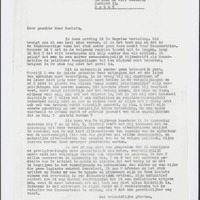
J. TINBERGEN DEN HAAG, 26 October 1954
Sijzenlaan 41
De Heer Dr W.P. Roelofs,
Kerkpad 53,
Soest
Zeer geachte Heer Roelofs,
In dank ontving ik Uw Engelse vertaling. Dit brengt ons al een heel eind verder, al is het toch nog zo, dat in de tegenwoordige vorm het stuk zeker geen kans maakt voor Econometrica. Wanneer ik U dat in de volgende regelen tracht uit te leggen, hoop ik dat U dat wilt beschouwen als hulp eerder dan als critiek. Ik geloof dat men in een zuiver wetenschappelijk tijdschrift als Econometrica de politieke toespelingen tot een minimum moet beperken, hetgeen in Uw stuk nog niet het geval is.
Dit is natuurlijk echter geen belangrijk punt. Terwijl U van de juiste gedachte bent uitgegaan dat er een lijst van symbolen moet voorafgaan, is de vraag bij mij opgekomen of de lezer niet iets meer inzicht moet hebben in de vergelijkingen en of U niet in plaats van alleen "some causal relationships" alle vergelijkingen zou moeten noemen. Dit laatste staat niet bij voorbaat vast, maar hangt natuurlijk met het betoog samen, dat hier en daar, althans voor mij, nog wel wat duister is. Ook is het mij niet helemaal duidelijk of U alles wat U aan definities en relaties vooropstelt inderdaad nodig hebt en aan de andere kant of alles wat U nodig hebt ook wel van tevoren wordt duidelijk gemaakt. Op blz. 4 heeft mijn eerste opmerking op een dergelijke keuze betrekking. Om een ander voorbeeld te geven: wordt er gebruik gemaakt van alle ongelijkheden die op blz. 5 gesteld worden?
Als kern van Uw bijdrage beschouw ik de opsomming onderaan blz 7 en op blz. 8. Hierbij treft het mij intussen dat de opsomming uit twee verschillende soorten van alternatieven schijnt te bestaan: aan de ene kant alternatieven ten aanzien van de structuur van de maatschappij (die men als gegeven zal willen beschouwen), en anderzijds alternatieven ten aanzien van de te volgen politiek. Mijns inziens moeten deze scherper gescheiden worden.
Ik heb er nog niet van gesproken dat ik overigens de gevolgtrekkingen maar gedeeltelijk kan maken, waarschijnlijk omdat niet het volledige stelsel van relaties is gegeven. Ik zou U willen aanbevelen de opsomming op blz. 7 en 8 tot het centrale gedeelte van Uw artikel te maken en slechts dat wat nodig is om dat te begrijpen in het voorafgaande te behandelen; dan echter op een wijze die geen logische schakel overslaat. Ik zou U afraden om het stuk critiek op Hicks er aan te hangen en uiteraard zijn de twee laatste zinnen ook overbodig in een econometrisch artikel. Mijn definitief oordeel zou ik nog moeten voorbehouden tot ik een definitieve uitgave heb, want ik moet bekennen dat mij toch nog niet alles duidelijk is. Intussen is het uiteraard Uw eigen recht om U rechtstreeks tot de redactie van Econometrica te wenden, als U dat een gemakkelijker weg vindt.
Met vriendelijke groeten,
-
en
J. TINBERGEN THE HAGUE, 26 October 1954
Sijzenlaan 41
Mr. Dr. W.P. Roelofs,
Kerkpad 53,
Soest
Dear Mr. Roelofs,
I received your English translation with thanks. This brings us quite a bit further, although it is still the case that in its present form the piece certainly stands no chance for Econometrica. When I try to explain this to you in the following lines, I hope that you will consider it as help rather than criticism. I believe that in a purely scientific journal like Econometrica, political allusions should be kept to a minimum, which is not yet the case in your piece.
This is, of course, not an important point. While you have started from the correct idea that a list of symbols should precede [the text], the question has occurred to me whether the reader should not have a bit more insight into the equations and whether you should not name all equations instead of only "some causal relationships". The latter is not fixed beforehand, but naturally depends on the argument, which here and there, at least for me, is still somewhat obscure. It is also not entirely clear to me whether you indeed need everything you put forward in terms of definitions and relations and, on the other hand, whether everything you need is also made clear beforehand. On page 4, my first remark relates to such a choice. To give another example: is use made of all the inequalities stated on page 5?
I consider the enumeration at the bottom of page 7 and on page 8 to be the core of your contribution. In the meantime, it strikes me that the enumeration seems to consist of two different types of alternatives: on the one hand, alternatives regarding the structure of society (which one will want to consider as given), and on the other hand, alternatives regarding the policy to be followed. In my view, these should be more sharply separated.
I have not yet mentioned that I can otherwise only partially draw the conclusions, probably because the complete system of relations is not given. I would like to recommend that you make the enumeration on pages 7 and 8 the central part of your article and only treat what is necessary to understand that in the preceding [part]; but then in a way that does not skip any logical link. I would advise you against attaching the piece of criticism on Hicks to it, and of course, the last two sentences are also redundant in an econometric article. I would still have to reserve my final judgment until I have a final edition, because I must confess that not everything is clear to me yet. In the meantime, it is of course your own right to turn directly to the editors of Econometrica, if you find that an easier way.
With kind regards,