-
Title
-
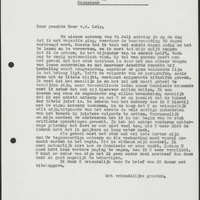
Letter to E.H.F. van der Lely
-
Description
-
Annex: corrections of a report of the Commissie uit de VIRO tot bestudering van het Plan Plesman.
-
Date
-
1954
-
Date in document
-
yes
-
Formulas or calculations
-
no
-
Inventory number
-
NL-RtEUR_TBCOR01_021L007
-
8006
-
Storage location
-
Specifiek Magazijn
-
Filename
-
CDM8006_NL-RtEUR_TBCOR01_021L007.pdf
-
Provenance
-
Jan Tinbergen
-
Accrual Method
-
donation
-
Rights
-

-
Revised transcript
-
ne
PROF. DR J. TINBERGEN DEN HAAG, 30 Juni 1954
Sijzenlaan 41
De Heer Dr E.H.F. v.d. Lely, Poortlaan 9, Wassenaar
Zeer geachte Heer v.d. Lely,
Uw nieuwe ontwerp van 14 Juli ontving ik op de dag dat ik met vacantie ging, waardoor de beantwoording 10 dagen vertraagd werd. Daarna had ik toch wel enkele dagen nodig om het te lezen en te verwerken, en ik moet tot mijn spijt zeggen dat ik de opbouw, in het bijzonder van de eerste helft, toch nog te weinig systematisch vind. Op tal van punten heeft men het gevoel dat het stuk ontstaan is door het aan elkaar voegen van losse onderdelen en dat daardoor dezelfde kwestie bij herhaling wordt aangesneden, waardoor er geen voldoende lijn in het betoog ligt. Zelfs de volgorde van de paragrafen, zoals deze uit de titels blijkt, vertoont enigermate ditzelfde gebrek. Ik weet dat het moeilijk is en het zal ook nooit geheel te vermijden zijn, maar verschillende leden onzer Commissie kennende weet ik zeker dat ook zij hierover zullen vallen. Ik zou daarom nog eens de omgekeerde weg willen bewandelen, namelijk dat ik een schets ontwerp en dat U er op toeziet dat de inhoud der titels juist is. De schets van het ontwerp doe ik U hierbij met Uw eigen ontwerp toekomen, in de hoop dat U zo vriendelijk wilt zijn, uitgaande van het eerste de vele nuttige onderdelen van het tweede in juistere volgorde te zetten. Voornamelijk om mijn oordeel te adstrueren heb ik in het begin van Uw stuk critische opmerkingen gemaakt. Ik heb dat echter verderop achterwege gelaten; het doet er ook niet veel toe, als U maar niet de indruk hebt dat ik spijkers op laag water zoek.
Als geheel moet het stuk ook wel iets korter zijn dan Uw tegenwoordige ontwerp en die verkorting moet vooral gezocht worden in het begin. Dit is althans mijn oordeel. Ik weet natuurlijk niet hoe de Commissie er over denkt. Indien U moed hebt deze verdere poging te wagen, ben ik U zeer verplicht. U kunt er zeker van zijn dat ik geen ander doel nastreef dan deze zaak zo goed mogelijk te behartigen.
Ik dank U vriendelijk voor Uw brief van 22 dezer met titelopgave.
Met vriendelijke groeten,
Ontwerp verslag van de Commissie uit de VIRO tot bestudering van het Plan Plesman
1. Opdracht en handelingen van de Commissie
Op de ..... werd door het Hoofdbestuur van de VIRO een commissie ingesteld met de opdracht een rapport uit te brengen over het plan van Dr Plesman tot internationale samenwerking, hetwelk door zijn auteur aan het Hoofdbestuur van de VIRO was voorgelegd. De samenstelling van de Commissie was als volgt: ..... . De Commissie heeft .... keer vergaderd en biedt hierbij haar rapport aan.
2. Achtergrond van het Plan Plesman
Het Plan Plesman is klaarblijkelijk ingegeven door de meer en meer duidelijk wordende urgentie van internationale activiteit op het gebied der economische ontwikkeling. De belangrijke krachten welke dit vraagstuk zo urgent maken, kunnen in het kort als volgt worden samengevat.
Er bestaat sedert geruime tijd een divergentie in de ontwikkeling van het levensniveau tussen de rijkere en de armere landen, welke de tendentie heeft sterker te worden. Daartegenover worden de internationale contrasten steeds geringer vooral door het toenemende verkeer en eveneens door de politieke propaganda die met name uitgaat van de communistisch georganiseerde landen. In ieder geval worden de volken der onderontwikkelde landen zich meer en meer bewust van de tegenstellingen. Het wordt onder deskundigen thans wel algemeen aanvaard dat de enige wijze waarop in dit dringende vraagstuk kan worden voorzien gelegen is in ontwikkelingsinvesteringen die internationaal gefinancierd worden. De deskundigen stellen ook dat het tempo waarin tot dusverre in deze richting wordt gewerkt te gering is. Het plan van Dr Plesman wil een bijdrage zijn tot het opvoeren van dit tempo. Het zoekt de oplossing in:
1. het creëren van een lichaam met een zekere autonomie;
2. het scheppen van garanties opdat de activiteiten van dit lichaam met grotere continuïteit kunnen worden gevoerd;
3. een vorm van organisatie waarvan hij als zakenman meende dat zij de voorkeur verdiende boven de in politieke sfeer gebruikelijke vormen van samenwerking.
3. Het Plan Plesman
Hier zou overeenkomstig pag. 4 van het thans voor ons liggende concept in het kort de inhoud van het Plan Plesman kunnen worden weergegeven. De indeling in ad 1 en ad 2 lijkt mij minder zinvol; het punt ad 2 is niet een onderdeel van het Plan Plesman, maar een feit dat reeds de basis vormt voor welke activiteit ook t.b.v. de ontwikkeling. Volstaan zou daarom kunnen worden met wat onder ad 1 is medegedeeld, wellicht op een enkel punt aangevuld.
4. De wenselijkheid van grotere activiteit en noodzakelijke organen op internationaal terrein
De Commissie deelt het inzicht van Dr Plesman door hem als uitgangspunt gekozen voor zijn plan, dat het zeer wenselijk is dat het ontwikkelingsproces geïntensiveerd wordt, alsmede het inzicht dat de bestaande internationale organen in dit opzicht onvoldoende zijn geëquipeerd. Bij het bespreken van de aanwezige en van de gewenste organen is het nuttig te onderscheiden tussen 3 elementen van de werkzaamheden, t.w. a. het bijeenbrengen van de financiële middelen, b. de besteding daarvan, en c. de uitvoering van de ontwikkelingswerken. De Commissie wil stellen dat het vanzelfsprekend is, dat de laatste functie verdeeld is over een groot aantal organen in vele landen en in vele bedrijfstakken en diensten. Zij meent aan de andere kant dat het voornaamste knelpunt inderdaad op het financiële terrein ligt, ook al zijn er plaatselijk en tijdelijk vaak andere knelpunten. Mede in verband met de daarvoor noodzakelijk bedragen meent de Commissie dan ook dat de hierboven onder a. genoemde functie op het ogenblik de meest urgente is, waarbij uiteraard de onder b. genoemde functie eveneens zal moeten worden uitgevoerd.
Wat nu het bijeenbrengen van de financiële middelen betreft, hiermede zijn thans belast een aantal nationale en imperiale instellingen, zoals de door de Verenigde Staten verstrekte hulp, het Colombo Plan, datgene dat door Frankrijk en België in hun eigen overzeese gebieden wordt gedaan, terwijl daarnaast de Technical Assistance Administration van de Verenigde Naties en de Internationale Bank werkzaam zijn. Daarbij is het budget van de Technical Assistance zeer beperkt, terwijl de Internationale Bank gebonden is aan haar statutaire verplichting haar kapitaal middelen te vinden op de vrije markt. In verband met een en ander is reeds geruime tijd gediscussieerd over de instelling van twee nieuwe internationale organen, t.w. het SUNFED and the International Finance Corporation. Tot op heden zijn deze echter nog niet tot activiteit gekomen, voornamelijk omdat de Verenigde Staten hun medewerking afhankelijk gesteld hebben van een vermindering der militaire uitgaven.
Tegen de achtergrond van deze activiteiten heeft de Commissie getracht het Plan Plesman te beoordelen.
5. De in het Plan Plesman voorgestelde organisatievorm
Ten aanzien van de in het Plan Plesman voorgestelde organisatievorm heeft de Commissie overwegende bezwaren. Zij is van mening dat in elke instelling van internationaal of supernationaal karakter, evenzeer als van nationaal karakter, welke in belangrijke mate openbare middelen verbruikt en activiteiten heeft te ontwikkelen in het algemeen belang, parlementaire contrôle een conditio sine qua non is. Zij meent dan ook dat niet te ontkomen is aan de noodzaak dat een internationale ontwikkelingsraad verantwoording zou moeten afleggen van zijn beleid voor een internationale vergadering van afgevaardigden en ziet de afwezigheid van een dergelijke contrôle in het Plan Plesman als een onoverkomelijk bezwaar.
6. Hoe kan het doel dat Dr Plesman nastreefde, het best worden verwezenlijkt?
(Aansluiting bij bestaande bestrevingen)
7. Het voornaamste knelpunt: bereidheid der ontwikkelde landen
(kan heel kort zijn)
8. Voorlichting en research
(Uw par. 9)
9. Kan de Nederlandse regering ten deze iets doen?
Dit worde zorgvuldig overwogen. Zij zou in elke geval het Dr Plesman-fonds een subsidie kunnen geven.
10. Conclusies
-
en
PROF. DR J. TINBERGEN THE HAGUE, 30 June 1954
Sijzenlaan 41
Mr. Dr E.H.F. v.d. Lely, Poortlaan 9, Wassenaar
Dear Mr. v.d. Lely,
I received your new draft of 14 July on the day I went on vacation, which delayed the reply by 10 days. After that, I still needed a few days to read and process it, and I must say to my regret that I still find the structure, especially of the first half, too unsystematic. At many points, one has the feeling that the piece was created by joining separate parts together and that as a result the same issue is raised repeatedly, so that there is no sufficient line in the argument. Even the order of the paragraphs, as appears from the titles, shows this same defect to some extent. I know it is difficult and it will never be entirely avoidable, but knowing various members of our Commission, I am sure that they too will take issue with this. I would therefore like to try the reverse approach once more, namely that I sketch a draft and that you ensure that the content of the titles is correct. I am enclosing the sketch of the draft with your own draft, in the hope that you will be so kind as to put the many useful parts of the second into a more correct order, starting from the first. Mainly to substantiate my judgment, I have made critical remarks at the beginning of your piece. However, I have omitted that further on; it doesn't matter much either, as long as you don't have the impression that I am nitpicking.
As a whole, the piece must also be somewhat shorter than your current draft and that shortening must mainly be sought at the beginning. This is at least my opinion. I do not know, of course, how the Commission thinks about it. If you have the courage to venture this further attempt, I would be very much obliged to you. You can be sure that I pursue no other goal than to promote this matter as well as possible.
I thank you kindly for your letter of the 22nd of this month with the list of titles.
With kind regards,
Draft report of the Commission from the VIRO for the study of the Plesman Plan
1. Mandate and actions of the Commission
On the ..... a commission was established by the Board of the VIRO with the mandate to issue a report on the plan of Dr Plesman for international cooperation, which had been submitted by its author to the Board of the VIRO. The composition of the Commission was as follows: ..... . The Commission has met .... times and hereby presents its report.
2. Background of the Plesman Plan
The Plesman Plan was clearly inspired by the increasingly evident urgency of international activity in the field of economic development. The important forces that make this issue so urgent can be briefly summarized as follows.
There has been a divergence for some time in the development of the standard of living between the richer and the poorer countries, which tends to become stronger. In contrast, international contrasts are becoming increasingly smaller, especially due to increasing traffic and also due to political propaganda emanating in particular from the communistically organized countries. In any case, the peoples of the underdeveloped countries are becoming more and more aware of the contradictions. It is now generally accepted among experts that the only way in which this urgent issue can be addressed lies in development investments that are internationally financed. The experts also state that the pace at which work has been done in this direction so far is too low. Dr Plesman's plan aims to be a contribution to increasing this pace. It seeks the solution in:
1. the creation of a body with a certain autonomy;
2. the creation of guarantees so that the activities of this body can be carried out with greater continuity;
3. a form of organization which he, as a businessman, believed deserved preference over the forms of cooperation customary in the political sphere.
3. The Plesman Plan
Here, in accordance with page 4 of the draft currently before us, the content of the Plesman Plan could be briefly presented. The division into ad 1 and ad 2 seems less meaningful to me; point ad 2 is not a part of the Plesman Plan, but a fact that already forms the basis for any activity also for the benefit of development. It would therefore suffice to state what is reported under ad 1, perhaps supplemented on a single point.
4. The desirability of greater activity and necessary organs in the international field
The Commission shares the insight of Dr Plesman chosen by him as a starting point for his plan, that it is very desirable that the development process be intensified, as well as the insight that the existing international organs are insufficiently equipped in this respect. In discussing the existing and the desired organs, it is useful to distinguish between 3 elements of the activities, namely a. the raising of financial resources, b. the spending thereof, and c. the execution of the development works. The Commission wishes to state that it is self-evident that the latter function is divided among a large number of organs in many countries and in many branches of industry and services. On the other hand, it believes that the main bottleneck indeed lies in the financial field, even though there are often other bottlenecks locally and temporarily. Partly in connection with the amounts necessary for this, the Commission therefore believes that the function mentioned above under a. is currently the most urgent, whereby the function mentioned under b. will of course also have to be carried out.
As for the raising of financial resources, a number of national and imperial institutions are currently charged with this, such as the aid provided by the United States, the Colombo Plan, that which is done by France and Belgium in their own overseas territories, while in addition the Technical Assistance Administration of the United Nations and the International Bank are active. In addition, the budget of Technical Assistance is very limited, while the International Bank is bound by its statutory obligation to find its capital resources on the free market. In connection with all this, the establishment of two new international organs has been discussed for some time, namely the SUNFED and the International Finance Corporation. To date, however, these have not yet come into activity, mainly because the United States has made its cooperation dependent on a reduction in military spending.
Against the background of these activities, the Commission has tried to evaluate the Plesman Plan.
5. The organizational form proposed in the Plesman Plan
With regard to the organizational form proposed in the Plesman Plan, the Commission has major objections. It is of the opinion that in every institution of an international or supranational character, as well as of a national character, which consumes public resources to a significant extent and has to develop activities in the general interest, parliamentary control is a conditio sine qua non. It therefore believes that there is no escaping the necessity that an international development council should have to account for its policy to an international assembly of delegates and sees the absence of such control in the Plesman Plan as an insurmountable objection.
6. How can the goal that Dr Plesman pursued best be achieved?
(Connection with existing efforts)
7. The main bottleneck: willingness of the developed countries
(can be very short)
8. Information and research
(Your par. 9)
9. Can the Dutch government do anything in this regard?
This should be carefully considered. It could in any case give a subsidy to the Dr Plesman fund.
10. Conclusions
-
annexCount
-
1