-
Title
-
Letter to E.P. Wellenstein
-
Date
-
1953
-
Date in document
-
yes
-
Formulas or calculations
-
no
-
Inventory number
-
NL-RtEUR_TBCOR01_019C018
-
3655
-
Storage location
-
Specifiek Magazijn
-
Filename
-
CDM3655_NL-RtEUR_TBCOR01_019C018.pdf
-
Provenance
-
Jan Tinbergen
-
Accrual Method
-
donation
-
Rights
-

-
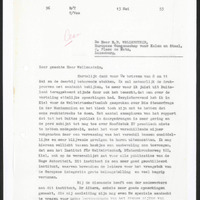
Revised transcript
-
ne
22
96 D/T 13 Mei 53
T/Vos
Cees
De Heer E.P. WELLENSTEIN, Europese Gemeenschap voor Kolen en Staal, 2, Place de Metz, Luxemburg.
Zeer geachte Heer Wellenstein,
Hartelijk dank voor Uw brieven van 8 en 11 Mei en de daarbij behorende stukken. Ik zal natuurlijk de drukproeven met aandacht bekijken, te meer waar ik juist uit Duitsland teruggekeerd zijnde daar ook heb bemerkt, dat men over de vertaling ettelijke opmerkingen had. Eergisteravond heb ik in Kiel voor de Weltwirtschaftsclub gesproken over Die Steuerfrage in der Montanunion en het bleek toch zijn nut te hebben dat eens rechtstreeks te doen. Het aantal exemplaren van het rapport dat tot het Duitse publiek is doorgedrongen is zeer gering en de pers schijnt tot nog toe over Hoofdstuk IV practisch niets te hebben medegedeeld, zodat het voor verschillende mijner vakgenoten daar een verrassing was het verschil tussen onmiddellijke en meer blijvende gevolgen te horen uiteenzetten. Ik mag hieraan wellicht tussen haakjes een aanbeveling aan toevoegen, dat men het Institut für Weltwirtschaft, Düsternbrookerweg 120, Kiel, ook op de verzendlijst zet voor alle publicaties van de Hoge Autoriteit. Dit instituut is een zeer goed geoutilleerd instituut, waarvan bovendien de leiders voor het vraagstuk van de Europese integratie grote belangstelling en veel begrip vertonen.
Bij de discussie heeft een der medewerkers aan dit instituut, Dr Albers, enkele zeer goede opmerkingen gemaakt, die mij aanleiding zijn nog even Uw speciale aandacht te vragen voor onze berekeningen van het Franse cijfer van
2.
29%. De heer Albers, die zich zeer in detail met de Franse belastingdruk op staal schijnt te hebben bezig gehouden, was uitdrukkelijk van mening, dat de door ons berekende secundaire invloed van resp. 4,4 en 5% (de rode cijfers in de tabel "Knüppel") aanmerkelijk te hoog zou zijn. Waar de heer Baré en U zich in deze zaken beter verdiept hebben dan ik, zou ik in elk geval Uw reactie hierop graag kennen. De heer Albers maakt op mij een zeer serieuze indruk en meende met name dat enkele der belastingen van cumulatief karakter, waarom het hier gaat, op staal niet toepasselijk zouden zijn, omdat zij in het bijzonder bij handelstransacties optreden; hij kon zich moeilijk voorstellen dat de belastingen op diensten en productiemiddelen aan deze betrekkelijk hoge cijfers debet konden zijn.
Bij voorbaat hartelijk dank,
met vriendelijke groeten,
(J. Tinbergen)
-
en
22
96 D/T 13 May 53
T/Vos
Cees
Mr. E.P. WELLENSTEIN, European Coal and Steel Community, 2, Place de Metz, Luxembourg.
Dear Mr. Wellenstein,
Thank you very much for your letters of May 8 and 11 and the accompanying documents. I will, of course, look at the proofs carefully, especially since I have just returned from Germany and noticed there that people had several remarks about the translation. The night before last, I spoke in Kiel for the World Economy Club on "The Tax Question in the Coal and Steel Community," and it turned out to be useful to do so directly. The number of copies of the report that have reached the German public is very small, and the press seems to have reported practically nothing about Chapter IV so far, so it was a surprise for several of my colleagues there to hear the difference between immediate and more permanent consequences explained. I might perhaps add a recommendation in parentheses here, that the Institute for the World Economy, Düsternbrooker Weg 120, Kiel, also be put on the mailing list for all publications of the High Authority. This institute is a very well-equipped institute, whose leaders, moreover, show great interest and much understanding for the issue of European integration.
During the discussion, one of the staff members at this institute, Dr. Albers, made some very good remarks, which give me reason to ask for your special attention for a moment for our calculations of the French figure of
2.
29%. Mr. Albers, who seems to have been very detailedly occupied with the French tax burden on steel, was explicitly of the opinion that the secondary influence calculated by us of 4.4 and 5% respectively (the red figures in the "Knüppel" table) would be considerably too high. Since Mr. Baré and you have delved deeper into these matters than I have, I would in any case like to know your reaction to this. Mr. Albers makes a very serious impression on me and believed in particular that some of the taxes of a cumulative nature, which are at issue here, would not be applicable to steel, because they occur particularly in commercial transactions; he could hardly imagine that the taxes on services and means of production could be responsible for these relatively high figures.
Thank you in advance,
with kind regards,
(J. Tinbergen)