-
Title
-
Letter to Oskar Morgenstern
-
Date
-
1954
-
Date in document
-
yes
-
Formulas or calculations
-
no
-
Inventory number
-
NL-RtEUR_TBCOR01_021M040
-
9223
-
Storage location
-
Specifiek Magazijn
-
Filename
-
CDM9223_NL-RtEUR_TBCOR01_021M040.pdf
-
Provenance
-
Jan Tinbergen
-
Accrual Method
-
donation
-
Rights
-

-
Revised transcript
-
en
PROF. DR J. TINBERGEN THE HAGUE, 20 August 1954
Sijzenlaan 41
289
Professor Oskar Morgenstern,
152, Westcott Road,
Princeton New Jersey
USA
Dear Morgenstern,
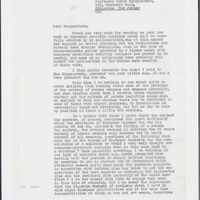
Thank you very much for sending me your new book on Economic Activity Analysis which will be carefully studied by my collaborators, who at this moment are engaged in detail planning for the Netherlands and already used similar techniques. Also in the case of macro-economic policy problems in a linear model with boundary conditions activity analysis has proved to be useful, and some of my colleagues here probably will submit for publication in the future some results of their work.
I also gladly remember the visit I paid to Mrs Morgenstern, yourself and your little son. It was a very pleasant day for me.
This time I am writing to you about quite another subject. When reading about some of the problems of the control of atomic weapons and weapons generally, and when hearing about them I several times wondered whether not the methods of modern logistics could also be applied to find out whether there may be solutions to some of these very urgent problems. My formulation is necessarily vague and defective, but let me try to make my position at least a little bit clearer.
In a recent talk which I heard about the subject the speaker, of course, mentioned the great difficulty which the existence of distrust between the two big powers, US and SU, causes to the finding of a scheme for control. For obvious reasons in addition the SU wants control of atomic weapons only whereas the US wants control of all weapons. Questions of the following kind come up: Is the element of distrust decisive for the non-existence of a solution or would a very well thought out technico-juridical analysis even in this case lead to a solution? More generally speaking, I am thinking of the type of analysis which e.g. Arrow presented when dealing with the problem of social welfare functions. My question to you is whether the US Government which evidently spends quite some money for research projects in connection with defence also has tried to get the co-operation of the best experts in analyzing the diplomatic side and the juridical side generally of the world conflict? I do not myself feel able to engage very much in this type of research, but I am under the impression that the rigorous thought of analysis which I have in mind might disclose possibilities and at the same time impossibilities of which we are not yet aware. Sometimes
XXX sort
-2-
official diplomacy gives the impression of using quite a bit of antiquated thinking but I cannot really prove the charge. The problems involved seem so vital that even the throwing away of a few millions of dollars would of course not count. My curiosity is whether your people, who in different functions have contacts with the highest authorities in the US Government, are confident that they have the best experts at their disposal not only in the field of atomic energy itself and warfare itself, but also in the field I indicated. When being in Princeton I tried to pay a visit to your colleague Kennan, and I would have liked to submit this question, among other things, also to him. I do not know if you have any contact with him and what his interest in modern logistics would be, but I do think that the question is extremely important, and I would very much appreciate any news you could tell me about it. Apart from this I would of course appreciate also very much having your opinion about what I said in this letter.
With many thanks beforehand and my best regards to Mrs Morgenstern and yourself,
yours very sincerely,