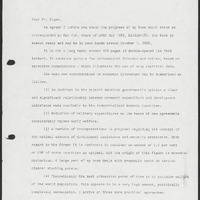
Letter to Edward Elgar
- Title
- Letter to Edward Elgar
- Description
- Letter to the publisher of World security and equity. See also E.1.16-35 and E.1.16-36.
- Recipient
- Elgar, Edward
- Organisation
- Edward Elgar Publishing
- Language
- English
- City
- Den Haag
- Date
- 1988
- Date in document
- yes
- Formulas or calculations
- no
- Inventory number
- NL-RtEUR_TBCOR_E.1.16-34
- 1036
- Storage location
- Specifiek Magazijn
- Filename
- CDM1036_NL-RtEUR_TBCOR_E.1.16-34.pdf
- Provenance
- Jan Tinbergen
- Accrual Method
- donation
- Rights
-

- Revised transcript
-
en
Prof. J. TINBERGEN
2566 XD DEN HAAG, August 10, 1988
HAVIKLAAN 31
TELEFOON 070 - 644630
Dear Mr. Elgar,
As agreed I inform you about the progress of my book about which we corresponded in May (cf. yours of 24th May 1988, EE/SIH/98). The book is almost ready and may be in your hands around October 1, 1988.
It is not a long text: around 150 pages A4 double-spaced (as this letter). It contains quite a few mathematical formulae and tables, based on extensive computations - which illustrate the use of many empirical data.
Its main new contributions to economic literature may be summarised as follows.
(1) In contrast to the present American government's opinion a clear and significant relationship between armament expenditure and development assistance made available by the industrialised Western countries.
(2) Reduction of military expenditures on the basis of new agreements considerably raises world welfare.
(3) A variety of interpretations is proposed regarding the concept of the optimal amounts of development assistance and security assistance. With regard to the former it is customary to consider an amount of 0.7 per cent of GNP of donor countries as optimal. But the origin of this figure is somewhat mysterious. A large part of my book deals with proposals based on various clearer starting points.
(4) Theoretically the most attractive point of view is to maximise welfare of the world population. This appears to be a very high amount, politically completely unrealistic. I arrive at three more practical approaches.
- 2 -
(5) One is to reduce the income inequality now existing in the non-communist world to the inequality attained in the First World as a consequence of social security systems built up in the last century.
(6) A second approach is to aim at a doubling of the income of the Third World (as a ratio to that of the First World) in a few decades, which constitutes a perspective to the poverty-stricken continents. Both approaches have been analysed very concretely with the aid of data and studies made for the World Bank.
The results show that the 0.7 target is too low and should be doubled or trebled at least.
(7) In a further analysis I also show that some differentiation of the aid percentage between donor countries is conceivable, depending on their own real per capita income.
As I wrote you before the idiom of my text will need editing.
If you are still interested in the book I look forward to hearing from you about a possible contract.
With best wishes I am
Yours sincerely,
(J. Tinbergen)
- Item sets
- Tinbergen Letters Sent