-
Title
-
Letter to L.J. Zimmerman
-
Date
-
1951
-
Date in document
-
yes
-
Formulas or calculations
-
yes
-
Inventory number
-
NL-RtEUR_TBCOR01_015W027
-
3084
-
Storage location
-
Specifiek Magazijn
-
Filename
-
CDM3084_NL-RtEUR_TBCOR01_015W027.pdf
-
Provenance
-
Jan Tinbergen
-
Accrual Method
-
donation
-
Rights
-

-
Revised transcript
-
ne
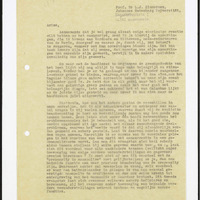
TINBERGEN DEN HAAG, 15 October 1951
Sijzenlaan 41
Prof. Dr L.J. Zimmerman,
Johannes Gutenberg Universität,
Lennebergplatz 5
MAINZ Gonsenheim
Amice,
Aannemende dat je wel graag alvast enige voorlopige reactie wilt hebben op het manuscript, zend ik je hierbij de opmerkingen, die ik tevens aan Verdoorn en Witteveen, mede-redacteuren van de Serie, doorgeef en waarop je, dunkt mij, pas behoeft te reageren, wanneer ook hun opmerkingen binnen zijn. Het kan toch immers zijn dat zij menen, dat sommige van mijn opmerkingen ten onrechte zijn gemaakt, terwijl ik in andere opzichten onvolledig kan zijn geweest.
Om maar met de hoofdzaak te beginnen: de grondgedachte van het boek lijkt mij nog altijd in hoge mate belangrijk en stimulerend. Verder ben je er in geslaagd om een bijzonder aangenaam leesbaar geheel te bieden, waarvan, voor zover ik kan zien, ook het Engelse idioom geen nadere correctie behoeft en naar mijn smaak bijzonder goed is. Je hebt dus in elk geval naar het mij voorkomt een gelukkige greep gedaan en zoals het meer gaat met belangrijke dingen, iets wat achteraf het ei van Columbus lijkt op de juiste wijze gesteld en voor zover ik kan zien naar de hoofdzaken juist uitgewerkt.
Niettemin, hoe zou het anders gezien de verschillen in onze werkwijze, heb ik als schoolmeester en ambtenaar een aantal vragen in mij voelen opkomen, waarvan dunkt mij de expliciete beantwoording je boek op verschillende punten nog ten goede zou kunnen komen. Deze laten zich onder één hoofd samenvatten: het problemencomplex dat je behandelt kan, als ik het goed zie, worden opgebouwd uit een aantal met elkaar samenhangende deelproblemen, waarvan het de moeite waard is dat zij afzonderlijk worden genoemd en scherp gesteld. Laat ik daarvan enkele voorbeelden mogen noemen. Enerzijds is er sprake van de voordelen gelegen in het omzetten van een markt met concurrentie in een gemonopoliseerde markt. Zou men dit vraagstuk niet heel scherp aldus kunnen stellen: bij welke gegeven waarde van ?d en ?s laat zich dit voordeel voor alle aanbieders tezamen (wellicht onder toevoeging van enige verdere veronderstellingen en gegevens) precies berekenen? Ik weet niet of men dit voordeel met de "propensity to monopolise" moet gelijkstellen; zo ja, dan zou bedoelde functie een meer preciese benadering van de propensity zijn. Daarnaast echter zal meespelen de vraag, welk voordeel er voor een buitenstaander in gelegen is van een eenmaal gevestigde monopolie te profiteren en dus ook welke kracht tot ondergraving van het monopolie er daardoor bestaat. Dit tweede vraagstuk laat zich evenzeer volkomen scherp definiëren en berekenen, zij het eveneens onder toevoeging van bepaalde verdere veronderstellingen omtrent kosten- en mogelijke andere functies.
- 2 -
Op blz. 46 e.v. wordt gesproken over "the dynamics of the market structures". Ik kan me hier twee verschillende groepen van verschijnselen bij denken. Ten eerste kan ik me denken dat de grootten van ?d en ?s op zichzelf reeds bepaalde bewegingsverschijnselen in de marktstructuur tot gevolg hebben, b.v. een monopolisatie. Daarnaast kan ik mij indenken dat wijzigingen in deze elasticiteiten, zoals jezelf er enige aanwijst, ook verdere wijzigingen in de marktstructuur meeslepen. Het eerste zou te vergelijken zijn met een endogene beweging van de marktstructuur, het tweede met een exogene. Is het niet nuttig ook hier volkomen klare wijn te schenken?
Bij je bespreking van de samenhang tussen marktstabiliteit en marktstructuur ga je bij de eerste helemaal uit van de dynamica behorende bij het spinneweb theorema, waaraan je enkele nieuwe gevallen toevoegt (staircase). Het is mij niet geheel duidelijk geworden of niet de dynamica behorende bij Marshall's veronderstellingen tot een andere correspondentie leidt; wat je daarover zegt blijft zeer summier. Wat betekent daarbij overigens ?p / ?q? Deze uitdrukking is, zoals wij weten, niet slechts afhankelijk van de twee elasticiteiten, doch ook van de verhouding van de grootte van de shifts in vraag- en aanbodlijn en dus geen "eenduidige" functie van de elasticiteit alleen. Ook hier is, dunkt mij, een verscherping van de probleemstelling zeer nuttig te achten.
Dit zijn de principiële opmerkingen. Verder zijn er een aantal detailopmerkingen, die ik voor ons aller gemak maar even in een lijstje laat volgen:
pag. 4 "amount of buyers" moet m.i. zijn "number of buyers". Dit komt op enige verdere bladzijden een paar keer terug, o.a. op pag. 18 en 19;
pag. 20 e.v. overal ware i.p.v. de ? de ronde ? te gebruiken;
pag. 24 er is een zekere verwarring inzake mintekens ontstaan. Enerzijds moet in tabel 3 voor elk der gedeelten een minteken worden gezet, anderzijds zijn m.n. op pag. 27, o.a. bij alle ongelijkheden daar genoemd, de mintekens aan de verkeerde kant gezet;
pag. 29 de eerste formule moet links luiden p/m i.p.v. p/q. Op deze pagina wordt het typisch van grote betekenis scherp te stellen wat b.v. p hier betekent. Is het de prijs bij monopolie? En is het niet goed voor de prijs bij concurrentie een apart symbool toe te voegen? De discussie van de vergelijkingen op pag. 29 is daardoor vermoedelijk ook onduidelijk, omdat de elasticiteiten toch vermoedelijk als gegevens worden beschouwd en men dan maar niet kan zeggen dat bepaalde uitdrukkingen met die elasticiteiten er in een zekere getallenwaarde moeten hebben;
pag. 29 t.av. de landbouwelastieiteiten is het misschien nog van belang op te merken dat deze voor de landbouw als geheel waarschijnlijk veel kleiner zijn dan voor een afzonderlijk product;
- 3 -
pag. 35 hier wordt aangekondigd de behandeling van de kostenelasticiteit in afhankelijkheid van de aanbodelasticiteit. Deze laatste komt echter in de formule in het geheel niet ter sprake en wel plotseling in de conclusies;
pag. 43 m.i. moet in de formule geheel onderaan ook weer het minteken aan de rechterkant staan. Heb ik dit verkeerd begrepen?
pag. 44 dezelfde vragen als op pag. 29;
pag. 47 is het niet beter om bij a) te zetten "discourages monopoly conditions" i.p.v. "favours competitive conditions", want is het niet zo dat alleen het proces naar het monopolie toe werkelijk activiteit inhoudt, terwijl de omgekeerde weg min of meer een passiviteit representeert?
pag. 49 regel 8 van onderen. Moet het laatste woord niet zijn "inelastic"?
pag. 55 regel 4 achter "quadrant" te schrijven: "of the ?d - ?s-plane";
pag. 60 regel 3 van onderen: moet dit niet zijn ?q / ?p?
Ik zou graag aan de andere redacteuren overlaten of men meent dat t.o.v. al deze punten wijzigingen van het manuscript wenselijk geacht worden. Ik kan mij ook best indenken dat zij menen dat dit aan jezelf moet worden overgelaten, maar ik heb je in ieder geval mijn blijk van belangstelling in deze werkelijk originele ontwikkeling willen geven.
Met hartelijke groeten,
-
en
TINBERGEN THE HAGUE, 15 October 1951
Sijzenlaan 41
Prof. Dr L.J. Zimmerman,
Johannes Gutenberg University,
Lennebergplatz 5
MAINZ Gonsenheim
Amice,
Assuming that you would like to have some preliminary reaction to the manuscript, I am sending you herewith the comments, which I am also passing on to Verdoorn and Witteveen, co-editors of the Series, and to which, it seems to me, you only need to respond once their comments are also in. After all, it may be that they believe some of my comments were made unjustly, while I may have been incomplete in other respects.
To start with the main point: the basic idea of the book still seems to me to be highly important and stimulating. Furthermore, you have succeeded in offering a particularly pleasantly readable whole, of which, as far as I can see, the English idiom also requires no further correction and is particularly good to my taste. You have therefore, in any case, it seems to me, made a fortunate choice and, as is often the case with important things, something that in hindsight seems like the egg of Columbus, correctly posed and, as far as I can see, correctly worked out in its main points.
Nevertheless, how could it be otherwise given the differences in our working methods, as a schoolmaster and civil servant, a number of questions have arisen in me, the explicit answering of which, it seems to me, could still benefit your book on several points. These can be summarized under one heading: the complex of problems you deal with can, if I see it correctly, be built up from a number of interrelated sub-problems, which are worth mentioning separately and stating sharply. Let me mention a few examples. On the one hand, there is talk of the advantages inherent in converting a market with competition into a monopolized market. Could this issue not be posed very sharply as follows: at what given value of ?d and ?s can this advantage for all suppliers together (perhaps with the addition of some further assumptions and data) be precisely calculated? I do not know whether this advantage should be equated with the "propensity to monopolise"; if so, then the function in question would be a more precise approximation of the propensity. In addition, however, the question will play a role as to what advantage there is for an outsider to profit from a once established monopoly and thus also what force for undermining the monopoly exists as a result. This second problem can also be defined and calculated perfectly sharply, albeit also with the addition of certain further assumptions regarding cost and possible other functions.
- 2 -
On page 46 et seq., "the dynamics of the market structures" is discussed. I can think of two different groups of phenomena here. Firstly, I can imagine that the magnitudes of ?d and ?s in themselves already result in certain movement phenomena in the market structure, e.g., a monopolization. In addition, I can imagine that changes in these elasticities, as you yourself point out some, also drag along further changes in the market structure. The first would be comparable to an endogenous movement of the market structure, the second to an exogenous one. Is it not useful to speak plainly here as well?
In your discussion of the connection between market stability and market structure, you start entirely from the dynamics belonging to the cobweb theorem, to which you add some new cases (staircase). It has not become entirely clear to me whether the dynamics belonging to Marshall's assumptions do not lead to a different correspondence; what you say about that remains very summary. What, moreover, does ?p / ?q mean there? This expression is, as we know, not only dependent on the two elasticities, but also on the ratio of the size of the shifts in demand and supply lines and thus not a "unique" function of elasticity alone. Here too, it seems to me, a sharpening of the problem statement is to be considered very useful.
These are the principal remarks. Furthermore, there are a number of detailed remarks, which I will list below for our collective convenience:
page 4 "amount of buyers" should in my opinion be "number of buyers". This recurs a few times on some further pages, including on pages 18 and 19;
page 20 et seq. everywhere the round ? should be used instead of the ?;
page 24 a certain confusion regarding minus signs has arisen. On the one hand, a minus sign must be placed in table 3 for each of the sections; on the other hand, particularly on page 27, among others in all inequalities mentioned there, the minus signs are placed on the wrong side;
page 29 the first formula on the left should read p/m instead of p/q. On this page it is typically of great importance to define sharply what, for example, p means here. Is it the price under monopoly? And would it not be good to add a separate symbol for the price under competition? The discussion of the equations on page 29 is therefore probably also unclear, because the elasticities are probably considered as given data and one cannot then just say that certain expressions with those elasticities in them must have a certain numerical value;
page 29 regarding agricultural elasticities, it might still be important to note that these for agriculture as a whole are probably much smaller than for an individual product;
- 3 -
page 35 here the treatment of cost elasticity in dependence on supply elasticity is announced. The latter, however, is not mentioned at all in the formula and then suddenly appears in the conclusions;
page 43 in my opinion, the minus sign should also be on the right side in the formula at the very bottom. Have I misunderstood this?
page 44 the same questions as on page 29;
page 47 is it not better to put under a) "discourages monopoly conditions" instead of "favours competitive conditions", for is it not the case that only the process towards monopoly actually involves activity, while the reverse path represents more or less a passivity?
page 49 line 8 from the bottom. Should the last word not be "inelastic"?
page 55 line 4 after "quadrant" write: "of the ?d - ?s-plane";
page 60 line 3 from the bottom: should this not be ?q / ?p?
I would like to leave it to the other editors whether they think that changes to the manuscript are desirable in view of all these points. I can also well imagine that they think this should be left to you, but in any case I wanted to give you my expression of interest in this truly original development.
With kind regards,