-
Title
-
Letter to F. van der Vliet
-
Date
-
1953
-
Date in document
-
yes
-
Formulas or calculations
-
no
-
Inventory number
-
NL-RtEUR_TBCOR01_019K030
-
6048
-
Storage location
-
Specifiek Magazijn
-
Filename
-
CDM6048_NL-RtEUR_TBCOR01_019K030.pdf
-
Provenance
-
Jan Tinbergen
-
Accrual Method
-
donation
-
Rights
-

-
Revised transcript
-
ne
168 D/T 18 Juli 53
De Heer F. van der Vliet, Coördinator van de K.L.M., Badhuisweg 260, 's-Gravenhage
Zeer geachte Heer Van der Vliet,
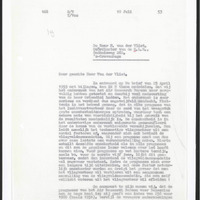
In antwoord op Uw brief van 25 April 1953 met bijlagen, kan ik U thans mededelen, dat wij het onderzoek van het Air Research Bureau zeer zorgvuldig hebben getoetst en daarbij veel medewerking van de heer Orlandini hebben gehad. Het onderzoek is zeer serieus en verdient dus ongetwijfeld aandacht. Niettemin is het bekend genoeg, dat in elke prognose van het luchtvaartverkeer door de aard van het vraagstuk grote onzekerheidsmarges optreden, waardoor toch een zekere mate van voorzichtigheid bij het gebruik van de resultaten noodzakelijk is. De onzekerheid is in het onderhavige onderzoek enigermate gecamoufleerd door de keuze van de verklarende verschijnselen. Men leidt namelijk het toekomstige vliegverkeer uit een aantal factoren af, waaronder zich ook bevindt de vliegveldaccommodatie. Bij een prognose moet men dus over deze laatste een veronderstelling maken. Hierin schuilt dezelfde onzekerheid als in alle prognoses en dit zou de argeloze lezer weleens over het hoofd kunnen zien. Voor prognoses op wat kortere termijn, zoals bv. voor de eerste vijf jaar, lijkt dit geen bezwaar, omdat dan inderdaad de vliegveldaccommodatie wel ongeveer vaststaat. Zodra de prognoses zich over een langere tijd uitstrekken, zal deze factor natuurlijk onzekerder worden en dreigt het gevaar dat men het vliegverkeer wil verklaren uit een aangenomen aanvulling van de vliegveldaccommodatie, die men zelf wellicht wederom uit het vliegverkeer wil afleiden!
Om concreet te zijn menen wij, dat de prognoses van het Air Research Bureau voor Beneswiss aan de hoge kant is; zij geeft een index van 258 voor 1960 (basis 1951), terwijl de vroegere onderzoekingen van het Nederlandsch Economisch Instituut en de Stichting Economisch Onderzoek voor 1970 een cijfer van 400 geven. Deze laatste waren reeds bedoeld als maximum schattingen; zou men een stijging van 1 op 2 1/2 per 10 jaar nemen, dan komt men echter reeds op boven 6 voor 20 jaar. Deze neiging tot hoge cijfers schijnt enige samenhang te vertonen met het feit, dat voorzover wij kunnen nagaan ook de elasticiteit van de vraag door het Air Research Bureau nogal hoog wordt geschat, nl. op 2, hetgeen, zoals U weet, wil zeggen, dat een tariefdaling van 10% zou leiden tot 20% meer vervoer. Naar voorlopig inzicht van het C.P.B. is een cijfer van 1,3 à 1,5 wellicht beter. Ook het C.P.B. echter is er zich van bewust, dat er grote onzekerheidsmarges in al deze cijfers steken.
In de hoop U hiermede van dienst te zijn geweest verblijf ik
met de meeste hoogachting,
(J. Tinbergen)
-
en
168 D/T 18 July 53
Mr. F. van der Vliet, Coordinator of the K.L.M., Badhuisweg 260, The Hague
Dear Mr. Van der Vliet,
In response to your letter of 25 April 1953 with attachments, I can now inform you that we have very carefully reviewed the investigation of the Air Research Bureau and received much cooperation from Mr. Orlandini. The investigation is very serious and therefore undoubtedly deserves attention. Nevertheless, it is well known enough that in every forecast of air traffic, due to the nature of the issue, large margins of uncertainty occur, which nevertheless makes a certain degree of caution necessary when using the results. The uncertainty in the present investigation is somewhat camouflaged by the choice of explanatory phenomena. Namely, future air traffic is derived from a number of factors, among which is also the airport accommodation. In a forecast, one must therefore make an assumption about the latter. Herein lies the same uncertainty as in all forecasts, and the unsuspecting reader might sometimes overlook this. For forecasts on a somewhat shorter term, such as for the first five years, this does not seem to be an objection, because then the airport accommodation is indeed more or less fixed. As soon as the forecasts extend over a longer period of time, this factor will naturally become more uncertain and there is a danger that one wants to explain air traffic from an assumed addition to the airport accommodation, which one might perhaps again want to derive from the air traffic itself!
To be concrete, we believe that the forecasts of the Air Research Bureau for Beneswiss are on the high side; it gives an index of 258 for 1960 (basis 1951), while the earlier investigations of the Netherlands Economic Institute and the Foundation for Economic Research give a figure of 400 for 1970. These latter were already intended as maximum estimates; if one were to take an increase of 1 to 2 1/2 per 10 years, one would however already reach above 6 for 20 years. This tendency towards high figures seems to show some connection with the fact that, as far as we can ascertain, the elasticity of demand is also estimated quite high by the Air Research Bureau, namely at 2, which, as you know, means that a tariff reduction of 10% would lead to 20% more transport. According to the provisional insight of the C.P.B., a figure of 1.3 to 1.5 is perhaps better. However, the C.P.B. is also aware that there are large margins of uncertainty in all these figures.
In the hope of having been of service to you, I remain
with the highest regards,
(J. Tinbergen)