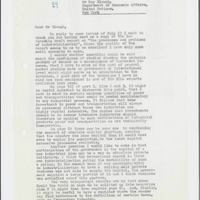
Letter to Roy Blough
- Title
- Letter to Roy Blough
- Recipient
- Blough, Roy
- Organisation
- United Nations, New York
- Language
- English
- City
- New York, NY
- Date
- 1954
- Date in document
- yes
- Formulas or calculations
- no
- Inventory number
- NL-RtEUR_TBCOR01_022B029
- 6720
- Storage location
- Specifiek Magazijn
- Filename
- CDM6720_NL-RtEUR_TBCOR01_022B029.pdf
- Provenance
- Jan Tinbergen
- Accrual Method
- donation
- Rights
-

- Revised transcript
-
en
PROF. DR J. TINBERGEN The Hague, 8 September 1954
Sijzenlaan 41
24 Mr Roy Blough, Department of Economic Affairs, United Nations, New York
Dear Mr Blough,
In reply to your letter of July 23 I want to thank you for having sent me a copy of the interesting draft report on "the processes and problems of industrialization". Since the quality of the report seems to me to be excellent I have only some small comments to make.
I wonder whether something could be said about the usefulness of studies showing the probable pattern of demand as a consequence of increased incomes. What I have in mind is the sort of general market studies made on government or international level which might serve as an orientation to the investor. A good deal of the technique I have in mind has been mentioned in one of the ECLA reports published last year.
On page 165 of part I, line 2 and 3, it might be useful somewhat to elaborate this point. What I have in mind is certain minimum quantities of power and transportation that would be needed complementary to any industrial process. It follows that some investment in power and transportation will always be necessary although these two industries are highly capital intensive. The maxime that investments should be in labour intensive industries should therefore be applied to such combinations of industrial products power and transportation as are technically inseparable.
On page 61 there may be some use in mentioning the concept of absolute capital shortage, meaning that the country has less capital than it would need even to employ its population in the least capital intensive processes available.
Another question I would like to make is that participation of the government in the capital of a new industrial plan may be a way to stimulate private initiative. I think the Netherlands showed in their own industrialization policy the workability of such a policy. In the moment when it was considered vital to industrialization to have a rolling mill private business was not able to supply the capital. The government supplied a large portion of it and I think business was satisfied about this gesture.
Two very unimportant remarks are my last ones: Could the table on page 64 be splitted up into countries also? It might then even replace page 62. And, finally, it might be useful to have a register where the reader may find references to the definition of certain terms, such as "secondary industry.
You may see from my comments that they are mainly meant as an indication of my interest. I can easily imagine that there are sound reasons not to go into the quetions I put.
- Item sets
- Tinbergen Letters Sent