-
Title
-
Letter to Ch. Glasz
-
Date
-
1951
-
Date in document
-
yes
-
Formulas or calculations
-
no
-
Inventory number
-
NL-RtEUR_TBCOR01_015G009
-
582
-
Storage location
-
Specifiek Magazijn
-
Filename
-
CDM582_NL-RtEUR_TBCOR01_015G009.pdf
-
Provenance
-
Jan Tinbergen
-
Accrual Method
-
donation
-
Rights
-

-
Revised transcript
-
ne
160
12 November 1951
Professor Chr. Glasz,
Clematislaan 6,
AERDENHOUT.
Amice,
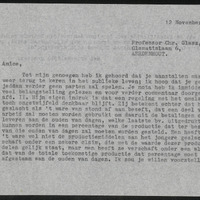
Tot mijn genoegen heb ik gehoord dat je aanstalten maakt om weer terug te keren in het publieke leven; ik hoop dat je gezondheid [voortaan] verder geen parten zal spelen. Je nota heb ik inmiddels met veel belangstelling gelezen en voor verder commentaar doorgegeven aan afd. II. Mijn eigen indruk is dat een regeling met het omslagstelsel toch ongetwijfeld denkbaar blijft. Zij betekent echter dat het jonge geslacht als 't ware van stond af aan beseft, dat een deel van zijn arbeid zal moeten worden gebruikt om daaruit de betalingen op te leveren aan de ouden van dagen, welke laatste bv. uitgedrukt zouden kunnen worden in een percentage van de productie dat ter beschikking van die ouden van dagen zal moeten worden gesteld. Men heeft dan als 't ware wel niet de productiemiddelen aan het jongere geslacht verschaft onder een zekere claim, die met de waarde dezer productiemiddelen gelijk staat, maar men heeft ze verschaft onder een algemeen beding dat van de totale toekomstige productie dat percentage moet worden afgestaan aan de ouden van dagen. Ik zou je willen voorstellen dat je wat de quantificatie van je eigen denkbeelden betreft rechtstreeks contact met de heren Lips en Schouten van mijn bureau zoekt, om de zaak niet te laten stagneren tijdens mijn afwezigheid.
Met vriendelijke groeten,
-
en
160
November 12, 1951
Professor Chr. Glasz,
Clematislaan 6,
AERDENHOUT.
Amice,
To my pleasure, I have heard that you are preparing to return to public life; I hope that your health [henceforth] will not play any further tricks on you. I have since read your note with much interest and passed it on to Dept. II for further comment. My own impression is that a regulation with the pay-as-you-go system certainly remains conceivable. However, it means that the younger generation realizes, as it were, from the outset that a part of its labor will have to be used to provide the payments from it to the elderly, which the latter could, for example, be expressed as a percentage of the production that will have to be made available to those elderly. One has then, as it were, not provided the means of production to the younger generation under a certain claim, which is equal to the value of these means of production, but one has provided them under a general condition that that percentage of the total future production must be ceded to the elderly. I would like to suggest to you that regarding the quantification of your own ideas, you seek direct contact with Messrs. Lips and Schouten of my office, in order not to let the matter stagnate during my absence.
With kind regards,