-
Title
-
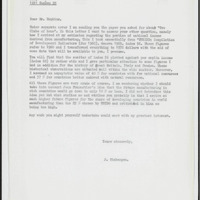
Letter to M. Hopkins
-
Description
-
From the folder 'ILO Conf. 1976'. Annex is missing.
-
Date
-
1975
-
Date in document
-
yes
-
Formulas or calculations
-
no
-
Inventory number
-
NL-RtEUR_TBCOR_B.1.31-4
-
286
-
Storage location
-
Specifiek Magazijn
-
Filename
-
CDM286_NL-RtEUR_TBCOR_B.1.31-4.pdf
-
Provenance
-
Jan Tinbergen
-
Accrual Method
-
donation
-
Revised transcript
-
en
May 1, 1975
Mr. Mike Hopkins,
BIT,
1211 Genève 22
Dear Mr. Hopkins,
Under separate cover I am sending you the paper you asked for about "Two Clubs of Rome". In this letter I want to answer your other question, namely how I arrived at my estimates regarding the portion of national income derived from manufacturing. This I took essentially from "UNRISD: Compilation of Development Indicators (for 1960), Geneva 1969, index 56. These figures refer to 1960 and I transformed everything to 1970 dollars with the aid of some data that will be available to you, I presume.
You will find that the scatter of index 56 plotted against per capita income (index 68) is rather wide and I gave particular attention to some figures I had in addition for the history of Great Britain, Italy and Sweden. These historical observations are situated well within the wide scatter. Moreover, I assumed an asymptotic value of 40 % for countries with few national resources and 37 % for countries better endowed with natural resources.
All these figures are very crude of course. I am wondering whether I should take into account Jean [Fourastié's] idea that the future manufacturing in rich countries would go down to only 10 % or less. I did not introduce this idea yet but what strikes me and strikes you probably is that I arrive at much higher future figures for the share of developing countries in world manufacturing than the 25 % chosen by UNIDO and criticized in Lima as being too high.
Any work you might yourself undertake would meet with my greatest interest.
Yours sincerely,
J. Tinbergen.
-
extracted text
-
May 1, 1975
Ifr. Mike Hopkins,
BIT,
1211 GeneYC 22
Dear Mr. Hopkins,
Under separate cover I am sending you the paper you asked for about "Two
Clubs of Eoae", In this letter I vjant to answer your other question, namely
how I arrived at my estimates regarding the portion of national income
derived from manufacturing. This I took essentially from "UIIRI3D: Compilation
of Devolopnent Indicators (for i960), Geneva 1969, index 56, These figures
refer to i960 and I transformed everything to 1970 dollars with the aid of
some data that will be available to you, I presume.
You will find that the scatter of index 56 plotted against per capita income
(index 68) is rather wide and I gave parbicular attention to some figures I
had in addition for the historjr of freat Britain, Italy and Sweden. These
historical observations are situated sell within tho wide eoatfcor. Ifbreover,
I assumed an asymptotic value of 40 r^ for countries with few national resources
and 57 '/ for countries bettor endowed with natural resources.
All these figures are very crude of course. I am wondering whether I should
take into account Jean Pourasticr'c idea that the future uaniifactracing in
rich countries would go down to only 10 '/ or less, I did not introduce this
idea yet but what strikes me and strikes you probably is that I arrive at
much higher i\iturc figures for tho cJiarv- of doveloping countries xn world
manufactxiring than the 25 /- chosen byÏÏNIIX)and critiaaéod in Lina as
being too high.
Any work you Eight yourself undertake would meet with ray greatest intorost.
Yours sincerely,
J. Tinbergen,
�99KiR
«TBR
'^rr'T^Xrr'.
r'^J/T/'i
s«-
• ^C'-i'i
.ïw ^wr
"Sl*ï5t "tfr
li-ÏSftffj
�