-
Title
-
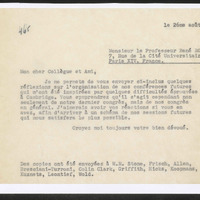
Letter to R. Roy
-
Description
-
Annexes: manuscript titled 'The Econometric Society. The efficiency of our European meetings'; copy of a circular letter.
-
Date
-
1952
-
Date in document
-
yes
-
Formulas or calculations
-
no
-
Inventory number
-
NL-RtEUR_TBCOR01_017R015
-
4958
-
Storage location
-
Specifiek Magazijn
-
Filename
-
CDM4958_NL-RtEUR_TBCOR01_017R015.pdf
-
Provenance
-
Jan Tinbergen
-
Accrual Method
-
donation
-
Rights
-

-
Revised transcript
-
en
465
C O P Y
PROF. DR J. TINBERGEN La Haye, le 26me août, 1952
Sijzenlaan 41
Monsieur le Professeur René ROY,
7, Rue de la Cité Universitaire,
Paris XIV, France.
Mon cher Collègue et Ami,
Je me permets de vous envoyer ci-inclus quelques réflexions sur l'organisation de nos conférences futures qui m'ont été inspirées par quelques difficultés éprouvées à Cambridge. Vous comprendrez qu'il s'agit cependant non seulement de notre dernier congrès, mais de nos congrès en général. J'aimerais avoir vos réactions si vous en avez, afin d'arriver à un schéma de nos sessions futures qui nous satisfera le plus possible.
Croyez moi toujours votre bien dévoué.
(get. J. Tinbergen)
Des copies ont été envoyées à M.M. Stone, Frisch, Allen, Bresciani-Turroni, Colin Clark, Evans, Hicks, Koopmans, Kuznets, Leontief, Wold.
THE ECONOMETRIC SOCIETY
The Efficiency of Our European Meetings
Although several most important contributions were made by the participants of our Cambridge meeting, and the material organization ran perfectly smoothly, I must confess that I was not satisfied by it, which partly may be due to the fact that I was not available during the evenings and that I was somewhat tired. Since, however, the few remarks that I have to make apply also to most of our previous meetings, I hope they may be of some use to the organizers of our future meetings. Indeed I think that the efficiency of our meetings is considerably less than it could be. I tried to analyse the reasons why this is so, and I think they are the following:
1. There is still a number of our French-speaking members that are speaking too quickly, and a number of our English-speaking members that are speaking not clearly enough in order to make them understandable for many of the other participants, in particular, if the subject is a difficult one. I think we should all exercise in speaking the econometric English and the econometric French so well known from Frisch's technique of leading in pre-war meetings.
2. A most important condition for really fruitful and deep-going discussions seems to me to be a sufficient degree of specialization of the subjects of the conferences. Subjects, therefore, should be chosen within a few rather narrow and well-defined parts of research and the participants shoud be either specialists on those subjects or wanting to specialize themselves on these subjects.
3. Readers should be careful as to the didactics of their paper. Problems should be stated clearly. The same applies to the hypotheses made and the methods followed. The main points should be shortly symbolized on the black-board. Difficult subjects should be introduced as much as possible by a simple but concrete example and only after that be generalized; in this example the main point should be set very clearly.
4. I think our programs have always been and still are overloaded: a number of three papers per morning and three papers per afternoon, leaving one hour for each paper (including the discussion) is far too much, particularly, if always again only a part of the contributors make it possible to distribute their papers in advance. Experience from the Driebergen-meeting in 1950 on input-output questions shows, I think, that one paper per morning and one paper per afternoon is a much better frequency. Correspondingly, the papers should perhaps be combined papers.
5. As already observed in the previous point, papers should be distributed well in advance; perhaps we should simply not accept papers in the final program that have not actually been distributed a fortnight before the conference.
374 D'52
- 2 -
I am sure these remarks are partly a reflexion of my own lack of understanding new and difficult subjects; nevertheless I do hope that they may lead, if somewhat propagated, to a considerable increase in efficiency of our bi- or multilinguist meetings, the costs of which to each individual participant or to the organization which pays them are usually pretty high. It is our duty to make them as efficient as possible.
J. Tinbergen
-
annexCount
-
2