-
Title
-
Letter to Ruth Skinner
-
Date
-
1953
-
Date in document
-
yes
-
Formulas or calculations
-
no
-
Inventory number
-
NL-RtEUR_TBCOR01_018E005
-
3647
-
Storage location
-
Specifiek Magazijn
-
Filename
-
CDM3647_NL-RtEUR_TBCOR01_018E005.pdf
-
Provenance
-
Jan Tinbergen
-
Accrual Method
-
donation
-
Revised transcript
-
en
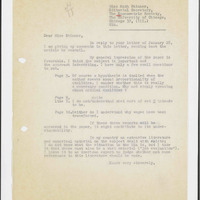
PROF. DR J. TINBERGEN THE HAGUE, 16 February 1953
Sijzenlaan 41
[ff]
Miss Ruth Skinner,
Editorial Secretary,
The Econometric Society,
The University of Chicago,
Chicago 37, (Ill.)
USA.
Dear Miss Skinner,
In reply to your letter of January 28, I am giving my comments in this letter, sending back the article by seamail.
My general impression of the paper is favorable. I think the subject is important and the approach interesting. I have only a few small questions to put.
Page 3. Of course a hypothesis is implied when the author speaks about proportionality of qualities. I wonder whether this is really a necessary condition. Why not simply speaking about ordinal qualities ?
Page 9, quite line 5. I do not/understand what sort of set M intends to be.
Page 10. Neither do I understand why wages have been transformed.
If these three remarks will be answered in the paper, it might contribute to its understandability.
In my country an extensive literature and numerical material on the subject dealt with exists; I do not know what the situation in the USA is, but I take it that there must also be a vast material ("job evaluation"). I leave it to an American expert to judge whether not some references to this literature should be made.
Yours very sincerely,
-
extracted text
-
PROF. DR J. TINBERGEN
THE HAGUE, l6 February 1953
Sijzenlaan ^-1
Miss Ruth Skinner,
Editorial Secretary,
The Econometric Society,
The university of Chicago,
Chicago 37, (111.)
USA.
Dear Miss Skinner,
In reply to your letter of January 28,
I am giving my comments in this letter, sending back the
article by seamail.
My general impression of the paper is
favorable. I think the subject is important and
the approach interesting. I have only a few small questions
to put.
Page 3» Of course a hypothesis is Implied vihen the
author speaks about proportionality of
qualities. I wonder whether this is really
a necessary condition. Why not simply speaking
about ordinal qualities ?
Page 9»
quite
l i n e 5» I do not/understand what s o r t of s e t ^ Intends
to be.
Page lO.IIeither do I understand in^iy wages have been
transformed.
If these three remarks w i l l be
answered in the paper, I t might contribute to i t s understandability.
In my country an extensive l i t e r a t u r e
and numerical material on the subject d e a l t with escists;
I do not know what th« s i t u a t i o n In the USA i s , but I take
i t t h a t there must alr.o be a vast material ("job e v a l u a t i o n " ) .
I leave I t to an American expert to judge whether not some
references to t h i s l i t e r a t u r e should be made.
ï o u r s very s i n c e r e l y ,
�«-*- tri '-y r* ?• A
.
rp
»v
togsod
i\J
rfCtiJfl 2 3lM
iBfTOitbE
3 sfiT
Ll.r
^o X
(.1X1)
f
.ASÜ
,i9nnl>!8
BBlM iBSÜ
,SS \;i6ijnBL l o le^fïsX lüox oct \lqfii
nl
9ncf >foBcf a n l b n s a fiQiiQl
alri:t nl acfna-nroo x^ 8 n l v l § ras I
.IlBrrrBf>B YCf BlotiiB
a l isqBq erü l o nolaaetqnil i B t e n e s Y^I
bnB ;tnB:fic-- ' "t ;^De^ ' "
anolctasjjp IXsrna wsl B .
ovBii
lovel
B srfd^
• d-jjq oef
srtt nsfiw b s l l q m l a l alaerfctoqicrf B eaiuoo 10 .£ sgB'ï
l o •^c^lXBnold-ioqo'iq iuodB a>fB9q8 loröwe
„rr,.,..-. „t alrfc)- isrid-erfw tebnow I . ? ' ' ' "
:è(ï^
3 cfon -^flW . n o l ^ l b n o o xii
? 8«l:tlXBjjp i B n l b i o iuodB
9itup
,9 93B*Ï
sbnöctnl ]i *98 l o rfioa efBrfw bnectai^bnuVon ob I .^ snlX
.9Cf
oi
need svBri ze^sv; xrbn bciBiBT.ebnu T ob i
.Ot 93B<Ï
. berrio'lBni^ict
©d XXlw QiliBmei eeitü sasxö I I
-I9bmj ad-1 oi eiudttinoo
ici'gtm it
^IBQBC
9'i.
nl
...
;J I iud
..,
_ ,,.
^^ „ „ ,.
. . ..^
1
r p . f 1 ï*.i t f
,31 A3U 9xö nl nol:tBjjrf-l
•
- iZBV
,'(iX9190nlB VTHV STIÏOY
hf^jg
T
Ê
.obi^n 9cf bijjoria ei:
Pr;'1 r<-r arrrr.';• •
tl
ai
�