-
Title
-
Letter to F. de Roos
-
Date
-
1954
-
Date in document
-
yes
-
Formulas or calculations
-
no
-
Inventory number
-
NL-RtEUR_TBCOR01_021R021
-
7007
-
Storage location
-
Specifiek Magazijn
-
Filename
-
CDM7007_NL-RtEUR_TBCOR01_021R021.pdf
-
Provenance
-
Jan Tinbergen
-
Accrual Method
-
donation
-
Rights
-

-
Revised transcript
-
ne
115 D/T 19 Mei 4
T/Vos
104
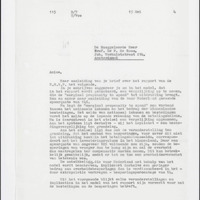
De Hooggeleerde Heer Prof. Dr F. de Roos, Joh. Verhulststraat 214, Amsterdam-Z
Amice,
Naar aanleiding van je brief over het rapport van de R.E.M.P. het volgende.
In je schrijven suggereer je om in het model, dat in het rapport wordt gehanteerd, een vergelijking op te nemen, die de "marginal propensity to spend" tot uitdrukking brengt. Een en ander naar aanleiding van de voor Nederland geraamde spaarquote van 14%.
Nu legt de "marginal propensity to spend" een verband tussen het nationale inkomen en het bedrag der binnenlandse bestedingen. Het saldo van nationaal inkomen en bestedingen vormt het saldo op de lopende rekening van de betalingsbalans. Nu is daaromtrent in het stelsel een vergelijking opgenomen. Aan het systeem ligt derhalve - zij het impliciet - een bestedingsvergelijking ten grondslag.
Aan het stelsel ligt dus ook de veronderstelling ten grondslag, dat het aanbod van besparingen, voor zover dit niet tot uitdrukking komt in het betalingsbalanssaldo, correspondeert met het investeringsvolume in het binnenland. Daar een spaarquote van ongeveer 10% voldoende zou zijn, zouden de besparingen van vroeger dus te hoog zijn en zal de overheid dus maatregelen ter compensatie moeten nemen. Dit kan betrekkelijk gemakkelijk, omdat er tot nu toe een overheidsoverschot van betekenis was.
De ontwikkeling, die voor Nederland met behulp van het model wordt beschreven, impliceert derhalve een geringer bedrag aan overheidsbesparingen dan is verdisconteerd in het - door extrapolatie verkregen - besparingspercentage van 14.
Uit het voorgaande blijkt welke veronderstellingen en implicaties in het model van het rapport zijn verwerkt voor wat de bestedingen en de besparingen betreft.
-2-
Aan je suggestie om één vergelijking aan het model toe te voegen, teneinde aan de gedachte der stagnatietheorie recht te doen wedervaren, kan derhalve niet zonder meer worden voldaan. Daartoe is wijziging van het stelsel nodig.
Met vriendelijke groeten,
(J. Tinbergen)
-
en
115 D/T 19 May 4
T/Vos
104
The Learned Gentleman Prof. Dr F. de Roos, Joh. Verhulststraat 214, Amsterdam-Z
Amice,
Following your letter about the R.E.M.P. report, the following.
In your writing, you suggest including an equation in the model used in the report that expresses the "marginal propensity to spend." This is in response to the savings rate of 14% estimated for the Netherlands.
Now, the "marginal propensity to spend" establishes a connection between national income and the amount of domestic spending. The balance of national income and spending forms the balance on the current account of the balance of payments. An equation regarding this has now been included in the system. Therefore, a spending equation underlies the system - albeit implicitly.
The system is therefore also based on the assumption that the supply of savings, insofar as this is not expressed in the balance of payments surplus, corresponds to the volume of investment in the domestic market. Since a savings rate of approximately 10% would be sufficient, the savings from before would therefore be too high and the government will therefore have to take compensatory measures. This can be done relatively easily, because until now there has been a significant government surplus.
The development described for the Netherlands with the help of the model therefore implies a smaller amount of government savings than is discounted in the - obtained by extrapolation - savings percentage of 14.
The foregoing shows which assumptions and implications have been incorporated into the model of the report regarding spending and savings.
-2-
Your suggestion to add one equation to the model, in order to do justice to the idea of stagnation theory, can therefore not be met without further ado. For this, a modification of the system is necessary.
With kind regards,
(J. Tinbergen)