-
Title
-
Letter to P. Hennipman
-
Date
-
1955
-
Date in document
-
yes
-
Formulas or calculations
-
no
-
Inventory number
-
NL-RtEUR_TBCOR01_023H011
-
8879
-
Storage location
-
Specifiek Magazijn
-
Filename
-
CDM8879_NL-RtEUR_TBCOR01_023H011.pdf
-
Provenance
-
Jan Tinbergen
-
Accrual Method
-
donation
-
Rights
-

-
Revised transcript
-
ne
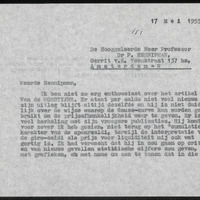
17 Mei 1955
151
De Hooggeleerde Heer Professor
Dr P. HENNIPMAN,
Gerrit v.d. Veenstraat 137 hs,
Amsterdam - W
Waarde Hennipman,
Ik ben niet zo erg enthousiast over het artikel van Van de WOESTIJNE. Er staat per saldo niet veel nieuws in, zijn uitleg blijft altijd dezelfde en hij is niet duidelijk over de wijze waarop de Gauss-curve kan worden gebruikt om de prijsafhankelijkheid weer te geven. Er is veel herhaling met zijn vroegere publicaties. Hij komt, voor zover ik heb gezien, niet terug op het "cumulatieve" karakter van de spaarsaldi, terwijl de interpretatie van de giro-saldi als prijs voor liquiditeit mij ook wat gortig is. Ik had verwacht dat hij in zou gaan op critiek en van nieuwe gevallen statistische cijfers zou geven, ev. met grafieken, en met name om aan te tonen dat in die gevallen met een rechtlijnige vraagcurve minder succes wordt bereikt. Misschien kan dit hem toch nog eens worden aanbevolen. Het spijt mij dat ik hem extra werk bezorg, maar ik vind dit artikel onder de maat.
Met vriendelijke groeten,
-
en
May 17, 1955
151
The Highly Learned Professor
Dr. P. HENNIPMAN,
Gerrit v.d. Veenstraat 137 hs,
Amsterdam - W
Dear Hennipman,
I am not very enthusiastic about the article by Van de WOESTIJNE. On balance, there is not much new in it, his explanation always remains the same and he is not clear about the way in which the Gauss curve can be used to represent price dependency. There is much repetition of his earlier publications. As far as I have seen, he does not return to the "cumulative" character of savings balances, while the interpretation of giro balances as a price for liquidity also seems a bit much to me. I had expected that he would address criticism and provide statistical figures for new cases, possibly with graphs, and especially to show that in those cases less success is achieved with a linear demand curve. Perhaps this can still be recommended to him. I am sorry to cause him extra work, but I find this article below par.
With kind regards,