-
Title
-
Letter to J.R.N. Stone
-
Description
-
With annex: Letter to her husband, mr. Stone
-
Date
-
1945
-
Date in document
-
yes
-
Formulas or calculations
-
no
-
Inventory number
-
NL-RtEUR_TBCOR01_012S033
-
2709
-
Storage location
-
Specifiek Magazijn
-
Filename
-
CDM2709_NL-RtEUR_TBCOR01_012S033.pdf
-
Provenance
-
Jan Tinbergen
-
Accrual Method
-
donation
-
Revised transcript
-
en
i.o.
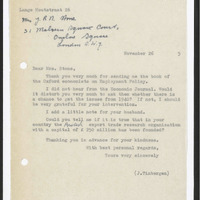
Lange Houtstraat 26
Mrs J. R. N. Stone
31 Malvern Court,
Onslow Square
London S.W.7
November 26 5
Dear Mrs. Stone,
Thank you very much for sending me the book of the Oxford economists on Employment Policy.
I did not hear from the Economic Journal. Would it disturb you very much to ask them whether there is a chance to get the issues from 1940? If not, I should be very grateful for your intervention.
I add a little note for your husband.
Could you tell me if it is true that in your country the British export trade research organization with a capital of £ 250 million has been founded?
Thanking you in advance for your kindness.
With best personal regards,
Yours very sincerely
(J.Tinbergen)
Stone 26 Nov. '45.
In our discussion on the advantages of free trade you proposed to consider the following case:
Is it not an advantage for South Africa that het diamond market in the United Kingdom is protected by an import duty and would not this prove that the abolition of this duty would be a disadvantage to at least one country, namely South Africa?
I think my answer is that the abolition of such an import duty will be accompanied by such retaliatory measures as to compensate for the disadvantage. Generally speaking, if South Africa is producing diamonds at a higher cost than other countries, there will be some other branch of industry which South Africa had better develop and of which the production will be hindered by the import duty on diamonds in the United Kingdom, since the diamond industry will attract labourers and capital.
From the last few words you see that my argument is only valid at the assumption of full employment everywhere, but of this I was quite aware at the time of our discussion.
-
annexCount
-
1
-
extracted text
-
i.o.
Lange Houtstraat 26
3 ; yruU^^
/aj^****r ör#*^^.
November 26
Dear Mrs. Stone,
Thank you very much for•sending me the book of
the Oxford economists on Employment Policy.
I did not hear from the Economic Joormal. Would
it disturb you very much to ask them whether there is
a chance to tjet the issues from 1940? If not, I should
be veiy grateful for your intervention.
I add a little note for your husband.
Coiild you tell me if it is true that in your
oouhtry the fifvi^U^. export trade research organization
with a capital of £ 2^0 million has been founded?
Thanking you in advance for your kindness.
With best personal regards,
Youre very sincerely
(J.Tinbergen)
�. » & - • * « .
,al>x»ai^
cëüÉ^i'
i, *80<f
ri*l¥V
�%rvvc
/((c4^'^^^
In our discussion on the advsuitages of free
trade you proposed to consider the following; caset
Is it not an advantage for South Africa that
het diamond market in the United Kingdom is protected by an import duty and would not this prove that
the abolition of this duty would be a disadvantage
to at least one country, namely South Africa?
I think my answer is that the abolition of
such an import duty will be accompanied by such
retaliatory measures as to compensate for the disadvantage. Generally speaking, if South Africa is
producing diamonds at a higher cost than other
countries, there will be some other branch of industry which South Africa had better develop and
of which the production will be hindered by the
import duty on diejnonds in the United Kin^idom,
since the diamond industry will attract labourers
and capital.
"From the last few words you see th?it my argument is only valid at the assumption ef full employment everywhere, but of this I v/as quite awcre at
the time of our discussion.
��