-
Title
-
Letter to J.B.D. Derksen
-
Date
-
1953
-
Date in document
-
yes
-
Formulas or calculations
-
no
-
Inventory number
-
NL-RtEUR_TBCOR01_018D009
-
5293
-
Storage location
-
Specifiek Magazijn
-
Filename
-
CDM5293_NL-RtEUR_TBCOR01_018D009.pdf
-
Provenance
-
Jan Tinbergen
-
Accrual Method
-
donation
-
Rights
-

-
Revised transcript
-
ne
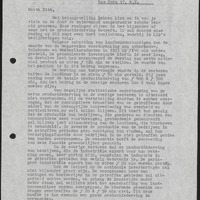
PROF. DR J. TINBERGEN DEN HAAG, 16 Maart 1953 Raamweg 18.
De Heer J.B.D. DERKSEN, Box 20, Grand Central P.O. New York 17, N.Y.
Beste Dick,
Met belangstelling hebben Lips en ik van je visie op de door de watersnood aangebrachte schade kennis genomen. Onze ramingen wijken in het bijzonder af waar het de productiederving betreft. Ik zal daarom onze raming op dit punt even kort toelichten, waarbij ik Lip's becijferingen volg.
Volgens schatting van landbouwdeskundigen kan de waarde van de weggevallen voortbrenging aan akkerbouw-, tuinbouw- en veeteeltproducten in 1953 op f 140 mln worden gesteld. De gecumuleerde invoerquote hierin is zeer laag, en derhalve leek het verantwoord de derving aan netto nationaal product op circa ƒ 120 mln te stellen. De waarde van het pachten is in dit bedrag begrepen.
De derving aan toegevoegde waarde in de sectoren buiten de landbouw is op circa ƒ 50 mln gesteld. Bij jouw raming voor de totale productiederving van ƒ 400 à ƒ 500 mln, zou het bedrag in de overige sectoren dus 6 maal hoger moeten zijn.
Een degelijke statistische onderbouwing van de netto productiederving in de overige sectoren is uiteraard niet voorhanden. Bij de vaststelling daarvan is echter overwogen, dat de consumptieve behoeften van de getroffenen door middel van de omvangrijke hulpverlening van overheid en particulieren op peil zullen blijven. Dit heeft tot gevolg dat de productie van bedrijven, die goederen en diensten van consumptieve aard voortbrengen, grotendeels gehandhaafd zal blijven (met uitzondering van de landbouw, die hierboven is behandeld). In zoverre de productie van de bedrijven in de getroffen gebieden geen voortgang kan vinden, zal hun verzorgingsfunctie door bedrijven in de niet getroffen gebieden worden overgenomen. De evacuatie heeft de overneming van deze functie gemakkelijker gemaakt.
In de overige sectoren zal de productiederving van bedrijven, die de industriële export voor hun rekening nemen, zeer gering zijn, aangezien de industrie in de getroffen gebieden van weinig betekenis is. De geringere industriële export kan op circa ƒ 20 mln worden gesteld.
Ook de invloed op de nationale investeringen zal niet bijzonder groot zijn. De voorgenomen bouw van woningen en boerderijen in de getroffen gebieden zal uitgesteld moeten worden, en zolang de landerijen onder water staan zal wellicht niet tot aanschaffing van landbouwmachines worden overgegaan. De hiermede gemoeide bedragen overtreffen de ƒ 20 à ƒ 30 mln niet. Uit deze hoofde is dus evenmin een grote productiederving te verwachten.
In aanmerking nemende hoe de nationale bestedingen en de export zich ten gevolge van de ramp (afgezien van het herstel daarvan) zullen wijzigen, blijkt er geen reden te zijn om ten aanzien van de productiederving buiten de landbouwsector erg pessimistisch te zijn.
Tenslotte zou ik willen opmerken, dat de onderwijzers en leraren normaal doorbetaald worden. Evenals voor andere ambtenaren pleegt men hun productie gelijk te stellen aan het uitgekeerde salarisbedrag. Er is dus geen reden om hier met een productiederving te rekenen. In zoverre je dit standpunt te formeel vindt, bedenk dan ook hier, dat de geëvacueerde kinderen door leerkrachten buiten de getroffen gebieden worden onderwezen; met andere woorden, de productie verplaatst zich, gelijk in vele andere gevallen.
Met hartelijke groeten,
Je
-
en
PROF. DR J. TINBERGEN THE HAGUE, 16 March 1953 Raamweg 18.
Mr. J.B.D. DERKSEN, Box 20, Grand Central P.O. New York 17, N.Y.
Dear Dick,
Lips and I have noted with interest your views on the damage caused by the flood. Our estimates differ particularly where production loss is concerned. I will therefore briefly explain our estimate on this point, following Lip's calculations.
According to estimates by agricultural experts, the value of the lost production of arable, horticultural, and livestock products in 1953 can be set at f 140 million. The cumulative import quota in this is very low, and therefore it seemed justified to set the loss in net national product at approximately ƒ 120 million. The value of rents is included in this amount.
The loss in value added in sectors outside agriculture is set at approximately ƒ 50 million. With your estimate for the total production loss of ƒ 400 to ƒ 500 million, the amount in the other sectors would therefore have to be 6 times higher.
A sound statistical basis for the net production loss in the other sectors is, of course, not available. In determining this, however, it has been considered that the consumption needs of those affected will remain at level through the extensive aid provided by the government and private individuals. This means that the production of companies that produce goods and services of a consumer nature will largely be maintained (with the exception of agriculture, which has been discussed above). Insofar as the production of companies in the affected areas cannot continue, their supply function will be taken over by companies in the non-affected areas. The evacuation has made the takeover of this function easier.
In the other sectors, the production loss of companies that handle industrial exports will be very small, as industry in the affected areas is of little significance. The lower industrial export can be set at approximately ƒ 20 million.
The influence on national investments will also not be particularly large. The planned construction of houses and farms in the affected areas will have to be postponed, and as long as the lands are under water, the purchase of agricultural machinery will probably not be proceeded with. The amounts involved do not exceed ƒ 20 to ƒ 30 million. For this reason, a large production loss is not to be expected either.
Taking into account how national spending and exports will change as a result of the disaster (apart from the recovery thereof), there appears to be no reason to be very pessimistic regarding the production loss outside the agricultural sector.
Finally, I would like to note that teachers and instructors are paid normally. As with other civil servants, their production is usually equated to the salary amount paid out. There is therefore no reason to calculate a production loss here. Insofar as you find this point of view too formal, consider also here that the evacuated children are taught by teachers outside the affected areas; in other words, production is shifting, as in many other cases.
With kind regards,
Yours