-
Title
-
Letter to C.A. Verrijn Stuart
-
Date
-
1953
-
Date in document
-
yes
-
Formulas or calculations
-
no
-
Inventory number
-
NL-RtEUR_TBCOR01_018V014
-
5325
-
Storage location
-
Specifiek Magazijn
-
Filename
-
CDM5325_NL-RtEUR_TBCOR01_018V014.pdf
-
Provenance
-
Jan Tinbergen
-
Accrual Method
-
donation
-
Rights
-

-
Revised transcript
-
ne
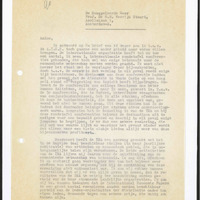
PROF DR J. TINBERGEN DEN HAAG, 14 Februari 1953 Sijzenlaan 41
De Hooggeleerde Heer Prof. Dr G.M. Verrijn Stuart, Apollolaan 1, Amsterdam-Z,
Amice,
In antwoord op Uw brief van 12 dezer zou ik t.a.v. de A.I.S.E. toch gaarne een ander geluid naar voren willen brengen. De internationale organisatie heeft tot nu toe een aantal, ik meen 3, internationale ronde tafel conferenties gehouden, die toch wel van enige betekenis voor de economische wetenschap moeten worden geacht. Ik weet niet hoever het staat met de verslagen dezer bijeenkomsten, doch t.a.v. de eerste is dat verslag in elk geval reeds enige tijd beschikbaar. De deelnemers aan deze conferentie hadden wel het gevoel dat de discussie in Monte Carlo op een hoog peil stond en tot vergroting van inzicht heeft bijgedragen. Omtrent de 2e conferentie zou collega Hennipman ons beter kunnen inlichten, die daar, naar ik meen, geweest is. T.a.v. de 3e conferentie, die in Oxford, betreffende vraagstukken van conjunctuuronderzoek, heb ik alle stukken, ofschoon ik door de kabinetscrisis, die toen net opgelost was, gemeend heb niet te kunnen gaan. Uit deze stukken had ik de indruk dat daaronder belangrijke stukken nieuw onderzoekingswerk waren. Aangezien het de bedoeling is van de IEA om bij deze rondetafel conferenties telkens de deskundigen uit te nodigen voor een bepaald gebied en daarbij in elk geval enige jongeren te begrijpen, is er dus een zekere roulering, die mij ook van waarde lijkt en waardoor het gevaar minder wordt dat alleen maar een klein clubje lieden altijd weer van deze bijeenkomsten profiteert.
Daarnaast heeft de IEA een aanvang gemaakt met het in de Engelse taal beschikbaar stellen (in haar jaarlijkse publicatie) van artikelen op economisch gebied, die in ontoegankelijke talen zijn verschenen. De beide activiteiten van de IEA lijken mij daarom voor de ontwikkeling van de economische wetenschap van betekenis. Ik zeg dit, ofschoon ik op zichzelf geen voorstander ben van het telkens weer creëren van nieuwe organen, ook bij de oprichting van deze vereniging niet enthousiast was. Ik zou mij echter kunnen voorstellen dat wij er van blijk geven te menen, dat de resultaten van de IEA te weinig ter beschikking worden gesteld van de haar steunende landelijke organisaties. Ik zou mij bv. kunnen indenken dat de International Economic Papers in een groot aantal exemplaren zouden worden beschikbaar gesteld aan de leden-organisaties ter distributie onder hun eigen leden, desnoods tegen een zekere prijs, die matig zou kunnen zijn.
Wat tenslotte de minder pleizierige verhouding t.a.v. de contact-commissie betreft, dit is een fout aan Nederlandse zijde. Hierover zou met de betrokken zustervereniging een hartig woordje kunnen worden gesproken, terwijl het allerbeste zou zijn een algemene fusie van de verschillende verenigingen die thans bestaan. Nederland heeft hier internationaal (overigens naast Frankrijk) weer eens een beeld van verdeeldheid gegeven, in tegenstelling tot de meeste andere landen. Onlangs is deze verdeeldheid verder toegenomen door de oprichting van de vereniging van afgestudeerden uit Rotterdam. Zou er soms iets in gelegen zijn alle nu bestaande groeperingen onder één vaandel bijeen te brengen met secties, evenals dat in de Vereniging voor de Statistiek het geval is, nationaal zowel als internationaal? Het is wellicht de moeite waard een en ander op een volgende bestuursvergadering eens te bespreken.
Met vriendelijke groeten,
-
en
PROF DR J. TINBERGEN THE HAGUE, 14 February 1953 Sijzenlaan 41
The Highly Learned Gentleman Prof. Dr G.M. Verrijn Stuart, Apollolaan 1, Amsterdam-Z,
Amice,
In response to your letter of the 12th of this month, I would like to bring forward a different sound regarding the A.I.S.E. The international organization has so far held a number of, I believe 3, international round table conferences, which must be considered of some significance for economic science. I do not know the status of the reports of these meetings, but regarding the first one, that report has in any case been available for some time. The participants in this conference did have the feeling that the discussion in Monte Carlo was at a high level and contributed to an increase in insight. Regarding the 2nd conference, colleague Hennipman could better inform us, who, I believe, was there. Regarding the 3rd conference, the one in Oxford, concerning issues of business cycle research, I have all the documents, although I felt I could not go because of the cabinet crisis, which had just been resolved then. From these documents, I had the impression that among them were important pieces of new research work. Since it is the intention of the IEA to invite experts for a specific field to these round table conferences each time and to include at least some young people in each case, there is thus a certain rotation, which also seems valuable to me and which reduces the danger that only a small club of people always profits from these meetings.
In addition, the IEA has made a start with making available in the English language (in its annual publication) articles in the economic field that have appeared in inaccessible languages. Both activities of the IEA therefore seem to me to be of significance for the development of economic science. I say this, although I am not in favor of repeatedly creating new bodies per se, and was not enthusiastic at the founding of this association either. I could imagine, however, that we show that we believe that the results of the IEA are made too little available to the national organizations supporting it. I could imagine, for example, that the International Economic Papers would be made available in a large number of copies to the member organizations for distribution among their own members, if necessary at a certain price, which could be moderate.
Finally, regarding the less pleasant relationship with respect to the contact committee, this is a mistake on the Dutch side. A firm word could be spoken about this with the sister association involved, while the very best would be a general merger of the various associations that currently exist. The Netherlands has once again presented a picture of division internationally (besides France, for that matter), in contrast to most other countries. Recently, this division has further increased due to the founding of the association of graduates from Rotterdam. Might there be something in bringing all currently existing groups together under one banner with sections, as is the case in the Association for Statistics, both nationally and internationally? It is perhaps worth discussing this at a subsequent board meeting.
With kind regards,