-
Title
-
Letter to Ferdinando Di Fenizio
-
Description
-
Annex: calculations
-
Date
-
1954
-
Date in document
-
yes
-
Formulas or calculations
-
yes
-
Inventory number
-
NL-RtEUR_TBCOR01_021F006
-
7940
-
Storage location
-
Specifiek Magazijn
-
Filename
-
CDM7940_NL-RtEUR_TBCOR01_021F006.pdf
-
Provenance
-
Jan Tinbergen
-
Accrual Method
-
donation
-
Rights
-

-
Revised transcript
-
en
PROF. DR J. TINBERGEN
THE HAGUE, July 27, 1954
Sijzenlaan 41
249
Professor Ferdinando di Fenizio,
Via Farneti 8,
Milano
Dear Professor di Fenizio,
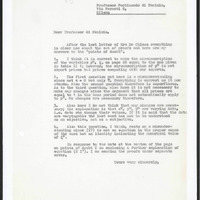
After the last letter of Mrs Dr Chiesa everything is clear now about the set of proofs and here are my answers to the "points of doubt".
1. I think it is correct to make the circumscription of the variables p^w, ? on page 26 equal to the one given in table II 1; however, the circumscription of p^w is not export prices but prices competing with our exports.
2. The first question put here is a misunderstanding since not ? = 0 but only ??. Everything is correct as it now stands. Also the second question therefore is superfluous. As to the third question, also here it is not necessary to make any changes since the argument that all prices are equal to 1 in the base period does not automatically apply to p^x. No changes are necessary therefore.
3. Also here I do not think that any changes are necessary; the explanation is that e^w, p^w, p^m are varying data, i.e. data who change their values. If it is said that the data are varyingable the last word has now to be understood as an adjective, not as a substantive.
4. Also this question, I think, rests on a misunderstanding since (27) is not an equation in the proper sense of the word but an identity indicating the numerical value of ?^3.
In response to the note at the bottom of the page on points of doubt I am enclosing a further explanation of equation (2 I'). I am sending the proofs under separate cover.
Yours very sincerely,
Deduction of equation (2 I'):
Equation (1), for ?_0 = 0: x = (1-?) Z^R + L^R = (1-?)(Y-L-Z?p^x) + L-L?p^x
Now Y = X+E-M = x+xp+e+ep-m-mp^m = x+e+ (x+?)p-m-m?p^m = (1+?)y+ (x+?)p - ?y - m? ?^m (p-p^m) - m? p^m and L = L? (1'+y), whereas p^x = p+?; using these transformations we find for x: x = (1-?) {(1+?)y + (x+?)p - ?y - m? ?^m (p-p^m) - m? p^m } - L? (1'+y)(1-?) - Z? (p+?)(1-?) + L? (1'+y) - L? (p+?)
Arranging the terms we get: x = {1-?-L? (1-?) + L? }y + {(1-?)(x+?-m? ?^m-Z?) -L? }p + { - (1-?) L? + L? }1' + {-Z?(1-?) -L? }? + {(1-?)(m? ?^m-m?) }p^m or x = (1-?+L??)y + {(1-?)(m?+L?-??^m)- L? } p + ? L? 1' + {-1+?-? L? }? + ?(1-?)(?^m-1) p^m.
In this latter transformation we have used the following identities: x+? = m?+L?+Z? being the definition of gross national income; m?=? and Z?+L?=1.
-
annexCount
-
1
-
extracted text
-
\
PROF. DR J. TINBEROBH
THE HA(3ÜS, July 27, 1954
Sijzenlaan ki
Professor Perdinando di Peniaio»
Via Pameti 8»
Milano
t^ÊtOP Professor di Penizio,
After the last letter of Mrs Dr Chiesa ©verythlng
is clear now a"bout the set of proofs and here are my
answers to the "points of dotfot".
1.
I think it is correct to make the ciroramscription
of the variables p^^, go on page 26 equal to the one given
in table II 1; however, the ciroüJTiscrlption of p^ is not
export prices but prices competing with oxiX' exports,
2.
The first question put here is a mi sunders tandlng
since not t a 0 but only ^, Everything is correct as it now
stands. Also the second question therefore is superfluous.
As to the third question, also here it is not necessary to
make any changes since the argument that all prices are
equal to 1 in the base period does not automatically apply
to p*. No changes are necessary therefore.
3»
Also here I do not think that any changes are necessary; the explanation is that e^, p'^, jP- are varying data,
i.e. data who change their values. If it is said that the date
are varyingable the last word has now to be understood
as an adjective, not as a subjective,
h»
Also this question, I think, rests on a ralsunderstanding since (2?) is not an equation in the proper sense
of the word but an identity indicating the numerical value
of 5'«
In response to the note at the bottom of the page
on points of doubt I am emclosing a furtiier esjplanation of
equation (2 I*), I am sending the proofs under separate
cover.
Youï's very sincerely,
�5!HT
mO^^P^-'"'
«clüï.f.ua'ï Jtfc Ci-.
4Q
^ol&Xa^% ïb ^oaa&lc^'^i 'ts&G
%r'i. .
*0£i 3± ^
a'ioO'iq ?tc Jae t.d$ ^t-c/odB won 'xast.Co s i
l o ...„..>>::,:-^
.-.-' ..-..- t^--..,..,„-. ,.
aff«* n;i
iQPlJbcfp-^ •"^•'^-^mmïEi .- ..* w^..i. -..., ..oxd"80up ^a-ïll ©x!ï
.i
viOii *J; e s
-ïa a l ««tirf^i-^g^cavl ,f \lLm ^ud 0 * 3 * *ofi s o n i a
,si::
imÈ4&mrg finooaa fdii^- oalA »B£>aQi8
-^ .. ,....:..^.> .v... ^ . .. , \-'' êlB ^olcfaeifp AilxCct srfd- o# BA
Uiïi) X
3'^'i%:^i^ 0 ^ J L > 1
«C„
t.f. . i l
•g.,-.
*i!«fe>if3- * « i ^ bt&B a i -ti 1:1 ,
J&OOJ?^-
i.-:^-'.,. „, _ _
v JDBO1*X
t^ff,'<:',j&&
eó . 8 , 1
9€i" Oi" w o n a«>.jU i^^ïw»';-' ü'Sioi. I#i .
' -.igtiXv'
. iïo e*s@*ï «üttiAiw ï. ,iiOi,üas;*i>,fc' ..
-!•*• 'if Tr,r-.-tnifpe iiB *ofi a i (VS)
oi£>ixI: ^^i>tn9f>i £1» ^x/cf Is-
3 :?,rTi;
.
9VOO
�Deduction of equation (2 I')j
Equation (1), for 5^= Ox
x = (1-o) Z^ + L^
= (1-o)(Y-L-Zp^) + L-Lp^
Now Y 3» X+E-M = x+xp+e+ep-ra-mpP^ = x+e+ (x+ê)p-iii-m5P »
= (1+M)y+ (x+ê)p " ny " me"- (p-jP^) - i%?"
and L = Z (iVy)» whereas p^ =s p-j-t ; using these transformations we find for XX
X = (i-o)Ki+*i)y + (x+«)p -My -ffle^(p~p"^)-isp"'i- E (l'+y)(i-o) - a (p+ir)(1-o) + L (I'+y) - L (p+n;)
Arranging the terms we g e t i
X = [1-Ö-L ( l - o ) + L ly + |(1-o)(x-f-ê-m8™-2) -L Ip +
+ \' (1-o) E + E l l V [-2(1-ö) -L k + .f(l-ö)(ras^^-in)lp'
or X 3= (l-o+Eo)y + f(l-o)(m+E-|iie^)- Ej p +<:Cl*+[-1+o-cdTr
In t h i s l a t t e r transfomiation we have used the follov/ing
identities:
1t+5 = 31+E+2 being the d e f i n i t i o n of gross
n a t i o n a l income; flfcifi and ,^+£=1.
��