-
Title
-
Letter to B.A. Chait
-
Date
-
1951
-
Date in document
-
yes
-
Formulas or calculations
-
no
-
Inventory number
-
NL-RtEUR_TBCOR01_016C009
-
394
-
Storage location
-
Specifiek Magazijn
-
Filename
-
CDM394_NL-RtEUR_TBCOR01_016C009.pdf
-
Provenance
-
Jan Tinbergen
-
Accrual Method
-
donation
-
Rights
-

-
Revised transcript
-
ne
B.CHAIT, Sur l'Économétrie, Office de Publicité, J. Lebègue, Bruxelles (Meulenhoff & Co N.V., Amsterdam), 1950, 46 pp.
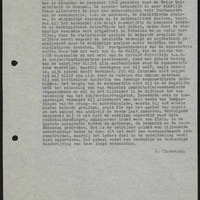
Dit boekje is een verkorte weergave van een serie voordrachten in November en December 1948 gehouden voor de Vrije Universiteit te Brussel. De spreker behandelt in zeer sierlijk Frans allereerst de door hem onderscheiden vier fundamenten van de econometrie, t.w. de economie, de statistische analyse, de wiskundige economie en de mathematische analyse, waarvan hij het samenspel als volgt beschrijft: de economie leverde de werkhypothese betreffende het object, welke door de wiskundige economie werd uitgedrukt in formules en zo nodig verfijnd, door de statistische analyse in bepaalde gevallen in cijfers wordt omgezet en tenslotte verenigd en synthetisch geanalyseerd door de wiskundige analyse onder contrôle van de statistische techniek. Uit voorgeschiedenis van de econometrie worden door hem het werk van S. de Wolff, die de crisis van 1929 voorspelde en het werk van de Harvard University t.a.v. de conjunctuurbarometers gereleveerd. Door het gehele betoog van de schrijver blijkt zijn enthousiasme voor de econometrische werkwijze, waarbij overigens ook hij zelf, zoals bekend is, zijn sporen heeft verdiend. Dit wil intussen niet zeggen dat hij blind zou zijn voor de nadelen die kunnen ontstaan bij een kritiekloze hantering van sommige econometrische technieken. Het belang van de econometrie ziet hij in de mogelijkheid tot oplossing van velerlei quantitatief-economische vraagstukken en wel in het bijzonder in de bijdrage tot een oplossing van het conjunctuurvraagstuk. Sprekende over de toepassingen vermeldt hij allereerst een hele reeks van toepassingen van de vraag- en aanbodanalyse, waarin hij ook enkele minder bekende gevallen, zoals die van het aanbod van appels en het aanbod van ansjovis de revue laat passeren. Vervolgens bespreekt hij in het kort de modellen opgesteld voor hele volkshuishoudingen, culminerend in het werk van Klein. In de laatste paragrafen worden de methoden, de techniek en de voorbehouden besproken. Het is de schrijver gelukt een bijzondere evenwichtige keuze te doen uit het werk van vooraanstaande econometristen, waarbij het ieders deel in de ontwikkeling recht doet wedervaren. Het geheel vormt een levendige en deskundige beschrijving van deze jonge wetenschap.
J. Tinbergen.
18 Mei 1951
De Heer Dr Ir B.A.Chait, Frankrijklei 62, ANTWERPEN.
Amice,
Hierbij zend ik je de bespreking die ik voor de Economist maakte van je boekje. Tevens bericht ik je dat een bespreking hiervan is opgenomen in de bibliographie van Revue van het Institut International de Statistique in de jaargang 1950, aflevering 1,2, pag.97. Binnenkort hoop ik in Rotterdam weer eens een afspraak te maken voor den Haag.
Met hartelijke groeten,
-
en
B.CHAIT, Sur l'Économétrie, Office de Publicité, J. Lebègue, Brussels (Meulenhoff & Co N.V., Amsterdam), 1950, 46 pp.
This booklet is a shortened version of a series of lectures held in November and December 1948 for the Free University of Brussels. The speaker first discusses, in very elegant French, the four foundations of econometrics distinguished by him, namely economics, statistical analysis, mathematical economics, and mathematical analysis, the interplay of which he describes as follows: economics provided the working hypothesis concerning the object, which was expressed in formulas by mathematical economics and refined if necessary, is converted into figures in certain cases by statistical analysis, and finally united and synthetically analyzed by mathematical analysis under the control of statistical technique. From the prehistory of econometrics, he highlights the work of S. de Wolff, who predicted the 1929 crisis, and the work of Harvard University regarding business cycle barometers. Throughout the author's entire argument, his enthusiasm for the econometric method is evident, in which he himself, as is well known, has earned his spurs. This does not mean, however, that he would be blind to the disadvantages that can arise from an uncritical handling of some econometric techniques. He sees the importance of econometrics in the possibility of solving many quantitative-economic problems, and in particular in the contribution to a solution of the business cycle problem. Speaking about the applications, he first mentions a whole series of applications of supply and demand analysis, in which he also reviews some lesser-known cases, such as the supply of apples and the supply of anchovies. He then briefly discusses the models drawn up for entire national economies, culminating in the work of Klein. In the final paragraphs, the methods, technique, and reservations are discussed. The author has succeeded in making a particularly balanced selection from the work of leading econometricians, doing justice to everyone's part in the development. The whole forms a lively and expert description of this young science.
J. Tinbergen.
18 May 1951
Mr. Dr. Ir. B.A.Chait, Frankrijklei 62, ANTWERP.
Amice,
I hereby send you the review I wrote for the Economist of your booklet. I also inform you that a review of it has been included in the bibliography of the Revue of the International Statistical Institute in the 1950 volume, issue 1,2, page 97. Soon I hope to make an appointment in Rotterdam again for The Hague.
With kind regards,