-
Title
-
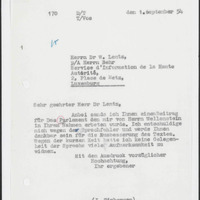
Letter to W. Lentz
-
Description
-
Annex: manuscript of a speech 'Was leistet theoretisch ein gemeinsamer Markt?'
-
Recipient
-
Lentz, W.
-
Date
-
1954
-
Date in document
-
yes
-
Formulas or calculations
-
no
-
Inventory number
-
NL-RtEUR_TBCOR01_022P018
-
8828
-
Storage location
-
Specifiek Magazijn
-
Filename
-
CDM8828_NL-RtEUR_TBCOR01_022P018.pdf
-
Provenance
-
Jan Tinbergen
-
Accrual Method
-
donation
-
Rights
-

-
Revised transcript
-
en
170 D/T September 1, 54
T/Vos
1 K
Dr. W. Lentz,
c/o Mr. Behr
Information Service of the High Authority,
2, Place de Metz,
Luxembourg
Dear Dr. Lentz,
Enclosed I am sending you a contribution for "Das Parlament" which was requested by Mr. Wellenstein on your behalf. I apologize for the linguistic errors and would be grateful to you for correcting the text. Due to the short time, I had no opportunity to devote much attention to the language.
With the expression of distinguished respect,
Yours sincerely,
(J. Tinbergen)
What does a common market achieve theoretically?
What is a "common market"?
The figure of the "common market" has, as is well known, played an important role in economics for a long time. By it is meant a market where exchange takes place without any hindrance and in free competition; often it is also assumed that no transport costs exist. In practice, such a market can therefore only be realized approximately. Apart from transport costs, the ideal image has nevertheless already been approached quite closely for the coal and steel market in the Coal and Steel Community through the removal of quantitative restrictions and import duties. Imperfections still exist, however, in the sense that the turnover tax and comparable taxes, which are only partially compensated at the border through exemptions, refunds, and equalization levies, are unequal within each of the cooperating states for the various branches of industry. As a result, the decisions of producers are influenced in an asymmetrical way in favor of certain productions and to the detriment of others.
The "Principle of Free Trade Theory"
That the common market has played such a role in economic theory is explained by the fact that, according to the considerations of theory, it achieves something that other forms of organization of the exchange process do not achieve: it leads to that application of productive forces whereby a maximum of production is obtained. To be more precise: the monetary value of the production of the entire area as well as of each individual country, calculated according to free trade prices, becomes a maximum. In short, this has probably been interpreted as meaning that a maximum of national welfare is brought about. This only applies, however, if the above definition of national welfare is chosen. If one were to choose the monetary value not of production but of expenditure as the starting point, other conclusions could result for individual countries of the group under consideration. Certain countries could then influence prices to their advantage through tariff manipulation and thus achieve a gain in real expenditure. If one were to assume that national welfare also depends on the distribution of the total product, deviating conclusions can likewise be drawn.
- 2-
The evidence of the mentioned "principle of free trade theory" becomes clearest when one visualizes the alternative applications of productive forces that prevail in the absence of a free common market. With every form of protection, the tendency arises to direct capital and labor to certain less productive applications. The importance of the principle can also be emphasized in another way, by stating that with free exchange, the international division of labor can fully prevail, which is precisely not the case with certain trade barriers. "Artificial, extra-economic" forces are avoided in the organization of production.
In the Coal and Steel Community
In the practice of the Coal and Steel Community, the common market means above all that in the long run the less productive units can be eliminated or their efficiency increased. The best plants can expand according to their actual performance. The system of double pricing can also be made to disappear. For the entire area, double prices always mean a loss in production value: certain enterprises are artificially favored, others disadvantaged. And indeed, it finally always comes to the point that less efficient enterprises are hindered in their development in favor of less productive units. The same applies to the double tariffs for the transport of products or raw materials that were very common in the past. It may have been in the direct interest of certain groups that these instruments of national economic policy were handled; it was certainly not in the general interest of the entire area of the Coal and Steel Community. And perhaps it was also not in the long-term interest of those who pursued this policy.
- 3-
Full Employment as a Condition
The theoretical considerations regarding the common market do not apply unconditionally. It is worth mentioning the most important conditions that should be fulfilled for their validity. A [very] important one is that of the full utilization of all productive forces. If a part of the production factors is not used, their involvement, even if not in the most efficient plants, can still mean an advantage for national welfare. The practical conclusion would probably be that the creation of a common market should have a policy of full employment - within practical limits - as a prerequisite: otherwise the advantages do not come to full development.
From the side of practical politics, it is clear enough anyway that it is in the interest of the cooperating peoples to fully utilize their productive forces. Nevertheless, it appears useful to see clearly the close connection between integration and employment policy.
Free Competition as a Further Condition
A further prerequisite that should be fulfilled - and about which there is an extensive literature - is that of free competition. It is clear that a correct use of productive forces is only guaranteed if production cannot be arbitrarily restricted by monopoly prices. This touches on a subject that can lead to great complications if the cost structure shows so-called "falling marginal costs". If there are such falling marginal costs up to the highest conceivable production quantities, an equilibrium position under free competition without subsidies is not possible; it would lead to permanent losses for the producers involved. We encounter here a profound problem of economic organization that cannot be treated exhaustively in a newspaper article. It should only be mentioned, as well as the relevance of this problem for the integration problem. The condition could best be formulated in a negative way, as mentioned above: the best possible international division of labor is not guaranteed if price formation shows monopolistic elements.
- 4-
Disadvantages of Partial Integration
Finally, one last condition should be pointed out that appears particularly significant politically. When the principle of free trade theory speaks of the optimal division of labor being maintained with free exchange of goods, it is clear that it is assumed that all branches of industry are in this position. If this free movement of goods exists only for individual industries, only a very partial division of labor can be achieved. Translated into everyday language, this simply means that an integration that covers only a few branches should be followed by further steps so that the complete result is obtained. The integration of only a single section of the economy will even be endangered if it is not completed by a total integration. The latter statement should be explained in more detail on a few points.
The Treaty of the Coal and Steel Community "liberates" trade in coal and steel and certain products of these raw materials. A reorientation will therefore prevail here whereby, let us say, country A will produce more of these goods, country B less of the same, because country A is cheaper, country B more expensive. This will only lead to a real increase in welfare if in other sectors country B gets the opportunity to expand its production. If, however, this production cannot be exchanged due to trade barriers, country B is threatened with unemployment, whereby the advantages of integration become illusory.
- 5-
There are further difficulties. Let us assume that among the partners in a common market there is a country F with higher general tariff rates than prevail in the other states. In this country, wages are also higher - because of the higher cost of living - than would be the case with free total trade. If a sector of economic life is now freed from tariffs, it will be difficult for this country to compete in this sector. Thus, even in the integrated sector, the final situation with the best possible international division of labor does not set in immediately. These are not arguments against the bold attempt to attack the problem of European integration first in a single important sector. Rather, they are arguments for not waiting long with general integration.
Common Market and Laissez-faire
It does not follow automatically that a common market should always be a stage for "laissez-faire" under all circumstances. The Treaty of the Coal and Steel Community correctly provides that there are circumstances where certain interventions appear desirable. Just as it generally applies that severe disturbances of equilibrium cannot always be cured in the same way as light ones, so it is here. In the case of a pronounced shortage, the High Authority will be able to set maximum prices, in the case of overproduction minimum prices; in addition, in the case of a shortage, the means of rationing can be used. Theoretically, one can think of this policy as being [justified] most simply in the way that in a state of shortage the normal functioning of price remains ineffective. It is the function of a relatively high price to challenge supply; in the case of an acute shortage, this is precisely impossible. This case illustrates at the same time that besides production (which remains the same anyway with or without [them] maximum prices and rationing), its distribution can also be relevant for national welfare. And it is precisely the function of the instruments just mentioned to organize this distribution optimally in periods where free price formation would fail. One may hope in the meantime that through a suitable general economic policy it will be possible to avoid such states of emergency as much as possible. The instruments of a correctly balanced economic policy of the Coal and Steel Community would not have been complete, however, if the action means just mentioned were not available to the High Authority.
- 6-
In summary, we would like to emphasize that, according to theoretical expectations, a common market primarily achieves the realization of maximum production of the entire area as well as of each individual area. For this achievement to come into full effect, however, certain conditions must be met. Productive forces should be fully utilized; free competition should prevail and "integration" should extend to all branches of economic life. In special cases, it will be necessary to set maximum or minimum prices. Reality never corresponds exactly to the theoretical image; therefore, deviations from the theoretical scheme, transitional measures, and auxiliary constructions will be necessary. In the main lines and in the long run, however, there is no reason to deviate from the guidelines of theory.
The Hague Jan Tinbergen
-
de
170 D/T den 1. September 54
T/Vos
1 K
Herrn Dr W. Lentz,
p/A Herrn Behr
Service d'Information de la Haute Autorité,
2, Place de Metz,
Luxemburg
Sehr geehrter Herr Dr Lentz,
Anbei sende ich Ihnen einen Beitrag für Das Parlament den mir von Herrn Wellenstein in Ihrem Namen erbeten wurde. Ich entschuldige mich wegen der Sprachfehler und werde Ihnen dankbar sein für die Ausbesserung des Textes. Wegen der kurzen Zeit hatte ich keine Gelegenheit der Sprache viele Aufmerksamkeit zu widmen.
Mit dem Ausdruck vorzüglicher Hochachtung,
Ihr ergebener
(J. Tinbergen)
Was leistet theoretisch ein gemeinsamer Markt?
Was ist ein "gemeinsamer Markt"?
Die Figur des "gemeinsamen Marktes" hat bekanntlich in der Wirtschaftswissenschaft seit langem eine wichtige Rolle gespielt. Mit ihr wird ein Markt gemeint wo ohne jede Hemmnis und in freier Konkurrenz getauscht wird; oft wird dazu noch angenommen es existieren auch keine Transportkosten. In der Praxis wird ein solcher Markt also nur annäherungsweise verwirklicht sein können. Von den Transportkosten abgesehen ist trotzdem für den Kohlen- und Stahlmarkt in der Montanunion das Idealbild doch schon ziemlich stark angenähert worden durch die Fortschaffung der quantitativen Beschränkungen und der Einfuhrzölle. Unvollkommenheiten existieren allerdings noch in der Hinsicht dass die Umsatzsteuer und die damit vergleichbaren Taxen, die an der Grenze nur teilweise durch Freisetzungen, Rückvergütungen und Ausgleichsabgaben kompensiert werden, innerhalb jeder der zusammenarbeitenden Staaten für die verschiedenen Betriebszweige ungleich sind. Dadurch werden die Entschlüsse der Produzenten in asymmetrischer Weise zugunsten bestimmter Produktionen und zuungunsten anderer beeinflusst.
Der "Grundsatz der Freihandelslehre"
Dass der gemeinsame Markt in der Wirtschaftslehre eine solche Rolle gespielt hat, erklärt sich daraus dass er nach den Überlegungen der Theorie etwas leistet das andere Organisationsformen des Tauschprozesses nicht leisten: er führt zu jener Anwendung der Produktivkräfte wobei ein Maximum an Produktion erhalten wird. Um genauer zu sein: der Geldwert der Produktion des Gesamtgebietes sowie jedes einzelnen Landes, berechnet nach Freihandelspreisen, wird zum Maximum. Kurz gefasst hat man das wohl so gedeutet dass ein Maximum an Volkswohlstand zustandegebracht wird. Das trifft allerdings nur dann zu wenn obige Definition des Volkswohlstandes gewählt wird. Würde man den Geldwert nicht der Produktion, sondern der Ausgaben zum Ausgangspunkt wählen, so könnten sich für einzelne Länder der betrachteten Gruppe andere Schlussfolgerungen ergeben. Es könnten dann bestimmte Länder durch Zollmanipulierung die Preise in ihren Vorteil beeinflussen und damit einen Gewinn an Realausgaben erreichen. Würde man annehmen dass der Volkswohlstand auch von der Verteilung des Gesamtproduktes abhängt, so können gleichfalls abweichende Schlüsse gezogen werden.
- 2-
Die Evidenz des erwähnten "Grundsatzes der Freihandelslehre" wird am klarsten wenn man sich die Alternativanwendungen der Produktivkräfte vergegenwärtigt, die sich in der Abwesenheit eines freien gemeinsamen Marktes durchsetzen. Bei jeder Form des Schutzes kommt die Tendenz auf, Kapital und Arbeit gewissen weniger ergiebigen Anwendungen zuzuführen. Die Bedeutung des Grundsatzes kann auch noch in anderer Weise betont werden, wenn man aussagt dass bei freiem Austausch die internationale Arbeitsteilung sich völlig durchsetzen kann, was bei gewissen Handelshemmnissen eben nicht der Fall ist. Es werden "künstliche, ausserwirtschaftliche" Kräfte bei der Produktionsgestaltung vermieden.
In der Montanunion
In der Praxis der Montanunion bedeutet der gemeinsame Markt vor allem dass auf die Dauer die weniger produktiven Einheiten ausgeschaltet werden können oder aber ihre Leistungsfähigkeit erhöht wird. Es können sich die besten Werke gemäss ihrer wirklichen Leistung ausdehnen. Das System der Doppelpreise kann auch zum Verschwinden gebracht werden. Für das Gesamtgebiet bedeuten Doppelpreise immer einen Verlust an Produktionswert: es werden künstlich bestimmte Unternehmungen bevorzugt, andere benachteiligt. Und zwar kommt es schliesslich immer dazu dass weniger leistungsfähige Unternehmungen in ihrer Entwicklung zugunsten weniger produktiven Einheiten gehindert werden. Dasselbe gilt für die früher sehr übliche Doppeltarife für die Beförderung der Erzeugnisse oder der Rohstoffe. Es mag im direkten Interesse gewisser Gruppen gewesen sein dass diese Instrumente der nationalen Wirtschaftspolitik gehandhabt wurden; im allgemeinen Interesse des Gesamtgebietes der Montanunion war es bestimmt nicht. Und vielleicht war es auch nicht im langfristigen Interesse derjenigen die diese Politik trieben.
- 3-
Vollbeschäftigung als Bedingung
Die theoretischen Überlegungen bezüglich des gemeinsamen Marktes gelten nicht unbedingt. Es lohnt sich die wichtigsten Bedingungen zu erwähnen die für ihre Gültigkeit erfüllt sein sollen. Eine [sehr] wichtige ist diejenige der Vollbenutzung aller Produktivkräfte. Wird ein Teil der Produktionsfaktoren nicht benutzt, so kann ihre Einschaltung, sogar wenn nicht in den leistungsfähigsten Betrieben noch immer ein Vorteil für den Volkswohlstand bedeuten. Die praktische Schlussfolgerung wäre wohl dass die Schaffung eines gemeinsamen Marktes eine Politik der Vollbeschäftigung - innerhalb praktischen Grenzen - zur Voraussetzung haben soll: sonst kommen die Vorteile nicht zu vollständiger Entfaltung.
Von der Seite der praktischen Politik ist es auch ohnehin klar genug dass es im Interesse der zusammenarbeitenden Völker ist ihre Produktivkräfte voll auszunutzen. Trotzdem erscheint es nützlich den engen Zusammenhang zwischen Integration und Beschäftigungspolitik klar zu sehen.
Freie Konkurrenz als weitere Bedingung
Eine weitere Voraussetzung die erfüllt sein soll - und worüber es eine ausgedehnte Litteratur gibt - ist diejenige der freien Konkurrenz. Es ist klar dass eine richtige Benutzung der Produktivkräfte nur dann gewährleistet ist wenn nicht willkürlich durch Monopolpreise die Produktion beschränkt werden kann. Hiermit wird ein Gegenstand berührt der zu grossen Komplikationen führen kann wenn die Kostenstruktur sogenannte "fallende Grenzkosten" aufzeigt. Falls es solche fallende Grenzkosten bis zu den höchstdenkbaren Produktionsmengen gibt, ist eine Gleichgewichtslage bei freier Konkurrenz ohne Subventionen nicht möglich; sie würde zu dauerhaften Verlusten der beteiligten Produzenten führen. Wir stossen hier auf ein tiefschürfendes Problem der Wirtschaftsorganisation, das in einem Zeitungsartikel nicht erschöpfend behandelt werden kann. Es soll nur erwähnt werden, ebenso wie die Relevanz dieser Problematik für das Integrationsproblem. Die Bedingung könnte am besten in negativer Weise, wie oben erwähnt, formuliert werden: die bestmögliche internationale Arbeitsteilung ist dann nicht gewährleistet wenn die Preisbildung monopolistische Elemente aufzeigt.
- 4-
Nachteile einer partiellen Integration
Zum Schluss möge noch auf eine letzte Bedingung hingewiesen werden die politisch besonders bedeutsam erscheint. Wenn im Grundsatz der Freihandelslehre die Rede davon ist dass bei freiem Güteraustausch die optimale Arbeitsteilung erhalten wird so ist es ja klar dass dabei vorausgesetzt wird es seien sämtliche Betriebszweige in dieser Lage. Wenn nur für einzelne Industrien diese Freizügigkeit der Waren existiert kann nur eine sehr partielle Arbeitsteilung erreicht werden. In der Alltagssprache übersetzt bedeutet dieses einfach dass eine Integration die nur wenige Zweige umfasst durch weitere Schritte gefolgt werden soll damit das vollständige Ergebnis erhalten wird. Die Integration nur eines einzelnen Ausschnitts aus der Wirtschaft wird sogar gefährdet werden, falls sie nicht von einer Gesamtintegration vervollständigt wird. Letztere Aussprache möge noch an einigen Punkten näher erläutert werden.
Der Vertrag der Montanunion "befreit" den Handel mit Kohle und Stahl und gewissen Produkten dieser Rohstoffe. Es wird sich hier also eine Neuorientierung durchsetzen wobei, sagen wir, Land A mehr dieser Waren, Land B weniger derselben erzeugen wird, weil Land A billiger ist, Land B teurer. Das wird nur dann zu wirklicher Wohlstandserhöhung führen wenn in anderen Branchen Land B die Gelegenheit bekommt seine Produktion auszudehnen. Falls nun aber diese Produktion durch Handelshemmnisse nicht ausgetauscht werden kann, wird Land B mit Arbeitslosigkeit bedroht, wodurch die Vorteile der Integration illusorisch werden.
- 5-
Es kommen noch weitere Schwierigkeiten hinzu. Nehmen wir an es befinde sich unter den Partnern an einem gemeinsamen Markt ein Land F mit höheren allgemeinen Zollsätzen als in den übrigen Staaten vorherrschen. In diesem Lande sind die Löhne auch höher - wegen der höheren Lebenshaltungskosten - als bei freiem Gesamthandel der Fall sein würde. Wird nun ein Sektor des Wirtschaftslebens von Zöllen befreit, so wird es diesem Lande schwerfallen in diesem Sektor mitzukonkurrieren. Es stellt sich also sogar im integrierten Sektor nicht unmittelbar die endgültige Lage mit der bestmöglichen internationalen Arbeitsteilung ein. Das sind keine Argumente wider den kühnen Versuch das Integrationsproblem Europas zunächst in einem einzelnen wichtigen Sektor anzugreifen. Vielmehr sind es Argumente dafür mit der allgemeinen Integration nicht lange zu warten.
Gemeinsamer Markt und Laisser-faire
Es folgt nicht ohne weiteres dass ein gemeinsamer Markt unter allen Umständen immer eine Bühne des "laisser faire" sein soll. Der Vertrag der Montanunion sieht richtigerweise vor dass es Umstände gibt wobei gewisse Eingriffe erwünscht erscheinen. Wie es im allgemeinen gilt dass schwere Gleichgewichtsstörungen nicht immer in derselben Weise kuriert werden können wie leichte, so auch hier. Im Fall einer ausgesprochenen Knappheit wird die Hohe Behörde Höchstpreise, im Fall einer Überproduktion Niedrigstpreise feststellen können; dazu wird im Falle einer Knappheit zum Mittel der Rationierung gegriffen werden können. Theoretisch kann man diese Politik am einfachsten in der Weise [begründet] denken dass in einem Zustand der Knappheit das normale Funktionieren des Preises unwirksam bleibt. Es ist die Funktion eines relativ hohen Preises, Angebot herauszufordern; im Falle einer akuten Knappheit ist dies eben unmöglich. Dieser Fall illustriert zugleicherzeit dass neben der Produktion (die ohne oder mit [ihnen] Höchstpreisen und Rationierung ohnehin die gleiche bleibt) noch die Verteilung derselben für den Volkswohlstand relevant sein kann. Und es ist gerade die Funktion der soeben genannten Instrumente, diese Verteilung optimal zu gestalten in Perioden wo die freie Preisbildung versagen würde. Man darf inzwischen hoffen dass es durch eine geeignete allgemeine Wirtschaftspolitik gelingen wird derartige Ausnahmezustände soviel wie möglich zu vermeiden. Das Instrumentarium einer richtig ausbalanzierten Wirtschaftspolitik der Montanunion wäre aber nicht vollständig gewesen wenn nicht der Hohen Behörde die soeben genannten Aktionsmittel zur Verfügung ständen.
- 6-
Zusammenfassend möchten wir hervorheben dass ein gemeinsamer Markt nach den theoretischen Erwartungen vor allem das Zustandekommen einer Höchstproduktion des Gesamtgebietes sowie jedes einzelnen Gebietes leistet. Damit diese Leistung voll zur Geltung gerät, sollen jedoch gewisse Bedingungen erfüllt sein. Es sollen die Produktivkräfte voll ausgenützt werden; es soll freie Konkurrenz vorherrschen und es soll sich die "Integration" bis auf alle Zweige des Wirtschaftslebens erstrecken. In Sonderfällen wird es notwendig sein, Höchst- oder Niedrigstpreise festzustellen. Dem theoretischen Bilde entspricht die Wirklichkeit nie genau; deshalb werden Abweichungen vom theoretischen Schema, Übergangsmassnahmen und Hilfskonstruktionen notwendig sein. In den Hauptlinien und auf die Dauer jedoch gibt es keinen Anlass von den Richtlinien der Theorie abzuweichen.
Den Haag Jan Tinbergen
-
annexCount
-
1