-
Title
-
Letter to P.J.A. Adriani
-
Date
-
1945
-
Date in document
-
yes
-
Formulas or calculations
-
no
-
Inventory number
-
NL-RtEUR_TBCOR01_014A002
-
561
-
Storage location
-
Specifiek Magazijn
-
Filename
-
CDM561_NL-RtEUR_TBCOR01_014A002.pdf
-
Provenance
-
Jan Tinbergen
-
Accrual Method
-
donation
-
Rights
-

-
Revised transcript
-
ne
Mei 1950
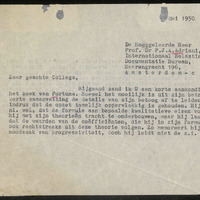
De Hogggeleerde Heer Prof. Dr P.J.A. Adriani, Internationaal Belasting Documentatie Bureau, Heerengracht 196, Amsterdam - c
Zeer geachte Collega,
Bijgaand zend ik U een korte aankondiging van het boek van Fortuna. Hoewel het moeilijk is uit zijn betrekkelijk korte samenvatting de details van zijn betoog af te leiden, is mijn indruk dat de opzet tamelijk oppervlakkig is gehouden. Hij betoogt nl. wel, dat de formule aan bepaalde kwalitatieve eisen voldoet, die hij met zijn theorieën tracht te onderbouwen, maar hij laat niet zien dat de waarden van de coëfficiënten, die hij in zijn formule gebruikt ook rechtstreeks uit deze theorie volgen. Zo memoreert hij wel de noodzaak van progressiviteit, doch hij leidt niet de z.i. noodzakelijke mate van progressiviteit af. Voorzover hij daarover bijzonderheden vermeldt, sta ik bovendien sceptisch tegenover de waarde zijner uiteenzettingen. Een der kernpunten van zijn betoog is nl., dat de menselijke eigenschappen verdeeld zijn volgens een systematische frequentieverdeling, waaruit hij afleidt dat ook de inkomsten systematisch moeten zijn verdeeld. Zoals ik enige tijd geleden voor de Akademie heb betoogd, mist deze stelling elke grond. Niettemin wordt zij door een aantal wetenschapsbeoefenaren aangehangen. Men kan dus moeilijk op grond van deze critiek het boek als onwetenschappelijk kwalificeren, doch de wetenschappelijke waarde lijkt mij niet zeer opvallend.
Met vriendelijke groeten,
-
en
May 1950
The Highly Learned Mr. Prof. Dr. P.J.A. Adriani, International Bureau of Fiscal Documentation, Heerengracht 196, Amsterdam - c
Dear Colleague,
Enclosed I send you a short announcement of Fortuna's book. Although it is difficult to derive the details of his argument from his relatively short summary, my impression is that the setup has been kept rather superficial. He does argue, namely, that the formula meets certain qualitative requirements, which he tries to support with his theories, but he does not show that the values of the coefficients he uses in his formula also follow directly from this theory. For instance, he does mention the necessity of progressivity, but he does not derive the in his view necessary degree of progressivity. Insofar as he mentions details about this, I am moreover skeptical about the value of his explanations. One of the key points of his argument is, namely, that human characteristics are distributed according to a systematic frequency distribution, from which he deduces that incomes must also be systematically distributed. As I argued some time ago before the Academy, this proposition lacks any basis. Nevertheless, it is supported by a number of scientists. One can therefore hardly qualify the book as unscientific on the basis of this criticism, but the scientific value does not seem very striking to me.
With kind regards,