-
Title
-
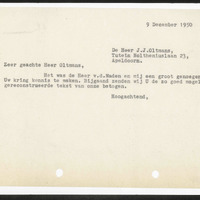
Letter to J.J. Oltmans
-
Description
-
With annex: Article, titled: 'Het nijverheidsonderwijs voor jongens en meisjes, gezien in het licht van de bevolkinsaanwas en industrialisatie'
-
Recipient
-
Oltmans, J.J.
-
Date
-
1950
-
Date in document
-
yes
-
Formulas or calculations
-
no
-
Inventory number
-
NL-RtEUR_TBCOR01_014O001
-
2161
-
Storage location
-
Specifiek Magazijn
-
Filename
-
CDM2161_NL-RtEUR_TBCOR01_014O001.pdf
-
Provenance
-
Jan Tinbergen
-
Accrual Method
-
donation
-
Rights
-

-
Revised transcript
-
ne
9 December 1950
De Heer J.J. Oltmans,
Tutein Noltheniuslaan 23,
Apeldoorn.
Zeer geachte Heer Oltmans,
Het was de Heer v.d. Maden en mij een groot genoegen met Uw kring kennis te maken. Bijgaand zenden wij U de zo goed mogelijk gereconstrueerde tekst van onze betogen.
Hoogachtend,
HET NIJVERHEIDSONDERWIJS VOOR JONGENS EN MEISJES, GEZIEN IN HET LICHT VAN DE BEVOLKINGSAANWAS EN INDUSTRIALISATIE
De oorlog heeft Nederland voor ernstige economische problemen gesteld. Hij heeft enerzijds het proces van het onafhankelijk worden van Indonesië zodanig versneld, dat nu de band met dit gebied zeer los is geworden, waardoor naar alle waarschijnlijkheid minder inkomsten uit dit land zullen kunnen worden betrokken. Bovendien heeft hij geleid tot een sterke verarming van een onzer belangrijkste afnemers en leveranciers, t.w. Duitsland, terwijl hij tenslotte ons bezit aan kapitaalgoederen aanzienlijk heeft verminderd. Dit alles heeft er toe bijgedragen dat er een aanmerkelijk tekort is in de betalingsbalans.
Daarbij komt nog dat de bevolkingstoeneming van Nederland, in vergelijking tot die van andere West-Europese landen, sterk is. Er moet dus om verschillende redenen worden gezocht naar nieuwe bestaansmogelijkheden voor ons volk. In verband met de kleine oppervlakte is het niet waarschijnlijk dat deze zullen kunnen worden gevonden in de landbouw. Ook de nieuwe inpolderingen zijn niet in staat een belangrijk aantal mensen op te nemen. Men moet dan ook aannemen dat het aantal personen in de landbouw werkzaam ten hoogste ongeveer gelijk zal kunnen blijven.
Wat de mogelijkheden in de handel betreft moet worden gerekend met de omstandigheid dat de wereldhandelswegen niet meer zodanig langs ons land lopen, als vroeger het geval was. Men denke aan de rechtstreekse handel tussen het Verre Oosten en Amerika, die zich meer en meer ontwikkelt, terwijl in het algemeen ook Amerika meer en meer het centrum wordt van de wereldeconomie en de plaats van Europa in verschillende opzichten gaat innemen. Uiteraard zullen wij moeten tonen wat wij kunnen, doch ook hier liggen de mogelijkheden niet zo gunstig.
De voornaamste mogelijkheid, die voor ons openstaat, is die van de industrialisatie. Opdat echter een belangrijk aantal mensen in de industrie een bestaan zouden kunnen vinden, moet aan een aantal voorwaarden voldaan zijn gelegen op het gebied 1) van scholing en vorming, 2) van de kapitaalvorming, en 3) van de afzetmogelijkheden.
Wat de scholing en vorming betreft zal het nodig zijn dat ons volk, meer dan tot nu toe, technici oplevert van hoog tot laag, dus dat er meer vaklieden, middelbare technici en ingenieurs worden opgeleid. De betekenis van het nijverheidsonderwijs hierbij is duidelijk. Het zal daarbij overigens mede gaan om het opvoeden van ons volk in het algemeen tot een grotere waardering van de technische arbeid. Veel te veel nog bestaat de neiging bij ouders, die hun kinderen willen laten vooruitkomen, het te zoeken in kantoorarbeid. Ten dele ligt dit hieraan dat de man met het witte boordje maatschappelijk meer waardering vindt dan de man in de overall. Van dit vooroordeel moeten wij ons volk afhelpen en wanneer dit lukt, zal ook daardoor de neiging zich tot de technische vakken te wenden toenemen. Doch ook de belangstelling van de arbeider zelf voor de werkstukken en zijn taak mag nog weleens worden verhoogd. In dat opzicht steken de Amerikaanse arbeiders bepaald gunstig af bij de Nederlandse; de goede niet te na gesproken.
De industrialisatie zal daarnaast zware eisen stellen aan de kapitaalvorming, die overigens in de laatste tijd ongeveer 20% van het nationale inkomen vormt, hetgeen niet onbevredigend is. Ook de kwestie van het vinden van afzetgebieden is verre van eenvoudig. De cijfers in de Industrialisatienota genoemd zijn zo goed mogelijk gebaseerd op wat men meent dat in de komende jaren aan het buitenland kan worden verkocht. Wil dit programma echter gerealiseerd worden, dan zal het terdege nodig zijn dat de Nederlandse producenten goedkoop produceren en goed produceren. Deze beide eisen betekenen ook een en ander voor de personen die door het nijverheidsonderwijs worden afgeleverd. Bij hen ook moet het inzicht bestaan dat voor Nederland een levenskwestie gelegen is in het leveren van goedkope goederen (men denke aan de concurrentie van Duitsland) en van goederen van goede kwaliteit (men denke aan de producten van Zweden, Zwitserland en Amerika).
Het is dus wel duidelijk dat voor het nijverheidsonderwijs in de komende jaren een zeer belangrijke taak is weggelegd.
-
en
9 December 1950
Mr. J.J. Oltmans,
Tutein Noltheniuslaan 23,
Apeldoorn.
Dear Mr. Oltmans,
It was a great pleasure for Mr. v.d. Maden and me to meet your circle. Enclosed we send you the best possible reconstructed text of our speeches.
Sincerely,
VOCATIONAL EDUCATION FOR BOYS AND GIRLS, SEEN IN THE LIGHT OF POPULATION GROWTH AND INDUSTRIALIZATION
The war has presented the Netherlands with serious economic problems. On the one hand, it has accelerated the process of Indonesia becoming independent to such an extent that the bond with this area has now become very loose, as a result of which, in all probability, less income can be drawn from this country. Moreover, it has led to a severe impoverishment of one of our most important customers and suppliers, namely Germany, while finally it has significantly reduced our possession of capital goods. All this has contributed to a considerable deficit in the balance of payments.
In addition, the population increase in the Netherlands, compared to that of other West European countries, is strong. For various reasons, new means of existence must therefore be sought for our people. In connection with the small surface area, it is unlikely that these will be found in agriculture. The new polders are also not capable of absorbing a significant number of people. It must therefore be assumed that the number of people employed in agriculture can at most remain approximately the same.
As far as the possibilities in trade are concerned, one must take into account the circumstance that world trade routes no longer pass through our country as they used to. One should think of the direct trade between the Far East and America, which is developing more and more, while in general America is also increasingly becoming the center of the world economy and is taking over Europe's place in various respects. Naturally, we will have to show what we can do, but here too the possibilities are not so favorable.
The main possibility open to us is that of industrialization. However, in order for a significant number of people to be able to find a living in industry, a number of conditions must be met in the areas of 1) schooling and training, 2) capital formation, and 3) market opportunities.
As far as schooling and training are concerned, it will be necessary for our people, more than until now, to produce technicians from high to low, so that more craftsmen, middle-level technicians, and engineers are trained. The significance of vocational education in this regard is clear. It will also involve educating our people in general towards a greater appreciation of technical labor. Far too much, there is still a tendency among parents who want their children to get ahead to seek it in office work. This is partly due to the fact that the man with the white collar finds more social appreciation than the man in overalls. We must help our people overcome this prejudice, and if this succeeds, the tendency to turn to technical subjects will also increase. But the interest of the worker himself in the workpieces and his task may also be increased at times. In that respect, American workers stand out quite favorably compared to the Dutch; not to speak ill of the good ones.
Industrialization will also place heavy demands on capital formation, which incidentally has recently accounted for about 20% of the national income, which is not unsatisfactory. The issue of finding market areas is also far from simple. The figures mentioned in the Industrialization Note are based as well as possible on what it is believed can be sold abroad in the coming years. If this program is to be realized, however, it will be absolutely necessary for Dutch producers to produce cheaply and produce well. Both of these requirements also mean something for the people who are delivered by vocational education. They too must understand that for the Netherlands, a vital issue lies in the delivery of cheap goods (think of the competition from Germany) and of goods of good quality (think of the products from Sweden, Switzerland, and America).
It is therefore clear that a very important task is reserved for vocational education in the coming years.
-
annexCount
-
1